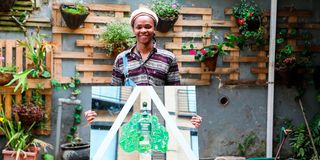
In a quiet corner of Roysambu, tucked behind a steel door, is a modest studio that smells of fresh paint, and shards of broken glass gleam under the afternoon light. Against one wall, champagne bottles have been turned into textured portraits, their green and amber fragments catching the sun like jewels. Some of the artworks are neatly framed, wrapped in transparent plastic and awaiting delivery to clients. Others are unfinished, lying on a workbench covered with glass cutting instruments, sandpaper, gloves, and jars of resin. The studio seems to come alive as if each one of the bottles still retains pieces of laughter, toasts, and confessions that it overheard before.
This is 27-year-old Max Peter Macharia Kinuthia's workshop. He makes portraits from broken glass.
"I had to do something different," he explains as he sands away the jagged end of a wine bottle slowly until it feels smooth in his hand. "Everyone is painting. There is so much competition in painting. But glass? I have not seen anyone doing this in Kenya before."
Max Macharia is an artist who turns glass into fine art.
Photo credit: Bonface Bogita | Nation
The craft
Once the bottles arrive, he removes labels and logos and then breaks them up with a glass cutter into desired shapes. Shards are carefully sanded to smooth out sharp edges, both for safety and texture. Resin liquid sets the pieces together, giving the final piece a glossy, three-dimensional finish.
"Resin is magic," he says, pouring it into a mold. "It keeps the glass together and infuses the art with a sense of life. This is not a two-dimensional painting. It's something you can see and feel too."
The studio workbench tells its story. Tools cover the floor, from grinders imported from China at Sh8,500, down to gloves and brushes. Glass dust sparkles on the floor like glitter. Completed portraits shine on one side under transparent plastic, each of them waiting to be collected by a client.
A single piece takes about three days to complete. "I can do it in a day," Max admits, "but I prefer to tell customers to give me three days. It allows me time to focus on detail and sometimes handle several orders at a time."
Max Peter Macharia carefully arranges broken bottle pieces into a frame at his workstation along Kamiti Road in Nairobi on September 9, 2025.
Photo credit: Bonface Bogita | Nation
Booming business
His largest sale to date was an A1 ocean wave design piece that was sold at Sh78,000. A massive custom painting order also fetched him Sh52,000.
He earns up to Sh150,000 in a good month. "It's more than I ever earned fixing computers," he smiles. "But it's not all about money. This is something I love."
To Max, every piece carries a story. Some of his customers bring their own bottles, a champagne corked on a wedding evening, a wine drunk on a honeymoon. He writes names, dates, even love messages into the paintings.
"I want people to own their memories through my artwork," he says. "When they look at it, it should remind them of something real."
One couple gave him a champagne bottle from their honeymoon. He made it into a framed portrait and engraved on it the wedding date. "That piece wasn't art. It was memory," he says.
His customer base varies. "I target the party people, the youth, the drinking lovers," he laughs. "They understand the celebration, the mood. Some just want something new for the club or house."
Indeed, his pieces have begun appearing in Nairobi's night life joints. He has provided artwork to at least five clubs, which have given their interior a facelift. "Most of the clubs use stickers and posters," he claims. "But then you walk in a club and you see glass portraits lit on the wall, it changes the whole atmosphere."
From computers to creativity
His computer skills got him hustles like CCTV installations in the city, and full-time work at Jamia Mall working with Horn ICT Solutions. There, he repaired laptops and sold gadgets. His monthly salary was Sh30,000, but with commissions and bonuses, his earnings rose as high as Sh50,000. “It was good money for a young man, enough to live comfortably,” he says.
But art kept tugging at him. In high school, he had been known for pencil sketches. Afterward, he dabbled in brush painting but set it aside. Still, the creative impulse lingered. “I think art was always in me,” he says, “but I neglected it for a long time.”
A night, one bottle and a beginning
“That bottle meant something to me,” he recalls. “It was about the advice my father gave me that night. I couldn’t just throw it away.”
In his small studio, he began experimenting, cutting the glass, arranging the shards, and binding them with resin into a framed design. That first piece, born from a father-son moment, was the spark. He still keeps it in his studio.
In a short while, he made three more pieces. A friend who visited his house was stunned. “He asked me where I bought the artwork,” Max laughs. “When I told him I made it, he said, ‘Bro, you have to post this online.’”
Max listened. He uploaded a short video on Tiktok, showcasing his glass portraits. Within 24 hours, it got 210,000 views. Orders began coming his way, “That was mind-blowing,” he says. “I realised this could be bigger than I imagined.”
By March 2024, Max resigned from his job at Jamia Mall. “I had to write a resignation letter to my boss,” he says. “I was already earning more from art than what I earned from computers.”
Max Peter Macharia carefully arranges broken bottle pieces into a frame at his workstation along Kamiti Road in Nairobi on September 9, 2025.
Photo credit: Bonface Bogita
Risk, recycling, and healing
He also thinks of what he does as recycling. "These bottles would be in the garbage and all over the streets, and children might get hurt from playing with them," he says. "By doing this, I keep them from going to waste and provide them with a second chance."
But other than recycling, he finds the work therapeutic. "Art heals," he states. "If I provide somebody with a portrait, it's not just a decoration. It can take away stress, it can be an emotional trigger of happiness and a smile. That's why I call it textural art, something you can touch, something you can feel."
Despite his success, Max wants to do more. He would love to have a larger studio, have assistants, and be able to instruct young artists in textured and glass art. "This is new in Kenya," he says to Nation Lifestyle. "I don't want to just be seen as an artist. I want to create a movement."
He imagines a space where all types of art co-exist, pencil sketches, paintings, sculptures, and glass portraits. "I want to give people choices," he says. "If you don't enjoy painting, maybe you'll love glass. If you don't love glass, maybe textured clay. Art should give a choice."
Five years from now, he wants to be famous not just in Kenya, but all over the world. " My clients tell me, 'In years to come, you'll be driving a Range Rover.' I don't think too much about the vehicles," he laughs. "What I desire is power. I want them to say Kenya gave the world a new art form."
Max picks up a nearly finished portrait. It is built from fragments of Moët, the green glass glinting against the deep black frame. He shines it under the light, watching it sparkle. To him, every fragment is more than a work of art. It is a fragment of a story, broken, remolded, and restored.
"Glass breaks," he says softly, "But when you put it together, it tells a better story."