Initially, drawing was considered a hobby for talented school children, a pastime activity for street mural painters, or a side hustle for sign writers. But with the rise of the matatu culture, those with the gift of the brush have been presented with something else – a moving gallery.
The nganyas, matatus or ma3, are no longer simply public transport. They’re bold, loud, and impossible to ignore. With flashing lights, booming sound systems, and popping colours, these moving machines are works of art. But who are the minds behind the images you see on popular nganyas?
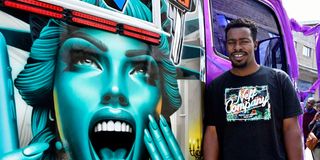
One of the most exciting names in this business is Babel Gody, the visionary behind Ongata Rongai’s Detroit and Ngong Road’s Ikigai. At just 30 years old, Babel Gody has become one of the names to watch in Nairobi’s vibrant world of nganya graffiti, a unique art form that decorates the city’s famous nganyas. Babel’s work turns every ride into a moving gallery.
"The most popular matatus I have worked on include Detroit, Moxie, and Ikigai," he brags. "Optimus Prime is set to come out of the kitchen soon."
Babel’s sources for inspiration mostly on the internet. "I get ideas and themes online, then I fill them out with what I believe is suitable." He does not do it to simply decorate, but to convey messages. "It's about showing something real, something that people can view and relate to."
Babel Gody, 30, is the visionary behind Ongata Rongai’s Detroit and Ngong Road’s Ikigai.
Photo credit: Pool
What makes Nairobi’s nganya art so special? “It moves. When art moves, it catches more attention. It travels beyond Nairobi, reaching more people every day,” Babel explains.
His early introduction to graffiti came at a young age. "I learned from Kells Auto back in 2015," he states, naming his first mentor. "But you need passion and the correct mindset to make it through. Any piece of work I get, I treat it like a gift. Regardless of what people say to me or the money I get, I do my best.”
The challenges are many, from clients' pressure or complexity of the work itself, but Babel loves his work. "When I finish a design, I feel like I'm living my dream."
Babel uses airbrushes and spray guns to do the job, and works with three assistants. "A basic design can take a week but a complicated design can take up to four months depending on how the client is utilising the materials."
Babel believes the future is bright for Nairobi street artists. "If the government stops fighting this culture and accepts it, more young people will use their voice. We need to change the way we view art."
But Babel is not the only one. At his side is a whole team of innovative thinkers pushing the limits of nganya graffiti. One of them is Mike Oby, a seasoned design expert who has been a part of the design industry for over a decade.
Mike Oby next to his artistic work on a matatu at a garage on Lunga Lunga Road, Nairobi on July 24, 2025.
Photo credit: Francis Nderitu | Nation Media Group
Designing ‘Mood’
Creating such attention-grabbing art is no overnight phenomenon. "It took us about eight months to complete the design," says Mike. "It takes each vehicle about three months from start to finish." The team worked long hours, starting at 2am and ending at 6pm, sometimes sleeping overnight at the shop to meet deadlines.
Mike worked with six individuals on the graphics alone, and three more to paint, plus two to work on the interior. "It was a big team," Mike describes, illustrating the level of collaboration that goes into these rolling masterpieces.
Despite the extended working hours, Mike is content knowing that their labor is being appreciated. "When you get paid and see others appreciating it, you get motivated to keep going," he says.
Over his decade in this job, Mike has worked on many projects, including Boombox, and Catalyst. But he believes Mood stands out the most. “People have been appreciating it more than anything we’ve done before. We used to dream of projects like this. I feel I’ve even exceeded my own expectations.”
Mike welcomes the large number of young talents pouring into the scene. "It is good they are busy doing something constructive."
From the streets of Kayole to the big stage
Cliff Khalifa, 28, is a nganya and street graffiti artist from Kayole, Nairobi.
Photo credit: Pool
At age 28, Cliff is already a household name among Kenya's street artists. However, he did not start life in expensive studios and big galleries, he began in high school.
"During Mother's Day celebrations at school, I would always be the one making posters or decorating. After school, I didn't want the creativity to end there. I wanted to be part of the business, I still had ideas.
Cliff's work is not all about colours and brushes, it is about expression and concession. "Sometimes customers come with their own ideas. Other times they just let me do my thing. When I was young, there weren't so many young people doing this, but today there are many. It is growing into a serious career."
He has also collaborated with a number of other artists in the scene, including Babel Gody.
"To make it in this industry, you have to have the eye and hand for art. But once you're in business, you keep learning."
The biggest challenge? "The weather!” Mike says. “If it rains, you can't paint. Sometimes we even have electricity cuts and can’t use the machines."
Cliff's most memorable projects? "Definitely when I designed Khaligraph Jones’ cars." He has also worked on nganyas like Prime Optimus and Detroit.
So, what tools does Cliff use? "An airbrush and a compressor," he explains. "And regular brushes as well. And I use Duco or NC paints. NC is ideal for graffiti and for detailed images."
Has this career been worth it? "I can't lie, this job pays well. That's why I keep doing it. It's not entirely about money though. It's my hobby. I learned all this from someone called Ndifu Graphics of Kayole. I have no idea where he is now, but I'm thankful."
And what does it feel like to have his art work on the streets, in videos, or on social media? "I feel proud. People sometimes judge you before they know your history. But when they see the work, they respect it. That's what matters."
Creativity into moving canvases
Patrick Kimweli (Speck), is a graffiti artist who fuses creativity and imagination to create matatu art.
Photo credit: Pool
It all began with his two greatest passions – cars and creativity. "My dad is a mechanic, so I was raised around engines, metal, and oil. And, I was born an artist. I wanted to incorporate the two, and that's where I got into painting cars and then also tattoos.
For Speck, graffiti and auto art are not just a show. They're his way of earning a living. "This work feeds me now, and is a stepping stone to bigger projects and more serious art jobs. If everything goes well, I'd like to get into animation. I've already developed some scripts."
When it comes to ideas, inspiration can come from anywhere. “Sometimes I’ll hear a song, and the characters or lyrics spark a whole design. Other times, it’s a movie I’ve watched. Or even just talking with people. My art comes from real life.”
He has also worked with a number of creatives including Setik Auto and Aron Pimp Creative. “It is not just about paint. To succeed in this world, you'll need something more than talent. You have to know how to cook.
He laughs, then continues, "By cooking, I mean you must understand how to put things together properly. And you must enjoy the work. Because it's not always easy. You've got to think fast, stay sharp, and hang in there."
And is it worth the effort? "It depends. If you get the job done right, there'll be more work. But if you get sloppy, it becomes hard. The industry rewards hustle and discipline."
Pioneer of Nganya graffiti
Mohamed Kartar (Moha), 47, is a veteran matatu graffiti artist who has been in the business since 1991.
Photo credit: Pool
The 47-year-old visionary artist's tale is one of love for cars and art but with a twist. "I started out painting canvases and portraits, but it just didn't feel right. I wanted something people could see and react to."
Starting in the late '90s, Moha original graffiti and abstract patterns revolutionised urban art experience among Nairobians. "It was all about abstract images and graffiti then, nothing specific. But it caught on, and now everyone loves it," he explains with a broad smile.
What set Moha apart was his creativity. Most individuals splatter paint with no particular theme in mind, but he worked to a theme, whether it was hip-hop culture, sport, or social issues. "If the theme was Manchester United, the whole car reflected relevant colours and pictures. I never did things by accident. It was always creative and intentional."
Nairobi’s nganyas are unique in the world of urban art because they’re not static. “This art moves. It is seen by thousands every day, not just here but by tourists and visitors around the world.” His work attracted international attention, with tours organised for visitors to see moving pieces of art and the garages where they come to life.
Moha introduced the idea of fitting screens inside matatus, imported tailor-made tyres for 14-seaters, and redesigned the fronts of the vehicles, unleashing new innovations that are now taken for granted. "If you look at a feature on a matatu today, chances are, I was the first to do it," he says.
Despite his success, Moha humbly reflects on the commercial side. "Matatu art did not make me rich, but it introduced me to experience, a reputation, and skill. It taught me patience and tolerance in this demanding field." He stopped working on matatu art some five years back but still paints private vans.
"By 1991, I was making small stickers for matatus. Those mini buses were like billboards on wheels with slogans, medals, and stickers. I'm glad to be the pioneer of that. Young people are coming into this business, and that's a good thing. It keeps them busy and creative.”