I have been stung by wasps, bitten by bed bugs and blood-sucked by mosquitoes. I’m not really fond of insects. But I learned to respect them – most of them – when I read Dr Dino Martins’ Pocket Guide: Insects of East Africa when it was published in 2014. I went back to it a week ago, in preparation for a Nature Kenya ‘dudu walk’ at the Ondiri Swamp near Kikuyu
Dino Martins is sometimes known as Doctor Dudu. As someone once said, he is a man who finds beauty in every bug. To be a bit more formal, he is a Kenyan entomologist, evolutionary biologist, researcher and author. Around the world, he is known for his work and stories on insects, pollination, plant–insect relationships, co-evolution, and tropical ecology. He has written a companion guidebook on butterflies and, this year, his book on parasites, Hidden Creatures, has been published, which explores the ecological and evolutionary world of parasites.
His Insects of East Africa makes a very good case for respecting and valuing their role. He points out that the over one million species of insects have been described as one of the most wonderful, interesting and diverse groups of creatures on our planet. Bigger is not always better. He writes about their daily impact.
They play a vital role in recycling nutrients and energy, breaking down biomass, building and aerating soils, dispersing seeds and pollinating plants. ‘Without bees and other insect pollinators,’ he says, ‘there would be no mangoes, avocados, guavas, apples, pears, plums, papayas, passion fruit, cowpeas, or cocoa (meaning no chocolate) – and far less coffee in East Africa…. It is estimated that we owe one in three bites of food to the service of pollinators – mainly insects.’
Friends of Ondiri pose for pictures at Ondiri Swamp in Kikuyu, Kiambu County on September 25, 2025.
Photo credit: Frankline Akhubula | Nation Media Group
On the other hand, Dino Martins notes that insects do much damage to crops and stored food; they are also the cause of diseases such as malaria and sleeping sickness. But whether they are for good or bad, we should know more about them, learn to appreciate and respect them – and what better way to do those things than with Nature Kenya?
There were about 30 of us assembled on the high ground near the Ondiri Swamp Eco-Toilet that has been sponsored by NEMA – the National Environment Management Authority. Among the 30 were a number of experts – on insects, birds, plants and ecology – some from Nature Kenya, scientific researchers of the National Museums of Kenya, UNEP and Friends of Ondiri Swamp. A few of them gave short briefings before walking down the steep slope toward the swamp that is the source of the Nairobi River.
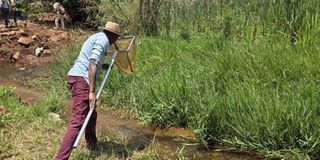
Actually, I spent a good deal of the time on a metal bench, hoping insects would crawl to me. But the only close company I had was a common bulbul – the bird that mimics so many others. My wife, Lut, did the more energetic dudu walking and studying the many insects caught in the nets carried by the guides.
There was also plenty of time for me to read the notices put up to describe a very ambitious and interesting project at the swamp that is already being constructed by a Chinese company. It is described as a key component of the Nairobi River Basin Conservation, Restoration and Beautification Project that aims to restore and improve the landscape of the swamp that is also called the Ondiri Wetland. It is building a sustainable demonstration area that combines ecological conservation, nature education, community leisure and tourism attractions.
The initiative, involving the national and the local government, includes an amphitheatre, a nature trail, three birdwatching decks, a boardwalk, other recreational facilities and fencing.
The notice says ’this project will not only enhance the water conservation and biodiversity protection capacity of the Ondiri Wetland, but also become a model for the ecological comprehensive management of the Nairobi River Basin, improving the regional ecological environment’.
When Lut joined me at the bench again, I asked her what the favourite insect that she had seen. She said it was an assassin bug. And there it was in Dino Matins’ guide that I had carried in my pocket. They are described as ‘voracious predators that stalk, ambush and kill all kinds of insect prey whenever they can’. They paralyse the victims with their venom, and they then suck out their liquid insides. I’m glad they are so small.
A section of Ondiri Swamp in Kikuyu, Kiambu County on September 25, 2025.
Photo credit: Frankline Akhubula I Nation Media Group
This was the only one of the very many insects that were identified – insects such as damselflies, dragonflies, aquatic beetles, horse flies and lake flies. The fact that there were so many different species in such a small sampled area shows that the river source is remarkably clean – so different from how polluted it is as it flows through the city.
The swamp’s peat, reeds and permanently wet conditions make for a habitat that is so very different from its neighbouring landscape. It is a rare patch of nature surrounded by an increasingly urbanised area. It is a ‘natural sponge’ that absorbs floodwaters, filters pollutants, stores carbon and regulates water flow throughout the year.
Some of the group removed their shoes and socks and experienced walking in the swamp, which they said was like being on a child’s bouncy castle. In the high grass, they came across a grass-climbing lizard. There is a breeding pair of crowned cranes. At the founding of the capital, a pair of crowned cranes were adopted as part of its coat of arms – and so they remain there today.
As for the neighbouring landscape, I lived there for a couple of years in the late 1960s when I was on a secondment to the University of Nairobi’s Adult Studies Centre – now the university’s Kikuyu Campus. Then, the old Kikuyu Road that branches off the Old Naivasha Road was a single strip, wide enough for only one car. It was a mainly rural road. It is no longer that.
Driving to and from the Ondiri Swamp, I was amazed at how busy it is, lined with apartment blocks, small shopping malls and dukas, garages and petrol stations. Those who are concerned about the conservation of the small but unique and useful swamp can only hope that the Nairobi River Basin Conservation, Restoration and Beautification Project will be successful in holding off any further urbanising encroachment.