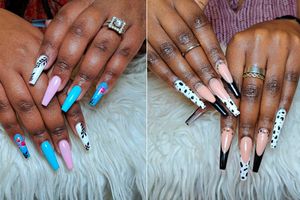
Zelipher Wakini’s nails have always been brittle. Pieces would split off while she cooked or washed dishes, sometimes without her noticing. Hoping to strengthen them, she turned to builder gel, then sticker nails, and eventually acrylics, getting her nails done monthly or every other month for about three years.
At first, the results were encouraging. But with each application, the wear time grew shorter, rarely stretching beyond three weeks, and her natural nails seemed to become weaker.
“There was a time my nails were very weak, almost paper thin, and it felt like my blood vessels were right there,” she says. “That’s when I thought, this is going to be detrimental in the long run.”
A gel can feel dry while still unhardened, leaving unreacted ingredients that can touch the skin and trigger an allergic reaction.
Photo credit: File
In September 2025, Zelipher stopped getting artificial nails. Although her nails are naturally weak, she has learnt she can grow them to a certain length by avoiding the treatments she believes made them more fragile. These days she files them neatly, applies clear polish and uses cuticle and hand creams. “When I stopped pushing myself to fit in that mould, I realised there were other professional ladies who actually just rock their natural nails,” she says.
Still, she feels some pressure. Social media portrays a femininity associated with elaborate nails and the expectation that a man should pay for them. “Because I don’t have the elaborate designs, I often get asked things like, ‘Do you not have money?’ or ‘Do you not have a man to take care of you?’” she says. Stepping back, she concludes she is not missing out. There is a financial incentive too, as her manicure budget is down to Sh500 per month from Sh3,000.
Janet Mwangi, founder and chief executive of Jada Africa and Jada Nail Clinic, says more women are choosing natural nails. “When I entered the industry eight years ago, natural nails were not common. I used to be the lone wolf,” she says. Now, at a table of about 10 women, almost half have natural nails, some taking a break after years of gel, acrylics or extensions.
According to Janet, the problem is not necessarily the enhancement. “The problem is never the product itself. It is how it’s applied and removed,” she says. Trouble starts when the nail is excessively filed or buffed to help the enhancement stick, then filed or drilled again to remove it.
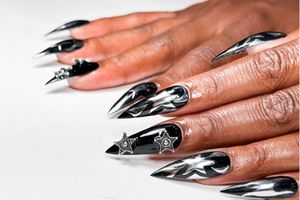
Woman's hand with black chrome nails. Overfiling, overbuffing or drilling leaves the nail thinner and more prone to splitting, breaking and sensitivity.
Photo credit: Shutterstock
She describes the nail as a stack of 50 to 100 tightly packed layers, with the outermost, the dorsal layer, making up about 20 per cent and protecting the rest. Overfiling, overbuffing or drilling wears that away, leaving the nail thinner and more prone to splitting, breaking and sensitivity. A very coarse file, she says, strips the protective layer with little effort.
“Use a finer file (about 240 grit) or nail dehydrators so enhancements adhere without heavy filing, and remove them with acetone rather than aggressive filing or drilling. Acetone is not what damages nails. What it does is cause temporary dehydration, but otherwise, it is one of the safest chemicals in the beauty industry,” she says.
At Jada Nail Clinic, she says one of the most common conditions among frequent enhancement wearers is onycholysis, where the nail plate separates from the nail bed, affecting about 60 per cent of clients. It can stem from nail dystrophy, excessive filing or too much heat from the UV lamp.
She also sees thinning plates, splinter haemorrhages and itching linked to allergies to gel polish.
Janet distinguishes between nail beauty, the surface colours and shapes, and nail care, what happens beneath. “Colour is amazing. I love it too. But we forget that these are chemicals and they can react with us,” she says.
Early in her career, she touched stick-on nails before the gel was properly cured and developed allergic contact dermatitis.
A gel can feel dry while still unhardened, leaving unreacted ingredients that can touch the skin and trigger an allergic reaction.
“Different gels are designed to cure under particular wavelengths and for particular lengths of time,” she says, recommending products and lamps designed to work together.
For those who have wondered whether repeated exposure to the curing lamp’s UV light could increase cancer risk, Janet says their wavelength is too low in intensity.
“We only use UV A for these lamps. UV B and UV C have been filtered out,” she says. “Also, the exposure time is usually minimal, only about eight minutes per visit.”
Going natural does not mean escaping maintenance. Janet recommends cleaning beneath the nails, moisturising cuticles, using strengthening creams and serums, eating well, trimming and filing regularly, and protecting hands during chores involving water, detergents or cleaning chemicals.
Nails can also signal overall health, she says. Beau’s lines, horizontal grooves that appear across the nail, can point to significant stress or hidden illness. Janet suggests photographing your nails between appointments.
“If you notice a persistent or unexplained change, don’t wait for it to become dire. Get it checked,” she says.