Uganda used to be called the ‘pearl of Africa’ by the British empire builders. It was one of the jewels in the colonialist’s crown. The country had incredibly fertile soil, it had well-established political and administrative structures in several kingdoms such as Buganda and Bunyoro-Kitara, and Christianity had firm roots by the time the colonial government was established.
The British did not face organised armed struggles the way they did in Kenya, especially after the end of the Second World War, when they decided to divest from the colonies. Thus, the transition from British rule to rule by the majority African population was more or less smooth.
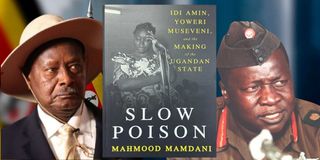
However, Milton Obote, who took over as the Prime Minister in 1962 and later became the president of the Republic of Uganda, may have introduced what academic Mahmood Mamdani calls ‘slow poison’ in his new book Slow Poison : Idi Amin, Yoweri Museveni, and the Making of the Ugandan State (Jahazi Press, 2025).
When he fell out with the Kabaka of Buganda and deposed him in 1966. Obote continued the colonial legacy of employing many of his own people in the army and government, thus creating an imbalance in access to state offices, power and opportunities between southern and northern Uganda.
That divide, often presented as one between the Bantu and the Nilotes (or Luo) continues to haunt Uganda to date. Amin, although not a Bantu, exploited this distinction when hundreds of military officers, mostly from the north, were killed on suspicion of being pro-Obote or anti-regime after he took over in 1971.
The National Resistance Army (NRA), previously known as the Front for National Salvation (FRONASA) didn’t hesitate to exploit the same divide when it recruited its fighters to overthrow the second Obote regime, using young men and women from the Buganda area that came to be known as the Luwero Triangle. But when the NRA marched into Kampala as a triumphant army, was it prepared to run the country?
Mamdani suggests in Slow Poison that the National Resistance Movement, the political wing of NRA that took over in 1986, found the transition from fighting in the bush to managing political and administrative offices a different matter altogether. It is not surprising, therefore, that in the beginning, the NRA/NRM appeared inclusive.
Ugandan President Yoweri Museveni.
Photo credit: File | AFP
They sought to bring together in government people from different organisations, those who had worked in the previous regimes and even intellectuals such as Mamdani. As Museveni suggested in his autobiography, the Mustard Seed, the struggles by NRA/NRM were part of the anti-colonial liberation efforts.
However, as Mamdani demonstrates through close textual analysis of documents — historical texts, policies, media reports, NGO reports; anecdotes, personal accounts and speeches etc — that Amin and Museveni may have come to power as some kind of saviour, but they ended up not being up to the task. They may both have sought to undo the colonial structures that had created ethnic differences (even where none existed), class and racial distinctions, yet in the end, they capitulated to the dictates of colonialism. When Amin fell out with the British and Israelis, who had supported his overthrow of Obote in 1971, he simply went populist by turning to the racial differences that the British had carefully created in Uganda.
When the economy struggled, Amin named the Bayindi (Asians) as the root cause. He decided to deport them, distribute their wealth and create an African economic elite, Mamdani shows. This single act of ‘Africanising’ the economy endeared him to many non-Asian and non-European Ugandans. Amin also expelled Europeans when he felt that they were undermining his rule. Thus, Mamdani argues, he managed to stay in power for much longer than the six months that “most African states gave Amin to…survive.”
Mamdani suggests that “Amin may rightly be considered the father of the Ugandan nation, whose birth was a consequence of the Asian expulsion. Amin racialised the nation as Black.”
In contrast, although Museveni has been hailed as having restored peace in Uganda, Mamdani charges him with having “tribalised” the nation. He writes, “In tribalising ethnicity, Museveni fragmented the nation. Museveni dismantled the nation, dividing it into an increasing number of minorities, tribe by tribe.”
The peace dividend that NRA/NRM promised and relatively delivered, writes Mamdani, was, however, presented as a “licence to rule without a time limit: he promised peace to the population, but only so long as he ruled. The price of continuing peace would be political servitude. Museveni rationalised that Uganda is a pre-modern collection of tribes, which can only be ruled with a strong hand guided by a sound iron will. Like the colonial power, Museveni set out to create the Uganda of his imagination. The more the tribes, the merrier the ruler.” The creation of ‘administrative districts’ (135 plus) in Uganda has been nothing but an avenue to control power locally, distribute state largesse and manipulate politics - just pork barrel politics, notes Mamdani.
Former Ugandan President Idi Amin is seen at a news conference during a visit to Damascus, Syria, in this October 16, 1973 photo.
Photo credit: File | AP
Mamdani suggests that the Amin regime faced several difficulties that undermined his rule, including handing over large sections of businesses that the departing Asians left to soldiers and individuals who did not know how to run them, internal problems in his army, and the continued tension between the northerners and southerners, as well as his falling out with his erstwhile sponsors, Britain and Israel.
The 1970s were also difficult times for the global economy. Yet, Amin remained in power for eight years. Despite accusations of widespread human abuses, as Mamdani notes, Amin even established a Commission of Inquiry into the Disappearances of People in Uganda since the 25th of January 1971.” The Commission began its work in 1974 and concluded in 1975. Amin even submitted a copy of the Report to the United Nations. However, the international press had somehow decided that Amin was a bad boy and nothing good could come out of him or Uganda during his rule.
Museveni had the goodwill to succeed where previous regimes had failed when he arrived in Kampala. But he probably had not calculated how Uganda’s economy was connected to the global financial systems. It wasn’t long before he discarded the Marxist/socialist ideals from his university days and stay in Dar es Salaam. Mamdani notes that Museveni found empty state coffers. He had a regime to build, a country to stabilise and an economy to nurture. The IMF and World Bank were experimenting with structural adjustment programs (SAPs). Faced with insurgency in literally more than half the country and a devastating HIV/AIDS, it was easy for him to recant his old dreams and replace them with new ones.
Former Uganda President Milton Obote.
Photo credit: File | Nation Media Group
Still, it is not easy to understand how the previous idea(l)s of progress, citizenship, freedom and equality could easily be discarded to be replaced with claims of development, peace and stability, where development may mean access to state resources courtesy of proximity and loyalty to the ruler; when peace means ‘don’t ask questions or don’t oppose the ruler’ decrees; and when stability means the state retains the right to define order and enforce it. How did a man of the people become a man of his own people?
Mamdani, whose son Zohran was recently elected New York mayor, has known the who-is-who of the ruling class in Uganda for decades. He is as Ugandan as any other person who claims to be Ugandan, despite the ever-evolving designations of citizenship. He has lived and worked in Uganda most of his life, teaching and researching at Makerere; researching and working on the ground with communities; serving the state whenever needed in different capacities; advising the government etc.
Slow Poison is a long and intensive look by an insider, who can also be seen as an outsider, into the unraveling of the drama of power, of in a home that they belong to. As he concludes, “How can we learn to live with dirty hands?” What can one say about a comrade who no longer behaves comradely, when the relationship between comrades is slowly poisoned?