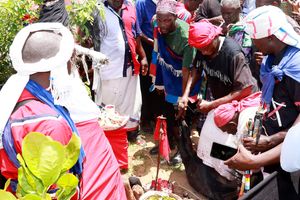
The Kenya Constitution 2010 underscored the importance of mother tongue as a vehicle of cultural development.
In 1976, the Gachathi Commission recommended mother tongue as a language of instruction in the early years of education specifically pre-primary and lower primary.
The Koech Education Report of 1999 lamented that children were being introduced to foreign languages too early before they had mastered their mother tongue.
Research has shown that schools, specifical teachers, do not always adhere to the stipulated language in education policy.
For instance, in a research by Wanjohi (2014) in Nyeri county, it was reported that 89 per cent of the schools were not using any of the three languages of education namely mother tongue, Kiswahili or English solely.
Instead, teachers as well as learners were spontaneously code-switching or code-mixing.
This was replicated in Kilifi, Kisumu, Machakos and Uasin Gishu. Nevertheless, in remote rural areas, mother tongue was observed to be the language of communication as well as of instruction in most schools.
In the recent past, Kenya has witnessed a cacophony of noise from campaigners trying to woo voters.
Unfortunately, some campaigners used crude language awash with sexual innuendos.
Nevertheless, it is worth noting that the richness and beauty of the diverse languages spoken in Kenya were witnessed.
Campaigners used idioms, proverbs and other forms of figurative language in the process, and occasionally poetry and song.
Going by the late former president Mwai Kibaki, one would mistakenly assume that the head of state is not supposed to speak in their mother tongue.
Indeed as a symbol of nationhood and national unity, it is expected that he should speak in an official language whenever in public. Not once did the late president speak to the public in mother tongue.
Outgoing President Uhuru Kenyatta uses his mother tongue often. This has been so since 2007 when he vied as a Member of Parliament for Gatundu and during his 10-year presidency.
His use of mother tongue in public meetings would be especially evident when he retreated to the Mount Kenya region after sensing rebellion against his influence.
Central Kenya is multi-lingual. There are people from across the country, other parts of Africa and the world who have settled there.
An example is the Kiambu region. In this county, multiethnic settlements are common, thanks to its proximity to the capital city.
It is reported that during the campaign leading to the 2007/2008 post-election violence, Kenyan ethnic communities were incited against each other through the use of their mother tongue.
The worst affected were parts of Nairobi slums and the Rift Valley. Clips showing non-indigenous or immigrant members of the community being threatened in various mother tongues at the time have been aired or posted on social media.
Conflict aside, mother tongue is an easy way to appeal to one’s constituents. Sociolinguists have enumerated many advantages of competence in the first language.
Key among them, and witnessed during this year’s elections, is that the first language gives a sense of belonging.
Some individuals have failed to appeal to their ethnic communities due to lack of fluency in their mother tongue.
This is a tool that Uhuru utilised well to woo his ethnic community. Ruto and Raila have made good use of their mother tongues whenever they are within their communities too. This has endeared them to their electorate.
Psycho-linguistics argue that competence in the first language is an enabler of cognitive development because concepts are easily and freely transferred through language.
This means that knowledge acquired in one’s mother tongue does not need to be re-learnt in a second language.
It is also underscored that competence in mother tongue is a predictor of an individual’s ease in learning a second language.
To avoid prejudice, suspicion, favour or fear, mother tongue should be made a mandatory subject in the Kenyan curriculum.
While mother tongue is recognised as the language of instruction and communication in pre-primary school, it is only a subject in lower primary and has no place in upper primary.
By the time an individual is through with primary and secondary education, the value of mother tongue has totally diminished.
The mother tongue should be taught throughout primary and junior secondary school and be an elective in senior secondary.
Departments of language at the university and in middle-level colleges should have local languages included in their curriculum.
This will allow Kenyans to learn as many languages as possible during their school life thus promoting our cultural heritage and our sense of nationhood.
Dr Wanjohi is a consultant in education and a lecturer of language in early childhood development at Kenyatta University wanjohi.g21@gmail