When President William Ruto launched the multi-billion Rironi-Nakuru-Mau Summit highway expansion project on November 28, 2025,he termed it a gateway to prosperity and economic transformation.
President Ruto said the dualling of the busy highway would herald a major milestone in the Northern Corridor,boost trade,facilitate movement,end decades of agonising traffic jams and tame disastrous accidents that have claimed thousands of lives over the years.
The launch,which followed years of delays in plans to upgrade the road,was expected to usher in a major infrastructure development that promised to ease transport along the Northern Corridor.
However,nearly a year later, the project, being implemented through a Public-Private Partnership (PPP) between China Road and Bridge Corporation (CRBC) and the National Social Security Fund (NSSF),whose construction is underway,has become a fresh political battleground and fodder for politicians as the 2027 General Election inches closer.
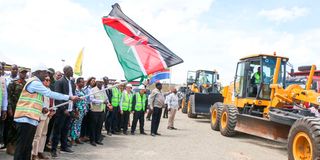
President William Ruto addresses residents of Mau Summit in Nakuru County where he made his third launch of the dualling of the Rironi-Mau Summit highway on November 28, 2025.
Photo credit: Boniface Mwangi | Nation Media Group
The road is becoming a key rallying point for both President Ruto and the opposition ahead of the 2027 polls.
The financing, implementation and planned tolling of the road have become the centre of national politics,which political analysts and experts say is set to become a key campaign tool for politicians,ahead of the 2027 polls.
For instance, both Democracy for Citizens Party (DCP) leader Rigathi Gachagua and Linda Mwananchi Movement's Edwin Sifuna have challenged the financing, transparency and public cost of the upgrade, President Ruto's flagship highway project.
The key opposition leaders, eyeing the presidency, are questioning the financial arrangements behind the ambitious highway expansion.
Among the latest critics is Nairobi Senator Edwin Sifuna,one of Ruto's fiercest critics and a presidential hopeful, who has accused the administration of keeping major infrastructure project contracts away from public scrutiny.
Mr Sifuna has pledged that if he is elected President in next year's General Election,he would make such agreements accessible to Kenyans if he is elected president.
The Linda Mwananchi Movement leader has raised concerns over the terms under which major infrastructure developments are being undertaken in the country.
"If l become President,the Linda Mwananchi Movement promises to make all project contracts available to the public in conformity with the values of the Constitution.We all know why the Ruto regime hides these agreements. From Bomas to Talanta to the Rironi highway to the Lamu refinery, we are being robbed blind,”stated Sifuna.
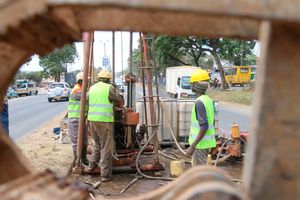
China Road and Bridge Corporation workers conduct geotechnical investigation for a flyover at Kolen in Nakuru along the Nakuru-Eldoret highway on January 19, 2026, as part of the Sh200 billion dualling of Rironi-Mau Summit highway.
Photo credit: Boniface Mwangi | Nation
Former Deputy President Rigathi Gachagua has also launched a scathing attack on the government over what it describes as the opaqueness of the project, accusing it of putting the highway expansion at risk through questionable financing arrangements.
DCP Secretary for Economic Planning Dr Peter Mbae for instance, has written to the Kenya National Highways Authority (KeNHA),demanding for disclosure of information about funding of the project as well as an explanation and justification of the proposed Sh8 per kilometre toll,and the Sh 180.7billion termination fee on the highway.
The DCP wants the government to abandon plans to toll the Rironi–Mau Summit highway, warning that the proposal would unfairly burden motorists.
"On June 23,2026, KeNHA announced a proposed toll of Sh 8 per kilometre for the completed Rironi-Nakuru-Mau Summit highway,with provision for subsequent adjustments.Earlier project documents indicated a 1 percent annual escalation.While the upgrading of the highway is highly welcome,the proposed toll imposes a substantial additional charge on motorists using a public road historically available without a toll and the imposition thereof will increase cost of movement of people,goods and services and stagnate the economic activities along the corridor," says Dr Mbae in a letter to KeNHA.
Dr Mbae in the letter argues that motorists already contribute to road maintenance through the Road Maintenance Levy Fund (RMLF) and should not be required to pay additional charges to use the highway.
“Since we pay through the Road Maintenance Levy Fund, that should be enough.Otherwise it will be double taxation,”he said.
DCP has also demanded for among other things, details on the approved project scope and cost, capital cost and lifecycle obligations forming the basis of the PPP arrangement,financial and traffic model-financing costs and the traffic methodology, with the precise calculation of the Sh 8 per kilometre and 1 percent escalation formula.
The DCP also wants the feasibility study ,value for money and risk assessment, including the assumptions demonstrating the necessity of toll revenue for recovery of the investment and return, justification of the proposed toll,given the public already bears substantial taxation and road-related charges, including the development taxes collected by the Kenya Revenue Authority.
"The apparent absence of information on alternative routes in the Rironi-Nakuru-Mau Summit highway as per international standards is unsettling,"further says Dr Mbae in the letter.
The demands come at a time when implementation of the project is underway, with toll charges expected to finance the investment, operation and maintenance of the road.
Mr Gachagua has also claimed that Chinese partners had withheld funding because of concerns over political uncertainty ahead of the 2027 General Election.
Democracy for the Citizens Party (DCP) leader and former Deputy President Rigathi Gachagua.
Photo credit: Dennis Onsongo | Nation Media Group
Speaking during a church service in Kikuyu, Kiambu County, last Sunday, November 1, 2026, Gachagua claimed Chinese government officials had declined to release funds because they considered the project politically risky ahead of next year's election.
“Now, I have been informed that Chinese government officials have refused to release funds for this road because they view it as a ‘political project’ and consider it too risky, given that we have an election coming up next year,” he said.
He also questioned the project's financing arrangements, alleging that Sh30 billion belonging to the NSSF had been channelled to two Chinese companies.
“I am saying there is no contract for that road. Money has been taken from NSSF, money belonging to pensioners, against the law. Sh30 billion has been given to two Chinese companies,” he claimed.
Gachagua warned companies and individuals involved in the financing arrangements that they would be held accountable, demanding that the money be returned.
The remarks by the opposition leaders have placed the Rironi-Mau Summit Road project at the centre of a wider debate over transparency in the financing, procurement and implementation of the project.
Political pundits now say the national debate about the project is set to place it at the centre of the 2027 campaigns.
"Considering the opposition demands about the project,the project is set to become fodder for politics ahead of next year's General Election. Politicians in the opposition will seek to exploit the issue surrounding financing and implementation of the project to gain political mileage,"Mr Kabita told the Nation.
"At the same time President William Ruto will use the project as a campaign tool to seek re-election in 2027,"added Kabita.
President Ruto and his lieutenants have in the past months used the project to rally Kenyans behind the Head of State ahead of the 2027 polls.
President Ruto recently said he wants to use the road to travel to Nakuru during next year's Madaraka Day celebrations that will be held at the Afraha Stadium in Nakuru City.
On November 1, Transport CS Davis Chirchir revealed that the Rironi-Naivasha section of the highway is set to be opened for use in December.
Ongoing construction of the Rironi–Mau Summit highway pictured at Rironi on September 13, 2026. Transport Cabinet Secretary David Chirchir said the expanded Rironi–Naivasha section will be fully dualled by October 30, 2026, allowing motorists to use the upgraded road.
Photo credit: Billy Ogada | Nation
The highway is expected to improve connectivity along the Nairobi-Nakuru corridor, a critical transport route serving motorists, traders and businesses travelling between the capital and Western Kenya as well as to reduce accidents along the route that have claimed thousands of lives over the years.
Experts say the key road that stretches across the most densely populated parts of the country, beginning in Nairobi, Kenya’s capital and commercial nerve centre and traversing counties of Kiambu and Nakuru, agricultural zones, wildlife reserves and tourism centres, would greatly improve the country’s economic fortunes.
The road is expected to decongest the existing highway and Nakuru City, as well as enhance efficiency of cargo transport to Western Kenya and other East African countries.
The Nairobi-Nakuru-Eldoret highway, which is part of the Northern Corridor is the most important road to Western Kenya and the artery that connects Kenya and the landlocked countries of Uganda, Southern Sudan, Rwanda and Burundi.
The road is used for transporting most of the West-bound cargo that originate from the Port of Mombasa and the Nairobi Metropolitan.
The expansion of the Rironi-Nakuru-Mai Mahiu part of the Northern Corridor has been necessitated by high congestion along the busy route.
The road currently carries an estimated 20,000 vehicles per day, a number that is expected to grow by four per cent annually.
Motorists along the Nairobi-Nakuru-Eldoret highway have frequently blamed KeNHA for heavy frequent traffic jams along the road.
Traffic snarl-ups, especially during holidays,sometimes stretching to almost five kilometres on both sides of the highway, are a common phenomenon, often forcing motorists to use alternative routes.
However, questions have emerged over its financial implications, particularly the proposed tolling arrangements and the long-term concessions granted to private partners.
Ongoing dualing of the Rironi-Mau Summit highway at Elementaita in Gilgil on October 2, 2026. The contractor, China Road and Bridge Corporation (CRBC) says earth work stands at 82 percent.
Photo credit: Boniface Mwangi | Nation
The project comprises two main sections, including the A8 Section, which extends from the Rironi interchange to the Mau Summit Turnoff,through Nakuru, covering a distance of approximately 174.90 kilometres.
In addition,it will have the A8 South Section running from the Rironi interchange to the Naivasha interchange via Mai Mahiu, spanning about 58 kilometres.
According to the KeNHA,the upgrade will include widening the existing two-way single carriageway into a four-lane carriageway from Rironi to Naivasha and six lanes from Naivasha to Nakuru City,to ease congestion and enhance connectivity across the corridor that links Nairobi to Western Kenya.
The project will also contain infrastructural improvements including; upgrade of existing interchanges and construction of new ones, reinforcement of embankments and construction of retaining walls where necessary as well as installation of street lighting and high mast lighting.
The upgrade will also involve installation of wildlife and livestock crossing points, provision of bus bays,shelters and truck lay-byes as well as construction of underpasses and overpasses.
The government in May 2025,cancelled a deal with French companies due to affordability concerns ,which required additional debt and budget allocations to finance the construction and now seeks to sign a deal with Chinese contractors to upgrade the busy highway.
The Nairobi-Nakuru-Eldoret highway is part of the Northern Corridor
It is the most important road to Western Kenya and the artery that connects Kenya and the landlocked countries of Uganda, Southern Sudan, Rwanda and Burundi.
The road is used for transporting most of the West-bound cargo from the Port of Mombasa and Nairobi Metropolitan.
Traffic snarl-ups along the route, especially during holidays, when people are heading upcountry-sometimes stretching to almost five kilometres on both sides of the highway, are a common phenomenon, often forcing motorists to use alternative routes.
In most cases, travellers have been forced to spend long nights along sections of the busy highway like at St Mary's,Gilgil weighbridge,Delemere Naivasha, and between Salgaa and Nakuru City.