Thank you are the two words that make you and me. When they are uttered with a genuine sincerity and received with a humble appreciation, they elevate our communication and relationship to a sublime level.
The speaker of the words acknowledges the worth of the addressee, and the addressee is warmed up by the graceful expression of the thankful sentiment.
Yet it is surprising, even distressing, to see how rarely people say genuine thanks to one another. At one level, it is sheer linguistic incompetence. A person who answers with a blunt “Fine” when asked how they are, is speaking “bad” English, plain and simple.
The correct answer is, “Fine, thanks.” Fellow teachers of English, and parents, listen, please.
But there is another, more fundamental, cause of this epidemic of ingratitude, the lack of gratefulness, among our people. This is “entitlement”, in today’s subtle play with language and facts. Many of our barbaric relatives feel it is their “right” to get our attention, our love and our services, unconditionally. They think, if they think at all, that they deserve and are “entitled” to whatever we offer them or do for them.
There are many reasons for this rude and crude attitude. Generally, there seems to be a rising tendency among our new generations to despise and disregard basic politeness (Mambo Mbotela’s cherished uungwana ).
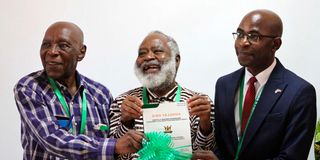
Prof Austin Bukenya, Kiswahili scholar Prof Kithaka wa Mberia (centre) and Oxford University Press regional boss John Mwazemba on February 27, 2025.
An age of machines seems to produce machine people, who “relate” to one another like tools. They forget that even machines need oil (politeness) to ensure smooth operation of their parts.
Other problems are money and power. The ungrateful shenzis (savages) feel that if they pay you, they do not have to thank you for what you give or provide. Similarly, those with privilege and power, whether through dynasty, education or political manoeuvring, expect to get everything by right. They have only themselves to thank.
Do the parents of such “wonders” expect any thanks from their children? Forget it. After all, the kids say, did we ask you to bear us, rear us, educate us and all that (nonsense)? We could take it as high as God, to whom our “scientific” generations owe no gratitude, since they did not beg Him to create them! Do you see how dreadful thanklessness and other impolitenesses can get?
Anyway, that is an extended introduction to my saying a sincere and profound thank you, my dear reader, for the great honour and favour you have done me for nearly 12 years. Even for those who were not reading yet in 2014, when the column first hit the pages of this paper, my “shukrans” are unreserved. Every time you walked, cycled or drove to the newstand and picked up the paper, just to see what Mwalimu was saying, you were doing me a favour.
The material benefits of the project might not have made me a millionaire. But its social, intellectual and professional values are inestimable and priceless for me. You have allowed me to share with you 1,000 words every week for more than 500 weeks. Even in my deepest humility and honesty, I cannot believe that those chats have been noises of sheer nonsense. Thank you for your attention that has challenged me to think of what to share with you.
You have taught me lessons in effective basic writing skills. You pulled me down from the podium of academic abstracts and speculation, where I had operated most of my working life, to the solid floor of real life, where we wrestle with the concrete issues of existence and interaction.
I boast of being a teacher, but you have been my best teachers. Thank you.
I am also grateful to you for having kept me in the unique company and band of superb scribes of the “Nation” stable, both past and present, whom I have followed and admired all my adult life. It warms my heart to imagine that when the role is called up yonder, I, too, may march forth with the likes of Tom Mshindi, Sarah Elderkin, Yousuf K. Dawood, Dorothy Kweyu and “Fifth Columnist” Philip Ochieng wuod Otani.
Above all, I thank you for your dedicated reading, which has enabled me to share with you some of the matters closest to my heart. Among these, I may single out female empowerment, our East African unity, with our language Kiswahili, the seriousness of a genuine faith and the need to educate our society in practical humaneness (ubuntu). If you, my reader can take up at least one of these and consistently promote it, I will feel richly rewarded.
This brings me to the “good bye”. I am exiting the column, as of this weekend. “Parting is such sweet sorrow,” as the Shakespeare character has it in Romeo and Juliet. But there is no need for inconsolable grief. This is no “adieu” (buriani) but a “kwa heri ya kuonana” (see you soon). We will be meeting on many other platforms, and continue with our sharing.
The break (no, rather, the breather) will also allow me the time to do or complete some other writings that many of you have been asking in your generous correspondence. These include my full- fledged “memoir“ (biography or autobiography) and maybe an executive summary of my “literary legacy”. These sound hefty – they almost make me laugh.
Incidentally, laughter is one of the serious good things I wish you in this festive season, and in all your ordinary lives. I have good evidence for its benefits in my own long life and the lives of my fellow wazee.