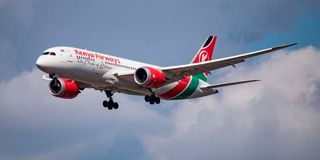
Do you wish you could fly? So do I. Indeed, you and I, and many people we know, do occasionally or frequently fly. Late last month, on June 26, 2025, to be exact, at ten to four in the morning, or zero-three-five-zero (0350) hours, as they put it in military and aviation terms, I found myself boarding Kenya Airways (KQ) Flight 419 from Entebbe to Nairobi (EBB/NBOJKIA). You know, everything up there is coded.
Anyway, I realised it was almost 60 years to the day since I made my maiden flight on this very route, aboard an East African Airlines (EAA) Fokker Friendship aeroplane. The exact date was July 25, 1965, and I was en route to Dar es Salaam (the Haven of Peace) to embark on my undergraduate studies at the University College there. Those of you who were there when I started chatting with you in this column will remember my regaling you with my adventures on that eventful journey.
I particularly recall my dear friend and illustrious colleague, Prof Maurice Amutabi, wondering, then, why I dwelt at length on the beauty and elegance of the air hostesses on the EAA planes. I did not answer him then. But if I had answered, I would have said, as I say now, that the hostesses were beautiful, and I was only twenty-one when I made that flight. I would not have added, as I brazenly do now, that my weakness for the lure of the feminine gender is ineradicable and lifelong.
Anyway, we are talking about flying, and I want to tell you that I have not stopped flying since that day in July 1965. Nor do I show any signs of stopping in the near future. Moreover, I do enjoy flying and I would probably choose it over any other means of travel wherever I had a choice. What I do not particularly like about flying is the process of getting on board those various “birds".
The irritants begin with the hassle of getting all the clutch of travel documents, passports, visas, health certificates and tickets, with the concomitant costs. Then there is the boring chore of packing! When I lived with most of my six sisters, I would just sit amid the litter of my clothes, toiletries, laptop and other equipment, and signal “depression”. In no time the gracious ladies would bring out my bags and sort out the mess for me.
Now that we have all gone our different ways, I struggle as best I can to assemble the essentials for my trips and ensure that they are on whatever contraption is taking me to the airport. Many are the times I have remembered, halfway down the road, that I had left the phone and its charger, or the purse with the identities and foreign currency, on the bedside table, and we have to turn back.
That also reminds one of the unholy hours at which one often has to leave home in order to catch those late night (usiku wa manane ) departures. These are rivalled only by the long “layovers” (waiting times for connections) in various airports. If I add the elaborate security checks that sometimes almost strip you to the skin, I would be turning this into a snivelling litany of the inconveniences of air travel.
But, maybe, I should entertain you with a classic flying tale from orature and literature. After all, this is supposed to be an easy weekend read for you. Humanity has always been both fascinated and challenged by the phenomenon of flying, moving through the air, like the birds. My favourite flying story from antiquity is that of sculptor and engineer Daedalus and his son, Icarus, from Greek mythology.
The Athenian master sculptor, craftsman and engineer, Daedalus, and his son Icarus fell foul of the powers-that were in Athens and they were imprisoned in a labyrinthine complex on the island of Crete. In an attempt to escape, Daedalus fabricated two pairs of wings, one for himself and one for his son, and the two flew up and out of the prison.
Their wings were made of feathers, thread and wax. So, their flying instructions were that they should maintain an average altitude that ensured that the wings were neither dampened by the sea spray nor melted by the heat of the sun. But young Icarus was so excited at the feel of flight that he soared straight towards the sun. It duly melted the wax on his wings and he dropped out of the skies and plunged into that part of the Mediterranean Sea called the Icarian Sea to this day.
So goes the story. I encountered it in its Latin version when, in Sixth Form (A-Level), I was trying to decipher Ovid’s poetic masterpiece, Metamorphoses. I suppose the moral of the tale (kisa na maana ) is that whatever we do, we should do in moderation. “In medio stat virtus,” the latter Romans were to say, meaning that it is in moderation that virtue lies.
Speaking of master sculptors, I somehow did not, until recently, get the sad news of the passing on of Prof Elkana Omweri Ong’esa, the soapstone guru. The sharp-humoured prof belonged to that super-creative class of Makerere’s Margaret Trowell School of Fine Art graduates, like Sam Ntiro, Gregory Maloba and Elimo Njau, who have stamped East African visual arts with an indelible originality.
Back to my six-decade flying saga, I have learnt three main lessons from my aerial crisscrossings of the seas and the continents. The first is never to think of what might go wrong with the mighty jets I board. The second is to acknowledge my own smallness in the infinitely vast spaces.