Kenya’s matatus still belched their songs into the cold July air, the boda bodas (motor bikes) still risked life and limb for a fare, and the Nairobi sun rose with its usual arrogance.
But to those attuned to politics, to the subtle movements of its undercurrents, something was afoot: somewhere — thousands of miles away — Rigathi Gachagua was landing.
Gachagua flew out to the United States on July 9, 2025. The trip is seen as groundwork for a potential 2027 presidential bid. Before the American trip, Gachagua had become an all-pervasive presence with memorable one-liners like “wantam/one-term” and “Hi cousins” that took the country by storm.
One can almost see the syllables flying out from the top of the open-roof Land Cruiser he talks from, the words zinging like stones, spiked and iridescent, bouncing off the umbrellas, chicken-wire fences, and jostling the headscarves and hats on bald heads. Even the wazees — old men in heavy sweaters and battered caps — laughed into their beards.
Former Deputy President Rigathi Gachagua.
Photo credit: Joseph Kanyi | Nation Media Group
There is no doubt that Gachagua is Kenya’s number one Meme King. It is as if, according to him, the truth will not only be televised but also “meme-vised”. Since his impeachment in October 2024, Gachagua has become something of a legend, a myth that has outgrown its own teller.
His rhetoric has become bolder — more the bludgeoning certainty of a rebel, less the sly subversion of a man on the run.
He became our Terminator, a disembodied voice haunting the administration that expelled him.
He is the blustering strongman of our headlines, sometimes making even his friends cringe as he “injects” his doses as a “truthful men.” He throws fiery zingers at the president and lets them marinate.
Phone screens of his supporters glow with his face. In matatus and mud-walled kiosks, the bellow of the meme king’s signature lines has almost outcompeted football commentary and the latest gospel hits.
His American journey reminds us of the story of Odysseus, who left his home in Ithaca to fight in the Trojan War. As King of Ithaca, he had to lead his army to war. This story is in the book written in the 8th century, The Odyssey, an epic poem by Homer. Odysseus’s absence from Ithaca was long, almost two decades.
Former Deputy President Rigathi Gachagua.
Photo credit: File | Nation Media Group
On his return, he faced obstacle after obstacle — from divine wrath to shipwrecks, enchantments, and detours. Odysseus knew what it meant to spend years adrift and coming home to find everything rearranged, the children grown, the world unrecognizable.
For Gachagua, even as he sleeps in hotels in American suburbia, maybe he sometimes lays awake, trying to remember the smell of Nairobi rain.
Gachagua, Odysseus contrast
Firstly, both figures leave behind turbulence. For Odysseus, he leaves behind a power vacuum: Ithaca lacked strong governance, the king was away (even presumed dead), and there was no clear successor, as his son, Telemachus, was too young to rule. And there was no local or regional leader that could step in to stabilise the kingdom.
Likewise, Gachagua has left behind turbulence in opposition. There seems to be a palpable sense of absence — a gravitational pull where Gachagua’s presence was.
Secondly, both Odysseus and Gachagua reappear in foreign lands, enjoying admiration away from their battlegrounds. If absence were an art, both Odysseus and Gachagua are deliberately painting on a grand canvas, each stroke calibrated for maximum longing.
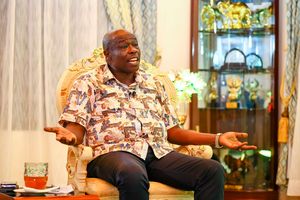
Former Deputy President and DCP leader Rigathi Gachagua gestures during an interview with NTV at his Karen home in Nairobi on June 27, 2025.
Photo credit: Wilfred Nyangaresi | Nation Media Group
They both understand that, absence, properly curated, is a weapon more subtle than any accusation or press statement. Therefore, their sojourns morph into strategic absence.
The absence of Odysseus from Ithaca fuels nostalgia, speculation, and yearning for his presence. Likewise, Gachagua understands that “absence makes the heart grow fonder” in the hearts and minds of Kenyans. Away from local visibility, Gachagua is stirring curiosity, and recalibrating public memory — maybe even fuelling nostalgia.
Thirdly, both Gachagua and Odysseus seem to understand mythmaking. In his absence, through stories, songs, and dreams, Odysseus becomes larger than life.
His absence swells him into a sort of enigma. Gachagua has recently talked admiring about former Prime Minister Raila Odinga’s hold on his base (Raila is ‘the Enigma of Kenyan politics’). Maybe Gachagua has ambitions to become the next ‘enigma’, and his absence and silence from the local scene feed into the myth.
Gachagua’s diaspora trip feels like a choreographed resurrection. He has tested his message with Kenyans in the diaspora. In one recent event, he said that he wanted to test the “Wantam” chant to see if Kenyans in the US know it. “Harambee,” he said. “Wantam,” the crowd shouted back. “Wewe Ruto/You Ruto,” he bellowed. “Wantam,” the crowd chanted. “Wewe Kasongo/You Kasongo,” he cried out, dialling up his voice, and was greeted with even louder chants of “Wantam.”
Fourthly, for both Odysseus and Gachagua, being away from home is a time to test the integrity of allies and expose pretenders. True allies will stay with them and be loyal, no matter how long the leaders stay away.
It’s interesting that Odysseus and Gachagua have anything in common at all. That an 8th-century text should be as current as the day’s headlines is a testament of the enduring impact of literature. Great literature speaks to us in every generation with the same potency.