Land, economists claim, is the first and most important factor of production. Land bears human beings. They built all manner of structures on land, for accommodation, transport, trade, education, conversion of raw materials sourced from land into products etc.
Land has resources that make life bearable for human beings, especially food. It has minerals and other resources that have aided man to invent machines, tools and equipment that have made humans overcome physical and environmental difficulties in pursuit of progress. Thus, land often leads to conflicts between humans that could remain unresolved for several years.
Modern economic thought and behaviour tends to apportion value to land, which when converted into monetary figures, can lead to very serious conflicts. Wasn’t this valuation of African land - and other lands that would become colonised by Europeans - the basis of capitalistic exploitation that still haunts the continent to date?
African scholars have tended to argue that colonialism was more exploitative and oppressive in settler colonies; in countries where a European minority simply claimed huge tracts of land, aided by the colonial administration, and established farms and related industries.
The success of these farms and the value-adding factories depended on use of free or cheap labour of men, women and children, whose land had been ‘stolen’, ironically.
When the colonizers departed, they decided the price at which they would ‘sell’ the farms and lands back to the Africans. This is the tragedy of Africans - of being robbed of land and having it sold back to them when they did not have the resources to buy it back, hence having to rely on loans from the former colonisers to fund the purchases.
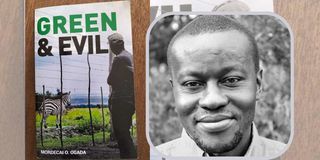
However, some more bigger tracts of land remained in the hands of the government and rich local and foreign land owners. What happened and continues to happen to this kind of land is what Mordecai Ogada writes about in Green and Evil: The New Empires and their Regents (Lens & Pens Publishing, 2025). This is the kind of book that scatters all the little, nice, long held, received wisdom about conservation.
Ogada knows what he is writing about. After all, he is a scholar of conservation and an ecologist. He knows the lay of the land, in a manner of speaking. It is just that he doesn’t like its appearance. The conservation landscape, from research to policy to practice, Ogada shows, has been shrouded in myths, stereotypes and violence. Conservation suggests positive action, rehabilitating, making good out of what is a bad situation, thus securing benefits for all concerned parties.
Yet, Ogada shows that conservation, in its modern sense - a sense that carries colonial and capitalistic exploitation - has displaced people, destroyed their livelihoods and communities, sometimes leading to death and in the end completely alienating them from what is being conserved. In the long run, conservation has morphed into a silent land grab.
Mordecai Ogada, author of ‘Green and Evil: The New Empires and their Regents’
Photo credit: Pool
Consider game parks, wildlife sanctuaries and conservancies. Why are they fenced off? What is the original intention of fencing these lands? To keep the wildlife in the park or keep humans out of the park? If, for instance, the land on which a conservancy has been established originally belonged to the neighbouring community, why would the local people be excluded from the parks? Who really owns the title to the land?
Why are game park entry fees so prohibitive for local populations? What is the history of the relationship between the locals and their environment, a relationship that had endured for thousands of years before being interrupted by what Ogada calls ‘elite interlopers' retailing the narrative of conservation?
Green & Evil is an insider’s destabilisation of narratives on conservation that have been accepted and retailed for years as the truth about conservation. Such stories have depicted Africans as incapable of harmoniously living with wildlife; they have sold the narrative that Africans would hunt animals to extinction and destroy plant life. Thus, African wildlife needs ‘outsiders’ to conserve it - either the government, which would rely on ‘experts’ or private conservators.
It hasn’t been by accident that most of the time the ‘warden’ watching over the conservancies or parks has been a white person. Why? Apparently, as Ogada argues, they are seen as more research driven, likely to attract funding for more research on wildlife and assure the consumers of the products of the wildlife - tourism - that all is well. In the end, the conservancies become literally ‘protected areas’, only accessed by a few and guarded by guns. It is a carefully crafted land grab, suggests Ogada.
In many words, Ogada suggests that the whole conservation industry has carried vestiges of racism and imperialism. How did game parks become a big conservation policy and practice issue in Africa? Game parks allowed rich Euro-Americans to fly into Africa and go hunting.
They would kill animals for sport, for trophies, for the adventure and thrill of it. They would slaughter elephants just for the task. When an African was caught hunting in the game park, he would be called a poacher. Poachers can be shot on sight, even when they are men who are hunting for food, on lands that their ancestors walked and lived on for millennia.
It is not surprising that conservation has taken another form - global warming and greenhouse emissions? Today Africa is being sold the narrative of carbon credits or carbon trade.
So, as Ogada notes, Europe, America and Asia can pollute the environment - which affects all humanity - whilst Africans could be paid some money to ‘not pollute the environment’ by planting some trees.
But here is the catch: the conversation on this kind of conservation is now led by money men; not environmental scientists. We all breath the same air, drink water and eat food grown on land. If someone upstream pollutes the air, water and land, those downstream will be more affected because the pollutants end up being deposited downstream. Yet, Africans are easily buying the snake oil tale of carbon swaps.
Ogada warns in Green & Evil that it is not easy to contest some of these fraudulent claims and tales on conservation. Why? There is enough funding for postgraduate students from Africa to pursue studies on preconceived notions on conservation, there are smooth-talking and convincing African conservationists and there are enough publications - academic and popular media - to promote received wisdom on the subject. This book bursts so many of the myths about conservation that it should be mandatory reading for any African interested in conservation.