“When Ngugi entered the Mung’etho National Hospital’s Cancer Ward and walked toward Kimani’s bed, he was greeted by the teeth of his old-time friend bared in excruciating pain… As Jennifer (Kimani’s wife) spoke, Ngugi felt something thick and hard moving up his throat, and almost choking him.
He noticed how helpless she was, looking vacantly before her and not mustering enough courage to face him. ‘You have done more for us than anybody ever could, Ngugi. But allow me to ask for a favour. Some money to give to the lab people. I have no money.’
Ngugi bit his lower lip bitterly. Then, he… went straight to the nurse. In rising anger, his arms swinging and fists punching the air he sought to be told why people should be forced to bribe to get a service they had a right to.
Can’t the nurses, the doctors, the hospital administration do something about it? The nurse listened attentively. ‘I don’t know,’ she said. ‘This place is like that. Unless you know somebody…’
Kimani recoiled in sharp pangs of pain that left his entire body shivering. ‘You-you are a g-r-raduate of our u-ni-ver-ver-sity, Ngugi. S-s-ome of th-em work here. I-is-n’t the-there some-one you know who cou-could help us…?’ Somebody you know! Someone you know! Former classmates! Relatives to assist you in a public office! Blood relations to help you out where they have no business! Ngugi felt insulted by his suffering friend. ‘I do not require to know anybody to be attended to in a public or private office,’ he said”.
These words from Magayu Magayu’s famous short story, “Do You Know Anybody” summarise the story of Kimani, Ngugi’s friend who went to a public hospital for treatment but couldn’t get any help in time because he didn’t know anybody and he had to pay a bribe to get help.
When Kimani finally dies, an old man says, “It is not the cancer that killed him. It is the thought that he knew nobody in this place to help him.”
For years, I have been haunted by these words and they came alive again on Wednesday 27 March 2024 when the Ethics and Anti-Corruption Commission (EACC) released its report that indicated that apart from the Ministry of Interior and Coordination of National Government that took first prize (for several years unbeaten), the other corrupt one is the Ministry of Health. Overall, 34.4 per cent of the Kenyans surveyed who sought government services were asked to pay a bribe and 28.3 per cent paid.
Corruption affects the poorest people because they often do not have the means to go for private services as they can’t afford them. And they can’t even afford the illegal bribes so they are left to the capriciousness of fate. And when corruption is in healthcare, the desperation deepens.
There is enough to worry about when one has a patient in those intensive care units with those dull curtains. The place reeks of certain chemicals and then there is the gurgling through plastic tubing, the slow dripping from the IV line, the disturbing racing when the machines beep and the nurses’ feet hit the floor towards a patient gasping for final breath.
And then one is asked for a bribe under such conditions. There is nothing more brutal. As the ancient Swahili poet, Muhammed Kijuma wrote, “The face of a poor man is lined/From hunger that thirsts in his belly/Poverty is no state for any mortal man/ It makes him a beast to be fed on grass/Poverty is unjust, if it befalls a man…”
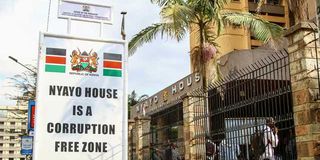
The Kenya Kwanza administration has its job cut. During the campaigns, the now ruling party promised that they would restore the dignity of Kenyans. Those queues at Nyayo House are hustlers looking for passports. Those queues in public hospitals are hustlers looking for medical attention. Not all medical practitioners in public hospitals are corrupt.
Some can’t do their job because they do not have the tools or resources needed to save patients’ lives. There are heartbreaking stories of people dying of avoidable causes. The government should start addressing both the issues of corruption and lack of resources in many of our public institutions.
We cannot separate human dignity from human rights. And since poverty is one the things that most debases men and women, the government should have a clear strategy to tackle poverty. In tackling poverty, some corruption could also be reduced because some of our public officers (without excusing their corruption) are paid so badly that they use corruption to “top up” what they need to survive. Paying public servants better is one of the ways to tackle corruption.
Human Rights Watch, in a report entitled “Breaking the Poverty Trap”, explains that: “When a person isn’t able to feed themselves or house their family, if they can’t access clean water or a decent job, or when kids have no choice but to drop out of school or get married because they’re living in poverty, these are all examples of human rights abuses.
When government and corporate practices systematically deprive people of the resources they need, poverty becomes entrenched and economic inequality grows”. The government should tackle the twin issues of poverty and corruption for the dignity of Kenyans.