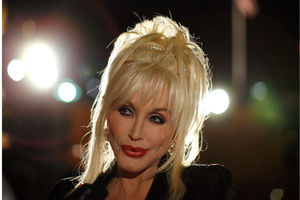
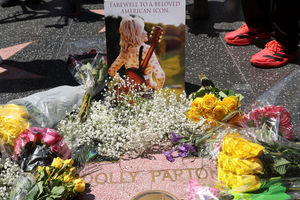
Like a protective goddess who had disguised herself in a sweeping cloak of sound, Dolly Parton sung soothingly, her tunes as softly murmured as the perfume of a flower. Her breezy style often gave the sadness in her lyrics a sneaky potency. In the soundtracks in some Kenyan matatus, she has a way of appearing out of the blue in the way a familiar scent can suddenly bloom in the middle of a crowded street.
In matatus with audacious graffiti and VIP interior setups, the music is synced to the light, a shifting aurora: blue, red, green. The matatu playlist swings from gospel to local Sheng and American rap, old benga hits and other African anthems.
American country music star Dolly Parton performs on the Pyramid Stage at Worthy Farm in Somerset, during the Glastonbury Festival June 29, 2014.
Photo credit: Reuters
And then Dolly Parton floats in. The song Islands in the Stream comes in warm, buoyant, and glowing; Kenny Rogers’s baritone grounds her clear soprano as the matatu sways through traffic. Dolly’s voice, light and tender, moves through the cabin, a reminder of sweetness in a city of concrete and steel.
For a moment, the passengers lean back as Dolly's voice envelopes them with a warmth that feels almost protective, creating a portrait of a possible life that is both hopeful and wistful – and far away.
Dolly’s music goes on, but she died in Nashville, USA, on August 25, 2026, at 80 . Dolly Rebecca Parton left 100 million records and a theme park. She also left something else most do not know: her lifelong love for books. Dolly Parton’s books form a second, unknown career running alongside her music. Some of the books she has written are Songteller (stories behind her song lyrics), Behind the Seams (a fashion memoir), Dolly: My Life and Other Unfinished Business (a classic biography) and many children’s books, from Coat of Many Colours to the playful Billy the Kid series.
And she did something else: hundreds of millions of books mailed, free of charge, to children who had never owned one. Through her Imagination Library, Dolly sent out over 300 million books. Her father, who was illiterate, inspired the project. Dolly said she created the Imagination Library “for him" so that no child would grow up feeling the shame he carried, the shame of not being able to read.
Dolly Parton accepts the Gary Haber Lifting Lives Award at Ashville, Tennessee, US in August 23, 2017.
Photo credit: Harrison McClary | Reuters
Dolly Parton wrote her songs the way novelists and other great men and women of literature write. And though her public persona shone with humour and sparkle, her music frequently revealed a deeper emotional intelligence — a tenderness edged with aching melancholy. In fact, despite her air of cutesy innocence, Dolly often wrote lyrics that hinted at a deeper self-awareness in her songwriting. She could be disarmingly honest.
In Jolene , she admits, “I cannot compete with you,” a line that reveals insecurity beneath the song’s bravado. In Coat of Many Colours , she recalls childhood poverty with a tenderness that borders on ache (the song pegged on the biblical story of Joseph whose father made him a beautiful coat of many colours): “Momma sewed the rags together, sewing every piece with love.” Even her most cheerful songs carry shadows if you listen closely. 9 to 5, with its bright rhythm and workplace humour, is built on the exhaustion of a woman who knows she is being undervalued (and probably underpaid).
Her songs hover between the places of both tenderness and grit — the Smoky Mountain of her childhood that haunted her all through life, the fragile courage of loving someone who might not love you back, and the suffering of working hard and hoping harder. She writes about struggling mothers, about women rising before dawn to face another long day, about hearts that break but keep singing anyway, anyhow, anywhere. Most of her melodies carry a certain nostalgia and longing, like a soft thread of loneliness woven through it all.
In her world, music is its own kind of poetry — with a certain tenderness of words and emotions.
Dolly Parton’s gentleness often set her apart from the brasher, rougher edges of the country music world around her. While many of her peers leaned into grit and outlaw swagger, she carried herself with a kind of bright, simple tenderness that made her seem almost out of step with the times. And she was a comrade of many in this journey of life, a poet of unusual clarity through music.
American country music star Dolly Parton performs on the Pyramid Stage at Worthy Farm in Somerset, during the Glastonbury Festival June 29, 2014.
Photo credit: Reuters
In her passing, she reminds us that the poetry deals with real life issues and it can even be set to music and rhyme. In mourning her, we can borrow from the old German army that had a traditional poem they set into a lamentation song that soldiers sang when their comrades died, entitled Ich hatt' einen Kameraden (I had a comrade). “I had a comrade,” it went, “You will find no better/ The drum called us to battle/He walked by my side/ In the same pace and step/ A bullet came a-flying… He was swept away... He still reaches out his hand to me… I cannot hold onto your hand/ You stay in eternal life/ My good comrade”.
Many had a comrade in Dolly Parton. She is gone. We cannot hold onto your hand. You stay in eternal life, Dolly, our good comrade.