“I have loved many poets and writers in my life, among whom I especially remember Dante, Dostoevsky and others… The words of writers helped me to understand myself, the world, my people… Poetry is open; it throws you somewhere else… You are eyes that look and dream. Not only looking but also dreaming. We human beings yearn for a new world that we will probably not fully see with our own eyes, yet we long for it, we seek it, we dream of it”.
This was part of the speech that Pope Francis gave on Saturday, May 27, 2023, to poets and artists during a conference of Global Aesthetics of the Catholic Imagination. As a Pope, his days were regimented, practised and precise, military-like in detail and execution. However, he loved literature. Maybe literature took him to another less regimented, less exhausting world.
Literature allows us to enter this world that is both exotic and doomed, a shimmering bubble with ideas veiled in shadows of mystery as we grapple with the meaning and meaninglessness of life, intimacy and abandonment. As we hunger for this that cannot be analysed or grasped, it induces an even greater desire — thrusting us into the realm of the restless wanderer reaching for the unreachable, the intangible, the eavesdropped — that only a writer with sharp instincts can paint for us.
A woman holds candles by an image of the late Pope Francis, at the Santo Spirito in Sassia church, in Rome, Italy, April 24, 2025.
Photo credit: REUTERS/Remo Casilli
Pope Francis, who died on April 21, 2025, said that we have physical eyes and also eyes to dream. We constantly dream of the past, a golden age, a time of greater happiness, of forgotten strains of joy. The home one grew up in, like an early morning sunrise, is magic. It’s like a castle from a fairy tale. “You can't go home again,” warned Thomas Wolfe. When we try to return, we find only ruins. The house could have the same walls but one finds it less alive: the compounds quiet, the dogs gone, some relatives dead and some beds empty. And as Dante once wrote, “There is no greater sorrow than to recall a happy time when miserable”.
As Pope Francis noted, literature has a serious impact on our lives. It is a quest to answer the big questions. The Irish writer Seán Ó Faoláin writes that, “Always we feel that something vast has entered into the imagination of the author, and we are impressed, and oppressed, by the weight of it”. What Ó Faoláin probably means here is that when we read certain works of art, we feel a certain burden we can’t ignore.
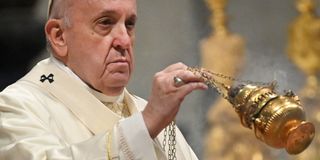
Pope Francis.
Photo credit: Photo | AFP
The basic role of literature whether through a play, novel, short story or poem is to tell a story, painting an alternate universe (according to Pope Francis ‘a new world that we will probably not fully see with our own eyes, yet we long for it, we seek it, we dream of it’). A poem or a novel can take the reader in a sweep of rapture to a world of no pain — effortless and strange — a world of lightness, ease, and pleasure without end. In the words of Pope Francis: “Poetry is open; it throws you somewhere else”.
For instance, in telling the story of his mother and grandmother (throwing us somewhere else), the poet Li-Young Lee writes in his poem, “I Ask My Mother to Sing” that, “She begins, and my grandmother joins her./Mother and daughter sing like young girls./If my father were alive, he would play his accordion and sway like a boat./I’ve never been in Peking, or the Summer Palace,/nor stood on the great Stone Boat to watch the rain begin on Kuen Ming Lake,/ the picnickers running away in the grass./But I love to hear it sung;/how the waterlilies fill with rain until they overturn,/ spilling water into water,/then rock back, and fill with more./Both women have begun to cry./But neither stops her song”.
Pope Francis's body lies in state at the chapel of Santa Martha at Vatican City.
Photo credit: File | Pool
The poet’s gaze here is symbolic of a certain time and spirit (elsewhere), now long gone, when Lee’s family was all together at Kuen Ming Lake and which French writer Marcel Proust would have described as “that comprehensive gaze with which, on the day of his departure, a traveller strives to bear away with him in memory the view of a country to which he may never return”. They will never return to the place where waterlilies would fill “with rain until they overturn, spilling water into water”.
Lee’s poem makes us understand new things, what Pope Francis describes as one of the roles of writers: “The words of writers helped me to understand myself, the world…”. Therefore, one other role of literature is to understand ourselves, others and our world.
The other role of literature is to explore the human condition, an excursion into the depths of one’s emotions. In Lee’s poem, the words “both women have begun to cry./ But neither stops her song” highlight the emotions of the women and we share in their sorrow.
Pope Francis reminded us that we can enjoy literature and that it can add value to our lives, making the world a better place. May he find rest in the next world — rest he longed for, sought after and dreamt of in the celestial city of great lights. And in Christian tradition, “till that resurrection morning”.