Poetry brings China and Africa together
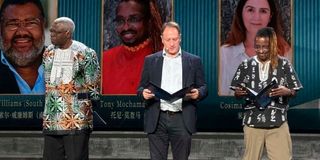
The author (Tony Mochama) performing with Reginald Gaul (France) and Prof Niyi Osundare of Nigeria.

What you need to know:
- The “International Poetry and Liquor Festival” has been annual event in the city of Luzhou since 2017.
- The third and final day of the Int’l Poetry & Liquor Conference was the Luzhou ‘Liquor City’ Cultural Tour.
We were in a shuttle from the airport to the Juyang International Hotel with the French poetry publisher, Monsieur Reginald Gaul, and as we were driving through the pretty city of Luzhou (pronounced Loo-Jao) of Sichuan province - that is at the intersection of the Yangtze and Yellow Rivers - we marveled at the fact that a giant Liquor company, Luzhou Laojiao, has actually partnered with the China Writers Association (and the great Chinese poet Jidi Majia) to make the “International Poetry and Liquor Festival” an annual reality since 2017.
For this tenth anniversary, they had invited ten international poets to the city (with myself as one of the three representing Africa) and a hundred local poets, and we all got to meet at a grand welcome banquet at the Nongxiang Guojiao Hui, where said maestro Jidi Majia:
“As a Yi Chinese poet as a youth, I identified with the African colonial struggle against the ‘White Devils’ from across the Ocean, having ourselves suffered almost a century of humiliation under Western Imperialism. The African complex in my own writing comes from a deep love of your rich cultures across the continent, and we have early African models in Leopold Sedar Senghor (the first African poet president of Senegal), Aime Cesaire (Martinique) who co-founded the review L’Etudiants Noir_ in 1935, and of course David Diop, who was an unshakeable bard.”
Jidi Majia then went on to praise the late Ngugi wa Thiongo for “teaching him to retain my footing in Yi heritage” as well as Shaaban Robert of Tanzania who “spins his yarns so deftly, he encourages a fidelity to preserve a genuinely lyrical writing style.”


And what would a dinner be without a toast to Wole Soyinka, whom last we were in China for the Shanghai Literary Festival in 2023?
The following morning was a four-hour session titled “Across Oceans and Continents: Sino-African Poetry Mutual Knowledge and Mutual Influence Upon Each Other,” at which North Carolina based academic and poetess Mildred Barya spoke of her great joy “at being invited to speak at the 2021 Int’l Poetry & Liquor Conference.”
‘Liquor City’ Cultural Tour
“I had a flashback moment of poetry and liquor warming everyone at my parents’ home. I hadn’t realized the drinking age but I loved the shared experience of community spirit and how the adults, often stern and strict, were now unscripted - relaxed, drinking and reciting poetry, as well as exchanging oral stories.”
The following afternoon at the “Let Poetry and Liquor Warm Us All” public poetry recital at the Guojiao 1573 Global Theatre Plaza, there was the chance to recite forms of poetry that showed off the spiritual essence as well as hybridity of our “Africannesses,” integrating tradition with modernity, and the Chinese sage proverb that “knowingness of knowledge is the true enjoyment,” with yours truly even reeling off original scenes of Swahili Shairi, which to be honest, was a first.
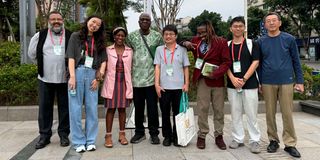
The African poets Dr Athol William, Miriam Barya, Prof Osundare, Tony Mochama, organiser Hu Hunter & visiting African Studies students from Shanghai.
The local Chinese poets then did their “Songs and Poems Across Mountains and Seas, Poetry and Liquor That Embraces the Passing Years” at the Luzhou Cultural Center Performance Hall that, like Lingala, although we didn’t understand the words, we enjoyed the performance.
The third and final day of the Int’l Poetry & Liquor Conference was the Luzhou ‘Liquor City’ Cultural Tour, during which we got to appreciate the true scale of the festival founded under the national initiative of “Cultural Public Welfare” - and has in the last decade facilitated the ten poetic festivals, attracting 300 foreign poets from 80 countries, 10,000 domestic literary celebrities, half a million poems projected, and tens of millions of TV viewers every year of the “Grand Closing Gala - the Glorious Night of Poetry and Liquor” held at the theatre stage of the Luzhou Olympic Sports Center. And what a night that was!
Musical and visual spectacle
We ten ‘international’ poets from France, The UK, Italy, Czech, Cuba, Russia, Iran, Uganda, Nigeria and of course Kenya were the Opening Act - before being totally blown away by the pomp, colour and sheer musical and visual spectacle of the China National Opera and Dance Drama, there to present more than 10 performances across five hours for the live television gala — the classic dance dramas ‘Confucius’, Li Bai, When We Were Young, Towards The South Bank of JinXing, Zhao Jun Departs the Frontier; and ‘The River,’ a musical drama which integrates elements of China’s poetry culture with liquor.
Nigerian academic and poet Niyi Osundare, former Head of Department at the University of Ibadan and recipient of the Nigerian National Order of Merit, won the deserved top accolade of a Lifetime Achievement Award, an honour that came with a 50,000 yuan cheque (Sh1 million).
In his acceptance speech, he quoted the sage Chinese poet Li Xing: “I shall bring the light for the world. I shall bring warmth...”
Which fully captures, pardon the pun, the spirit of the entire festival. Although Cosma Bruno was the poet from Italy, her translator and adjunct Lecturer of Chinese Literature in Rome, Veronica di Silvestre, said that this festival was “very enlightening for me as the interactions with the world’s great contemporary poets helped me unlock feeling and thoughts inside my own poetic thought.”
As I left my hotel suite for the airport on the dawn of the fifth day, I noticed a small sign at the window that read “No Throwing About!”
And thought of all the things one could throw out through the window - “beer cans, cigarette stubs, abandoned stabs at poetry, tissue paper, used condoms that crisscross the crevices between Chinese condominiums like broken birds; you could throw up last night’s liquor, like tequila, or the vomitus from your first pregnancy trimester, or terminal disease. You could throw a party, then throw out a guest or girlfriend as they do in apartments in Kileleshwa and Kitengela; or the suicidal poet throws themselves 26 stories down to hit the ground with a loud sound, where bypassing pedestrians will find your body parts... throwing about.”
These are what poetic thoughts soaked in Luzhou Laibajio liquor look like.
Tony Mochama’s book “How to be MCA in 2027” (Mvua Press) is out at the end of October.
Follow our WhatsApp channel for breaking news updates and more stories like this.