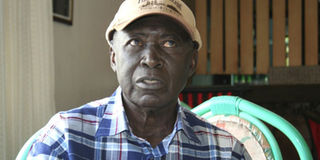
My difficulty in eulogising and celebrating William Ochieng is that — as far as most newspaper readers know — he and I were strange bedfellows.
They remember my frequent attempts to disabuse those who, because they confused between us, never thought twice about addressing me as “Professor Ochieng”.
But all that was an illusion. For, although I was a critic of the history scholar, to criticise need not be the same thing as to denigrate and to degrade.
In short, my critical exchanges with the professor cannot take away even an iota from his eminence as a teacher of the history of my ethnic and other African peoples.
William Robert Ochieng (“WR”), who died last week, was one of the two Kenyan historians to whom I owe my smattering of Nilotic — especially Luo — history.
The other was (and remains) the inimitable Prof Bethwell Allan Ogot, an erstwhile mathematician who taught us both (at different times and in different climes).
In fact, even at the height of our public exchanges, WR and I remained in close consultation on many social and political issues.
That was inevitable from the fact that we so often swapped roles. For, if he was the professional historian and amateur journalist, I am the professional journalist and amateur historian.
WR regularly trespassed into my territory by contributing straightforward thoughts to the newspaper pages both on history and on the history-in-the-making that we call politics; and I regularly invaded his tuff with articles on both kinds of history.
But criticism and counter-criticism was what kept WR and me in the same socio-intellectual orbit throughout.
I write this piece because, in my opinion, that is how things should be. Fearlessness in expressing one’s view — no matter with what discordance the view may land on anybody’s tympanum — that, I think, will be WR’s greatest contribution to the annals of Kenya’s history.
There can be only proviso. It is that, though always socially desirable, criticism can function positively only if it is offered in a manner that buoys up the spirits of those criticised.
If expressed too destructively, it is destroys their spirits and ends up aggravating the social situation which the critic is trying to improve.
That is where Prof Ochieng’s greatness lies. He never baulked at commenting on any topical issue, often handing down judgments on issues as controversial as Mau Mau and on the way that the first three post-colonial governments have treated the boisterous Odinga family at the head of the don’s Luo community.
On Mau Mau, for instance, he asserted, without adducing any convincing evidence, that this was merely an ethnic peasant uprising – even suggesting that it had no real cause.
He thus denied its countrywide inter-ethnic essence in a nation-in-the-making in which economic class distinctions were still largely inchoate.
In what tended to lower his intellectual dignity – at least more recently – Ochieng seemed to err inevitably on the side of the Luo on all issues in a colonially created ethnic situation in which the leaders of all ethnic communities had skeletons in the cupboard.
Despite the political misfortunes of the Luo leadership since Tom Mboya – misfortunes allegedly made possible by an orchestrated whipping up of anti-Luo feelings nationwide – the historian’s task, no matter what his or her tribe may be, is not to stoke any ethnic fire but to help thwart such a fire by putting the misfortunes of each ethnic community in its correct place in the vicissitudes of the whole nation-in-the-making.
But – and this is what goes for Prof Ochieng – despite sharp reactions from readers, many of them robust and even insolent – WR was never cowed.
In this way, indeed, he was rebuking the whole nation for its terrible failure to learn that freedom of opinion – freedom of criticism and self-criticism – is the mark of a nation on the road to intellectual maturity and techno-material take-off.
Yet, with seeming inevitability, all our national controversies – including the on-going ones on the media, security and presidential appointments – tend to generate only heat, not light.
The tribal, gender and generation passion is profuse and overwhelming; but it produces not a single spark of enlightenment for the collective national cause.
We use the most impolite language against all our targets of criticism. Even the most educated of us takes criticism personally and reacts to it with incivility, bitterness and even enmity.
We always forget the chief reason that freedom of speech is writ large in our Constitution – namely, so that, in some way, we can build a “data bank” of good opinions for our development projects.
The only way an opinion should be allowed into such a reservoir is whether it is offered with impersonality and dedication to truth.
Absence of these ingredients is what makes everything that now masquerades as “free debate” so dangerous to our goal to become a single and prosperous nation as soon as can be.
No matter how his opinions sounded in your ears – no matter how erroneous some of it might have been – Prof William Robert Ochieng always tried to help this country to build a tradition of knowledge and informed debate.