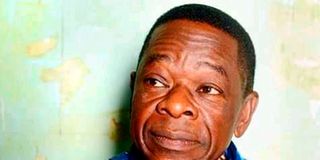
Rhumba music superstar Sam Mangwana, who last visited Kenya four decades ago, is excited about a possible return to the country, where he has a devoted following. Renditions of his popular Kiswahili songs Lugha ya Mapenzi , Masai and Furaha ya Bibi will be the highlight should he confirm his visit.
These songs were originally recorded during his last visit to Kenya in 1984. During that tour, he was backed by a group of Nairobi-based Congolese musicians including the guitarists Sammy Mansita, Siama, and Johnny Cowalengo (all of whom were with Orch Virunga at the time).
Today, Mangwana, who was born and raised in Kinshasa, is working with Luanda-based backup musicians in Angola. They belong to a session band which supports studio recordings.
Now aged 81, he is preparing for retirement, but is determined to finish his career with some major recordings. Although he sings about Furaha ya Bibi (the joy of women), Mangwana remains a senior bachelor. Popularly known as Le Pigeon Voyageur (the travelling pigeon) due to his tendency to tour the world, Mangwana is also a fitness enthusiast.
Speaking recently to the Saturday Nation, Mangwana, who now lives in his ancestral home in Luanda, pointed out that fitness has kept him healthy.
"Five days a week, I make sure I take a one-hour walk as part of my fitness routine. I made this decision some years back, encouraged by my personal physician," he said.
After his morning walk, he said that he often prefers to eat traditional African food, which he usually prepares himself at home.
“I avoid fatty foods and snacks, and instead prefer vegetables and rich African cuisine. I am also taking herbal medicine alongside synthetic medicine," he said.
This is what he does in his spare time away from his career as a musician, which involves performing in concerts and recording in the studio.
Veteran musician Sam Mangwana during a past performance in France.
Photo credit: File | Nation Media Group
He has also been considering engaging a Kenyan promoter to organise travel for him to the East African region, where he can entertain his many fans. This is especially pertinent as he celebrates 62 years in the music industry this year.
He also clarified that most of his love songs, such as Fatimata , Maria Tebbo and Suzana Coulibaly , were fictional and only served to illustrate real-life relationship experiences.
One of Mangwana's greatest strengths is his fluency in multiple languages. He is fluent in French, Lingala, Portuguese, English and Kiswahili.
At the end of last year, he was recognised by UNESCO as a rhumba ambassador and was also honoured by the President of the Democratic Republic of Congo (DRC), Félix Tshisekedi, in Kinshasa.
"It was a great honour to meet the DRC president, who expressed his deep appreciation for my long-standing contribution to Congolese rumba music," he said.
Mangwana's musical legacy stems from his collaboration with archrivals Tabu Ley Rochereau and Franco Luambo Makiadi, who were pillars of Congolese music from the mid-1950s onwards. These two great musicians were engaged in a rich musical rivalry, particularly in the 1970s. Many key musicians, including Mangwana, worked with both bands interchangeably.
One of Mangwana's most recent live performances was a show in Luanda last month. It was held in honour of Nyoka Longa Jossart, the band leader of Zaiko Langa Langa – Nkolo Mboka, and his sibling. Like Mangwana, Nyoka Longa's parents are of Angolan descent. Few Lingala music fans know that the parents of the legendary guitarists Felly Manuaku Waku and Syran Mbenza were also of Angolan ancestry.
Another famous singer of Angolan ancestry based in Kinshasa was Matadidi Mabele (also known as Mario or Buana Kitoko) of the Trio Madjesi band.
Unlike most others, Mangwana chose to return to the place from which his parents had fled Portuguese colonial oppression in the 1940s.
Today, he is proud to have returned home, preferring to live alone though he occasionally joins forces with his Angolan siblings.
“It's more peaceful here, and I also travel to the countryside to check on the agricultural products,” he said.
Mangwana initially found success as a singer through Tabu Ley's inspiration in the African Fiesta band in 1963. In 1968, he joined the star-studded Festival des Maquisards band, alongside musicians such as the guitarist Dizzy Mandjeku and the singers Guvano and Ntesa Dalienst.
The group later split, with Dizzy Mandjeku, Kiesse Diambu and Lokombe forming Grand Maquisards.
Mangwana then joined Tabu Ley’s Afrisa International before joining Franco Luambo Makiadi's TPOK Jazz in 1972. It was here that he sang backing vocals on famous songs such as Lutumba Simaro’s classic composition Mabele (Earth), which propelled him to fame within the TPOK Jazz band. For many, this classic ballad revealed Simaro's exceptional songwriting talent.
Mangwana collaborated with other artists, including Wuta Mayi, Josky Kiambukuta, Lola Checain and Michel Boyibanda. Together, they performed in some of TP OK Jazz's greatest songs, such as Toyeba Yo, Ebale ya Zaire, Nakoma Mbanda na Mama ya Mobali na Ngai, and many more. Mangwana left TPOK Jazz in 1975 to rejoin Tabu Ley's renamed Afrisa International Band, before embarking on a solo career in West Africa.
While in West Africa, he performed with the All African Stars alongside Dizzy Mandjeku, Theo Blaise Konkou, Lokassa ya Mbongo, and Moya Ringo.
He returned to Franco's TPOK Jazz in 1982 to sing on the Cooperation album. The Cooperation song notably features the refrain Ödongo, who, according to Mangwana, was a prominent Kenyan personality whom Franco had met in Nairobi and whom he was singing in praise of in this song.
However, one of Mangwana's most memorable moments, perhaps tinged with sadness, was his final recording with Franco, the Forever album. Franco was visibly unwell at this time, and subsequently undertook his final tour of Europe before dying in a Belgian hospital.
Mangwana was also saddened by the recent death of veteran saxophonist Modero Mekanisi, with whom he performed in the Afrisa International Band.
“Modero was a pillar, working alongside Tabu Ley,” he said.