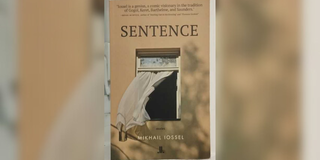
Life is a life sentence, and no one brings out the ‘sentence’ we have to serve out in this world than Mikhail Iossel, professor of Creative English at Concordia University in Montreal, starting with the story ‘Road Long.’
Only an academic of his stature could have crafted a technical work of short stories of this nature – jumping off from a story called ‘Sentence’ in his previous book (Love Like Water, Love Like Fire) – for this new book.
“Sentence,” launched a month ago worldwide and in Montreal, consists of stories that are all one sentence long; with some sentences running as long as 25 pages in the longest sentence in the collection.
So, a total of 38 stories, each a single sentence long, and in a gimmick that is actually virtuosity, each and every story not only makes sense, but is a story of great sensibility.
Read aloud, these stories have a rhythmic narrative feel, as if they are solely meant to be read out loud, yet they are also the kind of stories you want to read in silence and solitude, perhaps on a pre-dawn weekend morning when the rain is “stubbornly unstoppable, monotonous, relentless” as Mikhail Lossel writes in ‘Nairobi Rain’ – and take in this sentence(s) that rain words, yet are somehow reassuring, comforting, that we are in this storm of life together.
In “I Am,” Mikhail Iossel begins by describing how, in Kenya, we often end up mis-spelling his name as “Lossel,” (Kiswahili has no “Io” in its linguistic ions, so our eye auto corrects), yet he has come to ironically embrace the moniker – ‘Lossel,’ the Man of Losses.
And, to a large extent, the sentences in this book are actually a ledger of losses – lost childhood/innocence, loss of country, loss of language, lost time, lost loves, lost friends, and in the end, the existential loss of Self.
For example, in one story, a Kenyan newspaper interviewer in her late-20s, looking at the photographs of the protagonist four decades ago, when he was her age, asks ‘What happened?”, because of course the ravages of age are as yet inconceivable to her youthful self.
That life transitioned almost 40 years before, in the January of 1986, where the protagonist is in a Red Arrow night train between Moscow-and-Leningrad (now, again, Saint Petersburg).
He is drinking vodka and thinking thoughts with a ‘Dead Man Drinking’(DMD, 65) who has cancer and will be dead by about Easter, by which time our almost thirty hero will have left the USSR for the USA, about to live an unimaginable life because, as Iossel points out, “most people end up living the lives they could never have imagined for themselves when they were little …”
And Iossel’s red arrow of time points backwards too, such as the time he gets the news of the death of someone he hasn’t thought of in decades, back in Russia, someone about his own age who has just died alcohol-ravaged, bed-ridden, destitute and border-line demented.
Yet the writer misses the man, suddenly, in the way he misses his own life, to put it in a sentence, “the way in which everyone’s absence, no matter how presumably immaterial, leaves a permanent and irreversible emptiness …”
My favourite long sentence story in “Sentence” may be “Waltz No. 2,” where The Professor comes across a street busker near the Montreal-metro station playing a piece of Shostakovich that takes him back to 1982 in Abkhazia with a sweet, young beautiful woman in a post-midnight beachfront restaurant, and that waltz playing as the waters of the Black Sea waltzed nearby.
And the Professor is transported back in time for a while, and wants to pay for the memory of music (in another lifetime, a lifetime away), but has no money, and going to the ATM seems too much work (and the minimum $20, Canadian, Sh2,000 about) perhaps too much for a Shostakovich, so he awkwardly thanks the street musician; and hurries off to his departmental meeting.
Then it’s back to the past in the next tale where the professor is a seven year old wee lad, learning penmanship, literally clean handwriting, at the elbow of his father – the letters of the alphabet that make words that create these sentences that build a world.
We will go back to his first day in kindergarten at four, where the four year old boy “knows” that once he leaves his beloved nanny and walks through that gate, like one dipping into a deceptively placid river with raging undercurrents, from that time forwards, people that he most loves “will start moving towards old age …and start dying.”
In the end, Life passes us all a capital sentence!
But before that, Professor Iossel will tell you about the time he asked (a) student to ‘google gulag’ in a story by that name, before the protagonist realizes you begin with that goulash, and before one realises it, they are ‘hermetic hermitic word ciphers,’ making meaningless metonyms, before their nonsensical nonexistence comes into being. Surely, the arithmetic of Alzheimer’s, if one lives longest.
The Magic Tea Mug is one of the most touching sentences in “Sentence.” An old man, still sentient, is driven beyond mere sentimentality when a granddaughter gifts him one of those ‘magic mugs’ that when filled with hot tea, reveals pictures: in this story, the long lost photo of his wedding day with his late wife, looking happy and radiant in their twenties.
The man is inconsolable, his granddaughter thinks he sheds tears of joy. O, how we all cry for our forever-loved lost.
“There is no cure for happiness,” a homeless man sitting on a snowed-down bench eating a cheap tuna sandwich in winter twilight throws the sentence in another story; while the priceless phrase of the collection is “pokonchit samoubiyistvom.”
In ‘How to Write a Russian Sentence in English,’ a young lovesick American male tells a legendary poet his tale of woe regarding a (Russian) girl he’s fallen hopelessly in love with, who has assured him “she’ll never love him in that way” but he feels he cannot live without her. “What is to be done?” he beseeches the poet, who drops the above phrase in Russian: “Kill yourself!”
There is one story of a dream of Donald after a capital sentence at The Capitol, and another one on his ‘posh lust’ for constant attention, topics well covered by Mikhail on his Facebook pages where he eviscerates him (MI’s Facebook posts have, occasionally, become New Yorker tales)
I loved the ‘Swedish Death Cleaning’ story where two older men, one in a bus, the other on a pedestrian street crossing, have a brief “ships that pass in the night” moment, and somehow ‘recognise,’ each other, nod.
You feel that, with this book, Iossel tried to capture his/our subconscious whims with words.
In that sense, the prose in this book is poetically philosophic, the words of a Delphi who, in his words, is ‘still trying to figure out the mystery of it all, even in the evening of life.’
In ‘One More,’ the writer gives the game away as trying, once more, to complete putting complete sentences together to create something semi-timeless, which is what all truly ambitious authors try to tirelessly do. Does Mikhail Iossel achieve this ‘Holy Grail’? I’ll leave that up to you.
What he does do, and here the cliché is accurate, is ‘capture the human condition’ – including, but not limited to, the limitations of older age, inner indignities, the exhaustion of obligation and the angst of futurelessness. Time, or its relentless passage, is the Loch Ness monster.
Then there is the sweeter-bitter poignancy of the story called ‘That Girl’ – who is the summary of every soulmate we only briefly met but lost (or never even met, or if we did, perhaps only in our dreams), with whom we hope to either reunite (or meet one day, if we never have met) until “now that our lives are drawing to a close, maybe we’ll meet in another life, Tanya.”
In another sentence, someone tells his sweetheart not to be too heartbroken because “there is some kind of wi-fi in the afterlife,” so wry, a story long before “That Girl” that may make a reader cry.
In “Finishing Sentence,” a man begins, in a hoarse yet still strong voice: “Now that my life finally seems to have come to a close …”
But another sentence interrupts, the First and Last, how people are always asked about their first childhood memory, but never their last (adulthood) memory – the one we cannot share with anyone, ourselves included.