There is no “sabasabaness” in “Saba Saba”, double seven or the mathematical figures thereof. We agree to attach the meanings or significances to them. Language is “always already” symbolic, as the deconstructive philosophers tell us.
This means that every utterance we make is a symbol. A symbol, as you know, is something that represents or signifies a reality to which it has no direct, obvious connection. There is no “tableness” in the word “table”, my first linguistics teacher, Wilfred Whiteley, used to tell us. The word suggests or represents that four-legged wooden object with a flat top because we have agreed that that is what it will stand for.
Thus it was that this week, on the seventh day of July, the seventh month of the year, we were marking different events associated with that double seven symbolic date (“seven" being “saba” in Kiswahili). Note that I said “marking” rather than “celebrating”. This is because the two “saba saba” events uppermost in my mind were of a drastically different nature. One, indeed, was a celebration, but the other, well, well, well!
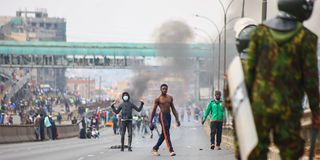
We are talking, on the one hand, of the saba saba event that was a commemoration of the landmark pro-democracy demonstration and rally at Kamukunji thirty-five years ago. For the participants in that event, the double-7 symbol stands for the struggle for political space. As you know, I normally say very little about politics. Still, I regret that people should die or get hurt while sharing their symbol.
The other saba-saba event or event cluster this week was certainly a joyous one for me. This was the fourth anniversary of the celebration of the International Kiswahili Day. It is also variously known as Kiswahili Language World Day or Kiswahili Language Day. We Waswahili have coined a comprehensive acronym for its celebration in East Africa.
“MASIKIDU” stands for celebration of World Kiswahili Day (maadhimisho ya siku ya Kiswahili Duniani). The inaugural celebrations of the Day were held in 2022 in Zanzibar, at the Headquarters of the East African Kiswahili Commission. The second edition was in Kampala, and last year we were in Mombasa. This year’s regional celebrations were in Kigali, Rwanda. There are also celebrations at various national and institutional centres.
Among the localised celebrations this year, in which I admittedly did not participate as actively as I would have liked to, three particularly caught my attention. One was a Kiswahili scholarly conference (Kongamano) at the Kisii University in Kenya and the other a similar one at the Institute of Languages of the Kabale University in Southwestern Uganda.
I also noticed a powerful virtual panel discussion, from the Eldoret University, among eminent scholars, like Dr Leonard Muaka of Howard University, Dr Angela Sawe of Eldoret University and author and activist Jane Bosibori Obuchi. All these scholarly encounters were aimed at interpreting and finding practical applications of this year’s Kiswahili Day theme, which is “Kiswahili for peace and prosperity.”
I believe you can see here a plausible link between the two “saba-saba” symbol events that we mentioned at the beginning of our chat. The Kiswahili Day theme is explicit about the universal aspiration for peace and prosperity, that is, wellbeing. I believe that peace and prosperity were also the aspirations of those who came out to commemorate the Kamukunji saba-saba rally. Its sad degeneration into violent confrontations and even injuries and deaths was, according to us Waswahili, a failure of those involved to communicate with and understand one another (kuwasiliana na kuelewana).
But the ability to talk with and understand one another does not come automatically, specially in moments of charged encounters between angry demonstrators and armed operatives. Effective conflict-resolving communication is a subtle and complex skill that takes years of upbringing, education and training to master. Then it must be made a lifelong habit in all our dealings with one another. This is what the Waswahili call “uungwana” (decency, civility).
A Mswahili is a decent person (Mswahili ni muungwana) and a decent person may claim to be a Mswahili. There are native ethnic Waswahili, despite the oft-repeated denial of the fact. But even native Waswahili lose their status if they fail on “uungwana”. I told you of the common Dar es Salaam taunt to Ill-mannered people: “Wewe si Mswahili” (you’re not a Mswahili).
I hail and congratulate all of you Waswahili of the Jumuiya who observed our Kiswahili Saba Saba. My heart went out to the Kongamano at Kabale University, and especially their keynote speaker, Prof Ruth Mukama, who, in the 1990s, seduced me into teaching Fasihi at Makerere.
But, as we celebrate our glorious international language, Kiswahili, let us remember that it cannot be separated from its “Uswahili”, which is uungwana.