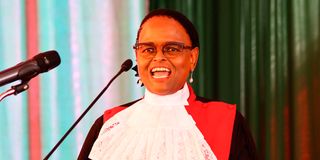
Chief Justice Martha Koome has appointed a three-judge bench to hear a high-stakes petition seeking to strip Kenyan judges of judicial immunity and reopen a three-decade dispute over the auction of a vast coffee estate by Kenya Commercial Bank (KCB).
According to a notice sent to the parties by the High Court Deputy Registrar, the Chief Justice empaneled Justices Eric Ogola, Hillary Chemitei, and Roselyne Aburili to hear and determine the petition. Justice Ogola will preside over the bench.
The CJ’s decision followed a High Court finding that the issues raised—particularly regarding judicial immunity—are weighty and constitutional in nature.
The registry directed advocates to urgently submit three sets of all filed documents to prepare files for the bench and to schedule the matter before the presiding judge for directions.
The petition was filed last month by businessman Captain Kung’u Muigai, Benjoh Amalgamated Limited, and Muiri Coffee Estate Limited.
They sued eight senior judges and the Judicial Service Commission (JSC) over the auction of a 443-acre coffee farm in Kiambu County to recover an alleged unpaid debt.
At the core of the case is a disputed consent decree dated May 4, 1992, which the petitioners allege never existed. They argue the decree was neither signed nor recorded yet was used to justify the sale of their land.
The judges named in the suit as respondents include Supreme Court Justices Mohamed Ibrahim, Njoki Ndung’u, and Isaac Lenaola, as well as Court of Appeal Judges Milton Asike Makhandia, Kathurima M’Inoti, Sankale Ole Kantai, Francis Tuiyott, and John Mativo. They were sued in their personal capacities—an unusual move testing judicial immunity limits.
The petitioners allege the auction relied on a fabricated consent decree, a claim initially upheld by Justice Erastus Githinji in 1997. However, appellate judges later overturned this finding, a decision the petitioners now challenge, citing subsequent integrity concerns about the appellate bench as the judges involved later left the Judiciary.
Despite multiple appeals, successive benches of both High Court and Court of Appeal led by Justices Lenaola (2004) and Mativo (2024) upheld KCB’s position and upheld the contested decree.
The petitioners argue these rulings were made in bad faith, citing Justice Githinji’s 1997 finding that no consent existed. The petition asserts these decisions entrenched an illegality, resulting in the loss of the land.
The bench will determine whether Article 160(5) of the Constitution—which grants judges immunity for lawful acts done in good faith—applies when judges are accused of unlawful conduct.
“The immunity clause cannot shield manifest illegality,” states the petition. It urges the court to delineate protected judicial acts from misconduct. The petitioners contend that immunity must be "transformatively interpreted" to exclude "manifestly illegal, unconstitutional, and unlawful acts."
The bench will also consider whether the petitioners’ constitutional rights were violated. They claim violations of their constitutional rights to property, fair administrative action, and due process.
Separately, they accuse the JSC of dismissing misconduct complaints filed between October 2024 and August 2025 without explanation.
On August 7, 2025, the JSC rejected their complaints, which their lawyer, Senior Counsel Nelson Havi, called a breach of constitutional oversight duties.
“The JSC’s refusal to probe the allegations or disclose the judges’ responses to the complaint undermines constitutional oversight,” argues advocate Havi.
By empaneling this bench, the Chief Justice has paved the way for resolving these substantial and novel questions.
The petitioners' advocate has urged the court to adopt what he calls a transformative reading of judicial immunity. He argues that Kenyans should not bear irreversible losses caused by judicial misconduct without any remedy.
The ruling could redefine judicial accountability and clarify whether immunity remains absolute amid allegations of unlawful conduct. The petition is awaiting hearing directions at the expanded bench.