The person on whom multitudes have pegged their hopes and dreams falls seriously sick. You are the spokesperson tasked with conveying that information to the public. Where do you start?
Cardiologist Dan Gikonyo, who was the physician for Kenya’s third president, Mwai Kibaki starting from 2002, writes in his book ‘Doctor at Heart’ that such communication has to contain hope. Those were the instructions he was given before briefing the media about the condition Mr Kibaki was in when he had an accident ahead of the 2002 General Election.
“We need to give Kenyans hope. Therefore, measure your words,” he recalls being told by Mr Kibaki’s aide Alfred Gitonga.
Measuring of words is also what former Prime Minister Raila Odinga required of his long-serving spokesman Dennis Onyango whenever he fell seriously ill. Mr Onyango told Nation that Mr Odinga did not seek a concealment of facts; only the message should be packaged the right way.
“With Raila, it was fairly straightforward because his policy was full disclosure; that people must be told the truth when he’s sick. And he was quite categorical about that,” said Mr Onyango, who served as Mr Odinga’s spokesman starting from 2008 until the former Prime Minister’s death in October last year .
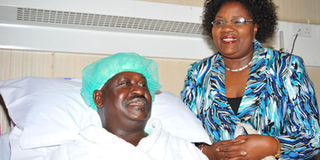
By his count, there were three prominent occasions when Mr Odinga’s health became a national talking point. The first was in June 2010 when, as a sitting Prime Minister, he checked into Nairobi Hospital complaining of exhaustion and headaches. He later underwent surgery to remove a blood clot on the surface of his brain.
The second was in March 2021 when he was admitted to the same hospital and tested positive for Covid-19, while the third was the illness that ended in his death in India.
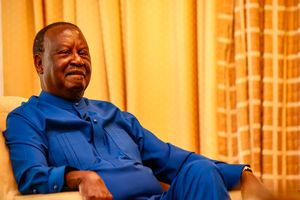
Kenya's former Prime Minister Raila Odinga.
Photo credit: File | Nation
“I remember when he was being taken in for the first time at Nairobi Hospital. We had a brief chat and his concern was: would the communication come out exactly the way he wanted it to come out? Because he knew people would have wanted to manipulate things here and there,” Mr Onyango recalled. “So, he was very concerned that his supporters must get the correct information.”
The formula, he explained, was for the secretariat to make the first announcement and then hand the microphone to the medics.
“Once he landed in the doctor’s hands, we insisted on doctors doing the talking. The doctors would do the briefings for purposes of believability,” he said. “Not all doctors were comfortable with that because it drove them into possible political territory, but I think on all the occasions that worked.”
The man most often doing the talking was neurosurgeon David Oluoch-Olunya, Mr Odinga’s long-time physician, who briefed the press after the 2010 operation and confirmed the 2021 Covid-19 diagnosis – a disclosure Mr Odinga personally authorised.
Neurosurgeon David Oluoch-Olunya, Mr Odinga’s long-time physician.
Photo credit: File | Nation Media Group
“He didn’t like his people struggling to know [whether] what they are getting is the real situation,” Mr Onyango said of the Covid-19 episode. “So again, we made his doctor, Olunya, to be signing those statements that we could then share with the public for purposes of believability. He believed that there must be full disclosure about his health.”
Yet Mr Odinga’s final chapter caught many Kenyans off guard. Days before Mr Odinga’s death, Mr Onyango dismissed claims about the ex-PM’s health as rivals’ misinformation, saying he was “not sick, nor indisposed”.
Days later, Mr Odinga’s brother, Siaya Senator Oburu Oginga, confirmed that the former was recuperating in India. On October 15, Mr Odinga collapsed during a morning walk in India and died aged 80.
Asked whether anything could have been done differently in the messaging relating to Mr Odinga’s final days, Mr Onyango replied in the negative: “No, I don’t think so. One, Raila was a very strong personality. You would not know even when he is very sick. He had a way of pumping himself up.”
He cited the ODM parliamentary group meeting of September 22, 2025, where Mr Odinga famously asked, “Who told you that ODM does not have a candidate in 2027?”
Said Mr Onyango: “That day, he was quite unwell. Personally, I knew he was unwell. I was worried. I was not even sure he would stay the whole course. But he stayed there and talked and talked and talked. And all the people who were with him there didn’t know he was unwell.”
The family has since shed more light on the illness. In a televised interview in November last year, Dr Oburu revealed that a blood clot had been discovered in his brother’s head and was being dissolved by doctors in Nairobi with strong medication that left him weak and tired. The clot, he said, was cleared in Mumbai, after which Mr Odinga went to Kerala to recuperate.
“He told me he was leaving where he had been hospitalised, going to another city, then connecting to come to Dubai, and then come to Nairobi. I asked him, ‘Have you been treated? Have those guys diagnosed everything?’ He told me, ‘Yes, there was some clot here. They removed it, and I am okay now.’”
“And you could feel he was okay. Even me, I told him, ‘Today I feel you are okay.’ So, there was no way we could have prepared the country for the possibility of him dying. It was too sudden,” Mr Onyango added.
For those aspiring to speak for a VIP, Mr Onyango’s advice is that the principal’s word is final.
“If the boss has said that when it comes to matters of health you’ve got to do full disclosure, that takes priority. His instructions take priority,” he said.
Mr Odinga, he added, did not tolerate dithering: “If you start fumbling around, Raila had a habit of asking you, ‘Who are you working for? Are you working for me or somebody else? I’ve told [you] to do it this way, so you do it that way.’”
But the job also demands diplomacy within the inner circle. “You have to be close, understand [the immediate family] and their concerns. You’ve got to understand the children, and you’ve got to be friends. If you are not, it can be very difficult. And the people around that space, the wife and others, have to understand that you mean well.”
There was also, he said, the ever-present worry about how Mr Odinga’s fiercely loyal supporters would react once they learnt he was in hospital. The fear that crowds could invade a hospital and demand to see him is why his team always tried to keep his hospital stays short.
In the social media age, spokespeople like Mr Onyango have their work cut out, often having to respond to rumours on social media. For instance, Mr Lee Njiru who was the long-serving spokesman of Kenya’s second president Daniel arap Moi spent a considerable amount of time in late 2019 responding to rumours about Mr Moi’s health status.
We also interviewed Mr Kibisu Kabatesi, who has been involved in political communications for years, regarding the intrigues of communication when a VIP has been taken ill.
Mr Kabatesi was the communications director for Mr Odinga’s 2007 presidential campaign and later worked on Musalia Mudavadi’s 2013 candidature. In 2022, he was in President William Ruto’s campaign as what he calls “a jack of all trades”, drafting policy and press statements.
“But the big one was the inauguration speech, which I did,” he said, referring to the “A Kenya for Everyone” address Dr Ruto delivered at Kasarani on September 13, 2022. He now runs a communications consultancy.
“When you’re in a company of that nature, you essentially are one of the last people to know [that the VIP is ill]. Nobody should cheat you otherwise,” he said. “If they were hospitalised, they’re already out of the hospital and recuperating at home. That is when information actually does filter to you.”
Of the principals he has served, Mr Kabatesi recalls Mr Mudavadi, now the Prime Cabinet Secretary, as the one who was taken ill and hospitalised. Such episodes, he says, are rare, but being kept in the dark is “quite terrifying”.
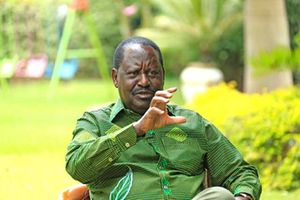
Former Prime Minister the late Raila Odinga.
Photo credit: Pool | Nation Media Group
“You are receiving that information from rumour mills, so you don’t know how to respond to that because you can’t even reach your principal in the first place. So, you begin to panic,” he says. “Everybody else is looking at you as a source of that information, yet you do not know; you are also seeking the information. Now you can figure out how this has a terrible effect: Do you lie? You might want to lie, hoping that it will become the truth.”
His counsel to VIPs was blunt: “You are in a public space; that is your choice and, therefore, anything and everything about you is public property. It is not a matter of hiding; it is a matter of how you communicate the same to the public.”
When the spokesman is blacked out, he warned, “the rumour mills take over”. Sickness, he added, tends to pull leaders into the family cocoon.
“That issue becomes a family secret that is managed by the family. That is okay, but now they shut you out,” said Mr Kabatesi. “You are being accused even by the family of leaking the same. And yet you have no idea. You are actually looking for the same information.”
Asked about the assurances Kenyans received in the days before Mr Odinga’s death, Mr Kabatesi offered sympathy rather than blame to Mr Onyango.
“I pity my friend, Dennis. I really pity him on that matter. Because what else could he say?” he posed.
Asked whether leaders in the West are more open about their health, Mr Kabatesi said it is a global issue.
“Generally, this is not just an African problem; it’s a worldwide problem,” he noted. “It is very rare, even in the American system itself, for them to actually say the president is unwell. Of course they would say he went for a normal check-up…but they will never quite tell you what kind of disease or illness or the severity of it.”
The secrecy, he said, takes on a more extreme form on the continent.
“Of course, it’s manifested more in Africa, where even in some countries, the age of the leader is denied,” he said. “But in terms of covering up, it’s a worldwide issue.”