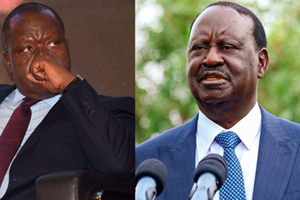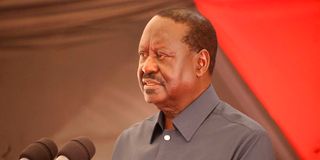
Former Prime Minister Raila Odinga.


Among the many details of Raila Odinga’s final moments, one that has drawn considerable attention is the medical treatment he sought in India, which is also the same treatment his daughter, Rosemary, had sought there in 2022.
Odinga collapsed on Wednesday morning at an Ayurvedic treatment facility, in what was attributed to a cardiac arrest, before he was rushed to a private hospital in the Koothattukulam area in Kerala State of India. At the private facility, media reports said, he was pronounced dead.
So, what is Ayurvedic treatment?
According to Dr Rajinder Prashad, who has studied Ayurvedic medicine and surgery and has been running an Ayurveda clinic in Nairobi for the last 27 years, it is a natural system of medicine considered to be one of the oldest healthcare systems.
“In an ancient language of India, Ayurveda translates to ‘knowledge of life,’” Dr Prashad told Nation, adding that “Ayurveda” comes from two words — “ayur” and “veda”.
“Ayur means ‘life’ or ‘age’. Veda means ‘knowledge’. The science which deals with the knowledge of life or science of life is Ayurveda. So, Ayurvedic treatment depends on the nature of the person. We believe [there are] three constituents of our body: Vata, Pit and Kapha. Vata means ‘air’, Pit means ‘fire’, and Kapha means ‘water’. Our body is made of three constituents,” he explained.
“When there is an imbalance inside these three constituents, disease occurs. So, our treatments are based on the nature of the body of the patient. We don’t cure the symptoms. We hit the roots. We are not going to suppress the symptoms. We are curing the disease,” he added.
'Internal cleansing process'
Dr Prashad explained that Ayurveda is a vast science.
“People have a concept that it is only the leaves, grass, roots, et cetera. But we sometimes convert gold into ash and use that as medicine. Or the ash of brass, copper or even gems like pearls. It involves an internal cleansing process, followed by a tailored regimen of special diets, herbal remedies, massage therapy, yoga, and meditation. The exact course of treatment is determined after a careful evaluation of the patient’s body constitution and other individual factors.”
If you are wondering if this type of treatment contains any artificial chemicals, Dr Prashad shakes his head — it doesn’t.
“Ayurvedic medicines are purely natural. It is from nature, and we process them naturally. And we don’t use any kind of chemical, like preservatives,” he said, adding that Ayurvedic treatment can be combined with normal medication.
Lifelong injuries from politics
Away from Ayurveda, few people can claim to have sustained lifelong injuries due to involvement in politics — and Odinga is one of them.
Detained and tortured many times under Kenya’s second president, Daniel arap Moi, Odinga saw his body take a beating due to political causes.
For instance, he attributed the regular tearing of his eyes to his time in detention. Speaking during the presidential debate preceding the 2017 General Election, he explained why he moved from a bright spot on the podium.
“You saw me walk away from that place because that light interferes with me. You see, my eyes sometimes water because of the damage I suffered when I was in detention and the poor lighting in detention. That is what damaged my eyes,” he said then.
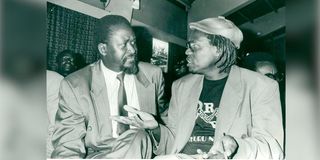
Birds of a feather? FORD Kenya’s Raila Odinga (left) listens to Koigi wa Wamwere at the All Saints Cathedral where they met for the Release Political Prisoners Cultural Week.
He attributed that injury to politics.
“I’ve been in politics because of what I think is right for this country,” he said.
That was not the only problem the detention brought him. According to a June 1991 report by Amnesty International, being jailed also worsened Odinga’s diabetes.
“[He is a] prisoner of conscience detained since July 1990. He is diabetic but is not allowed a special diet in Naivasha prison or facilities to monitor and control his diabetic condition,” it stated.
The organisation, in a letter sent to Moi and other top government officials, urged that Odinga be given all necessary medical tests and treatment, “including testing and dietary facilities to allow regular monitoring and control of his diabetes”.
However, we could not find instances where Mr Odinga said he was diabetic before, during or after the detention.
In later years, Odinga would be hospitalised for Covid-19 (2021), a spinal canal stenosis (2020), food poisoning (2017), fluid in the brain (2010), among others.
Last days
What baffled many was the fact that, as per many people’s accounts, he was communicating well by Tuesday. Mombasa Governor Abdullswamad Sherrif Nassir told journalists that Mr Odinga called him from India and that he was “in extremely high spirits”. Migori Senator Eddy Oketch said they spoke on the phone for seven minutes, where Odinga gave him “a lot of instructions”.
According to Dr Mohamed Hasham Varwani, an interventional cardiologist at the Aga Khan University Hospital, Nairobi, what follows a cardiac arrest is a sudden collapse, loss of consciousness and stoppage of breathing.
“Without quick action, especially CPR (cardiopulmonary resuscitations that mainly entail chest compressions) and use of a defibrillator, which can apply an electric shock to the heart, a cardiac arrest can cause death within minutes,” said Dr Varwani. “Acting quickly can make the difference between life and death. Every minute without CPR or defibrillation reduces the chances of survival by about 10 per cent.”
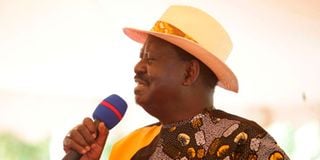
Azimio la Umoja party leader Raila Odinga.
On October 11, Odinga’s brother, Dr Oburu Oginga, had told the media that the latter was “a bit indisposed, just like every human being sometimes becomes indisposed”.
“He went for check-ups, it’s finished, he’s now just recuperating. Very soon, he will be back, up and about, kicking,” he said.
That was not to be.
Also, this was not the first time Oburu Oginga had discussed his younger brother’s hospitalisation. In 2020, when Raila Odinga went to Dubai for treatment, it was his elder brother who spoke to the media about the swirling rumours.
“Jakom (Raila) is out of the country for a minor surgical operation on his back. It is not a serious health issue, but just a minor one. So, he’s okay,” Oburu Oginga told journalists in June 2020.
Later, in an interview with the Sunday Nation, Raila Odinga revealed that he had an issue with his spine.
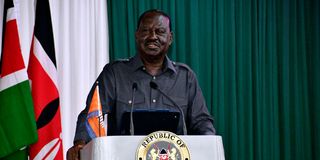
Former Prime Minister Raila Odinga speaks during the Memorandum of Understanding (MoU) signing between United Democratic Alliance and Orange Democratic Movement at the Kenyatta International Conference Center on March 7, 2025.
“The doctors told me it is called Spinal Canal Stenosis,” he said, referring to a condition that causes the narrowing of the spaces within the spine and which can be painful in some instances.
“What they did for me in Dubai is a minor procedure. It’s called lumbar decompression and fusion…The operation itself takes some few hours and then you need time to recuperate,” he added.
Raila had it rough
In March 2021, Dr Oginga was also in the news after responding to talks about his brother’s hospitalisation. He denied that Raila Odinga had contracted Covid-19, but the fact was later confirmed.
A decade earlier, in 2010, when Odinga was the Prime Minister, he underwent surgery at the Nairobi Hospital to remove fluid on his brain. Neurosurgeon Oluoch Olunya described the operation as “minor” and which was meant to relieve pressure that had built up outside Mr Odinga’s brain.
“Following examinations and initial investigations, he was found to have a build-up of pressure outside the brain leading to headache,” Dr Olunya told the media in June 2010.
“A team of doctors got together and, within a short period, it was agreed that a minor procedure be carried out on the left side of the head to relieve the pressure,” he added. “The pressure was relieved when some fluid was removed through a small opening in the skull.”
The doctor also inferred that the pressure might have been caused by Mr Odinga banging his head in his car. However, his press team had announced that he was being treated for fatigue.
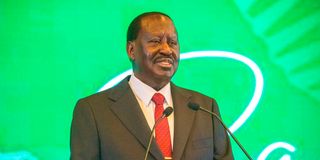
Raila Odinga at the AU headquarters in Addis Ababa on February12, 2025.
It is not clear whether the beatings he had received while in detention might have caused deeper injuries, but it is clear that Odinga had it rough. In his 2013 autobiography, “Flame of Freedom”, he described a scene where he was clobbered while being interrogated about the botched 1982 coup. He mentioned Special Branch Senior Superintendent Josiah Kipkurui Rono as one of his assailants.
“The blows to my head dazed me and I fell to the floor, and as I lay there, Rono and the others jumped on my chest and my genitals. Through the blinding pain, I heard them cock their guns, then Rono’s voice: I was either going to speak and tell the truth or I was dead meat. I waited for the end… But it did not come,” wrote Odinga.
He also described the other torture methods that included being placed in a lice-infested room and being stripped naked and placed in a water-filled room.
Another instance where Odinga’s health became a matter of public interest was in March 2017, when he was treated at the Karen Hospital. He issued a statement saying it was food poisoning (consuming a meal with an overload of naturally disease-causing toxins) and not poisoning by consuming a deliberately placed chemical.