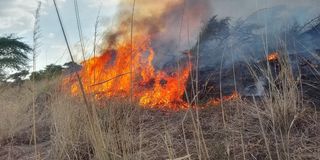
The country is experiencing a sudden and alarming rise in forest fires, with 180 incidents recorded since January 2025, a new report by the Kenya Forest Service (KFS) has shown.
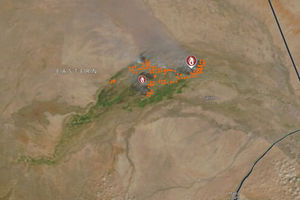
Over 1,357 hectares of vegetation have been lost to wildfires across protected areas, including the Maasai Mau, North Rift, Coast, Central Highlands (Mt Kenya and Aberdares), and Eastern Conservancies.
However, according to KFS, most concerning is the sharp rise in fire outbreaks over the past week, raising fears of a worsening crisis.
KFS officials warn that the fire season, fuelled by the high temperatures, low humidity, and strong winds, is expected to persist until mid-March.
“The rapid drying up of vegetation and the accumulation of combustible materials is further exacerbating the situation,” KFS says in a statement dated February 27.
Fires have also been reported in Isiolo, Garissa, and several coastal regions, with KFS maintaining a high fire danger rating across all its stations.
The government agency says that it has deployed more firefighting resources and personnel to work alongside Community Forest Associations, the Kenya Wildlife Service (KWS), and local government teams to contain the blazes.
As a precautionary measure, KFS has suspended all burning of vegetation near or within forested areas.
“Individuals intending to burn vegetation near forest reserves must provide written notification 48 hours in advance to the nearest KFS or Police Station,” KFS says.
To further enhance preparedness, the agency has reinforced its response capacity by deploying more firefighting equipment, pick-up vehicles, and troop carriers.
Additionally, all staff on leave have been recalled to strengthen fire suppression efforts.
KFS says that it has also implemented a smoke detection system to improve forest fire monitoring in Mt Kenya, Aberdares and Mau forests.
This comes as the government agency Wednesday February 26 reported two separate fires were reported in the Mt Kenya forest.
The wildfires were reported at the Gathiuri and Muringato Forest stations which are considered fire hotspots, particularly during the dry season.
At Gathiuri Forest Station, KFS Nyeri County Conservator Esther Mugo said that the fire that broke out around 4pm on Tuesday, was a suspected arson case.
“The incident is suspected to be an arson case, as the fire was spotted in two separate locations,” said Ms Mugo, noting that some community members believe burning grassland promotes more vigorous regrowth, improving grazing conditions for livestock.
She cautioned the public that such fires disrupt the forest ecosystem and biodiversity, adding that efforts by KFS officers and community members to contain the overnight fire were hampered by strong winds and darkness.
At the Aberdare Forest, teams were on Thursday February 27 fighting an active fire in the Embaringo section.
Kenya Wildlife Service (KWS) Senior Assistant Director in the Mountain Conservation Area Ms Lucy Mwati said the fire which broke out earlier in the day was the latest in a series of incidents reported over the past one week.
Every time we contain one, another breaks out in a different area due to the hot weather,’” Ms Mwati said.
KWS Assistant Director for Mt Kenya National Park, Eric Aduda, said the organisation was working closely with local communities and was on high alert.
As KFS officers were battling the blaze in the Mt Kenya and Aberdare forests, another wildfire whose cause could not be immediately established consumed several acres of vegetation at a section of Lolldaiga Conservancy in Laikipia County.
The fire started at the southern part of the 45,000-acre conservancy at midday on Wednesday with the management seeking support of the neighbouring community to put it out.
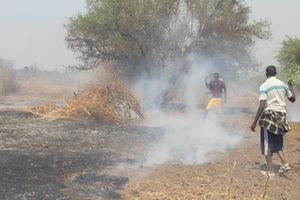
“I would estimate that about 30 acres of vegetation was destroyed before we managed to control it using twigs, branches and water that was supplied by bowsers,” said Mr Gateri Mwangi from Muramati, one of the villages neighbouring the conservancy.
Mr Mwangi said when he arrived in the conservancy with about 20 other people, the fire was spreading fast, fuelled by strong winds but they managed to contain it within two hours.
KWS Assistant Director in charge of Laikipia County Ms Rose Malenya said she had not been briefed about the incident, saying the cause of the fire was yet to be established.
The conservancy is a training ground for the British Army Train Unit in Kenya (BATUK) but the foreign soldiers are not currently on site with troops expected to report next month for the annual training exercises.