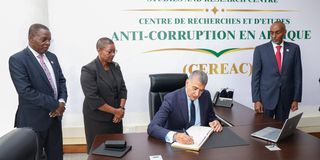
Kenya has positioned itself at the forefront of Africa's war against corruption following the launch of a research centre in Nairobi, expected to spearhead policy development in the graft war across the continent.
The launch of the the African Anti-Corruption Studies and Research Centre in Nairobi on Wednesday brought together anti-corruption agencies, policymakers, diplomats and governance experts from across Africa at a time when graft is becoming increasingly sophisticated, technology-driven and transnational.
For Kenya, the establishment of the centre is both a vote of confidence in the country's anti-corruption architecture and a recognition of its growing influence in shaping continental governance reforms.
President William Ruto in a speech by by Attorney-General Dorcas Oduor, described corruption as one of the greatest obstacles to Africa's economic transformation, social progress and democratic governance.
He warned that corruption has evolved beyond national borders, with illicit wealth increasingly hidden through shell companies, beneficial ownership structures, digital assets and complex international financial arrangements.
"The proceeds of corruption move rapidly across jurisdictions. Modern corruption networks are now intertwined with money laundering, cybercrime, trafficking, fraud and other forms of organised crime," President Ruto said.
The Head of State argued that sustainable anti-corruption success depends not only on prosecutions but also on preventing corruption before it occurs. He highlighted the growing importance of data analytics, artificial intelligence, digital registries and integrated financial management systems in detecting corruption and improving accountability.
He called on African governments to invest in institutional resilience, procurement integrity, beneficial ownership transparency, public financial management systems and mechanisms for tracing and recovering illicit assets.
"The fight against corruption is therefore not merely a legal or institutional undertaking. It is fundamentally a development imperative," he said.
Africa continues to lose billions of dollars annually through corruption, illicit financial flows, tax evasion and procurement fraud, resources that should otherwise be funding schools, hospitals, roads, water systems and opportunities for millions of young Africans.
In June 2025, African Union Advisory Board Against Corruption (AUABC) Vice-Chairperson Yvonne Mutepuka revealed that Africa loses up to 120 billion dollars annually to corruption; a crisis that continues to undermine the continent's economic independence and development ambitions.
Sub-Saharan Africa remains the world's lowest-performing region, recording an average score of just 32 out of 100. Only four of the 49 countries assessed scored above 50.
The region's best performers were Seychelles, which scored 68, followed by Cabo Verde (62), Botswana (58) and Rwanda (58). At the opposite end, Somalia and South Sudan scored just nine points, making them the most corrupt countries globally, while Libya and Eritrea scored 13.
In East Africa, Rwanda leads with a score of 58, followed by Tanzania at 40. Kenya scored 30, ranking 130th out of 181 countries globally and trailing several of its regional peers.
It is against this backdrop that the Nairobi-based Centre has been established. CEREAC will serve as the research and analytical arm of Association of African Anti-Corruption Authorities (AAACA) and is expected to generate evidence-based solutions to corruption challenges facing governments and institutions across the continent.
Speaking during the opening ceremony, Ethics and Anti-Corruption Commission (EACC) Chief Executive Officer Abdi Mohamud said the centre is the culmination of a four-year process that began during the assembly’s fifth annual general assembly in Bujumbura, Burundi, in 2022.
The project gained momentum when member states formally created the institution during the sixth assembly in Johannesburg, South Africa, in 2023. In January 2024, Kenya was unanimously selected as the host country before members resolved during the 2025 assembly in Algiers, Algeria, to officially launch the Centre in Nairobi this year.
Mr Mohamud said the facility represents a major milestone in strengthening evidence-based anti-corruption interventions across Africa.
"The centre will serve as the lobby’s research and analytical arm. Endowed with legal personality and administrative and financial autonomy, the Centre represents a major step forward in strengthening evidence-based anti-corruption policy, research, capacity building and knowledge sharing across the continent," he said.
The EACC chief noted that corruption schemes are becoming increasingly sophisticated and often transcend national boundaries, necessitating stronger collaboration among anti-corruption agencies.
Among the key issues discussed during the Nairobi assembly, which will continue until June 18, were cross-border investigations, mutual legal assistance, information sharing, asset tracking and recovery, as well as emerging threats linked to digital finance and virtual assets.
"While technology has created unprecedented development opportunities, it has also introduced new avenues for concealing illicit wealth," Mr Mohamud said, urging anti-corruption agencies to strengthen their technical capabilities to investigate and prosecute corruption in the digital age.
On his part, EACC Chairperson Bishop David Oginde described the Centre as a critical tool in ensuring Africa stays ahead of increasingly innovative corruption networks.
He noted that corruption is no longer confined to traditional forms of theft and bribery but has migrated into sophisticated digital platforms and international financial systems.
Bishop Oginde warned that anti-corruption agencies risk falling behind unless they embrace innovation and modern investigative tools. He said emerging technologies such as blockchain and advanced digital tracking systems offer opportunities to detect suspicious transactions and prevent the movement of illicit funds.
However, he cautioned that technology alone would not solve the problem. The continent, he said, must strengthen institutional cooperation, dismantle information silos and build robust frameworks for sharing intelligence and expertise among anti-corruption agencies.
"The theme of strengthening cooperation and institutional innovation is our collective declaration that no one institution can tackle this problem alone," he said.
The EACC chairperson said the new research Centre would play a crucial role in helping African countries anticipate emerging corruption trends rather than merely reacting to them.
AAACA President General Hashim El Rakaybi said the Centre would strengthen governance systems across Africa through capacity building and cutting-edge research.
"This will improve cooperation and coordination among member states and having a technical office will make work easy for the Secretariat. We have to work hard to prevent corruption and strengthen our institutions," he said.
The launch of the centre aligns with the aspirations of the African Union's Agenda 2063 and the African Union Convention on Preventing and Combating Corruption, both of which place good governance at the Centre of Africa's development agenda.
The challenge now, delegates agreed, will be translating research, innovation and cooperation into concrete action capable of recovering stolen assets, protecting public resources and restoring public trust in institutions.