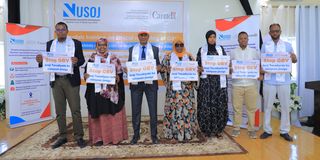
In Somalia, where gender-based violence remains widespread, journalists face the difficult task of reporting responsibly while upholding ethical standards.
This week, the National Union of Somali Journalists (NUSOJ) expanded its training programmes to mark International Human Rights Day. The initiative has been strengthened by support from the Canadian government, now a key partner in advancing safer and more ethical media practices.
Canada’s involvement was reinforced by Joshua Tabah, the Canadian Ambassador to Somalia and High Commissioner to Kenya and Uganda, who highlighted the broader consequences of unchecked gender-based violence.
The Ambassador warned that gender-based violence undermines efforts to rebuild societies emerging from conflict and stressed that journalists have a role in confronting it.
“Unfortunately, conflict means heightened risks for GBV, especially for women and girls,” he noted while linking this to this year’s theme, Safe Spaces, Strong Voices: A Conversation on Technology-Facilitated GBV, which draws attention to new digital threats.
Tabah also pointed to Canada’s backing for Somali women peacebuilders, recognising “their tireless work in creating safer, inclusive communities.”
“Canada reaffirms its commitment to supporting women advocating for the end of gender-based violence and taking steps to bring peace and stability to their communities. Lasting peace requires that women are not only included but engaged,” he added.
His visit to Somalia this week placed a spotlight on the country’s ongoing struggle with gender-based violence. His comments helped frame the wider support Somali journalists are receiving.
This diplomatic emphasis connects directly to the work of NUSOJ, which has been strengthening training for reporters and working with media managers to make newsrooms safer for women.
These efforts aim to ensure that women journalists not only remain in the profession but are protected and valued within it.
Promote women’s advancement
NUSOJ’s training programmes, supported through the Canada Fund for Local Initiatives, have been rolled out across the country to deepen journalists’ understanding of gender-based violence and promote women’s advancement in the media sector. The union says demand for this training has grown significantly.
One of the latest workshops, launched on December 10, encouraged media outlets to build safer and more inclusive newsrooms. It also aimed to improve reporting on the violence faced by women and girls, linking professional standards with broader human rights concerns.
These developments come at a time when Somalia continues to confront longstanding human rights challenges, particularly affecting women.
Progress has often been slowed by the absence of formal mechanisms to address such issues, which made the launch of Somalia’s first national human rights commission this week a notable step forward.
Earlier in the 16 Days campaign, on 25 November, NUSOJ introduced the National Safeguarding Initiative for Women Journalists in Mogadishu.
Supported by the Canadian High Commission in Nairobi, the initiative brought together more than 150 women journalists, their male colleagues and key partners for training on safety, digital security and advocacy.
This programme created new space for women journalists to build confidence, strengthen networks and enhance their protection both at work and in the field. It marked one of the most extensive safeguarding efforts ever organised by the union.
Reflecting on this progress, Nima Hassan Abdi, NUSOJ Organisation Secretary, said: “Emancipating and empowering women journalists, while bringing male colleagues to the table to confront long-ignored workplace abuses, has been vital in exposing harmful practices that must be eliminated from our media industry. These honest conversations are paving the way for concrete action to protect women journalists both online and in the office.”
That shift has extended beyond Mogadishu, with NUSOJ conducting similar workshops in Garowe and Kismayu. These sessions focused on ethical and responsible reporting of gender-based violence and equipped journalists with skills in trauma-informed storytelling, survivor-centred reporting and fact-based coverage.
The campaign culminated on December 10 with the Human Rights Colloquium in Mogadishu, held alongside a three-day training programme for journalists in the capital. The event gave reporters the chance to reflect on the difficulties of covering sexual violence and workplace harassment and to strengthen corrective practices.
Gender-sensitive reporting
Omar Faruk Osman, NUSOJ secretary general, used the occasion to reaffirm the profession’s obligations.
“Journalism is a public good that protects communities by shining a light on abuse and holding power to account. This duty can only be fulfilled when journalists are free, confident, skilled, and able to use their voices responsibly,” he said.
According to NUSOJ, these initiatives are already delivering results. Training provided to about 150 journalists has helped 62 media outlets improve their gender-sensitive reporting and adopt stronger internal policies to support women journalists.
Collectively, these outlets reached 2.5 million viewers and listeners and generated more than 1,120,000 social media engagements.
Stakeholders say this growing national effort is building momentum that can strengthen protections, boost accountability and advance meaningful gender justice for Somali women.