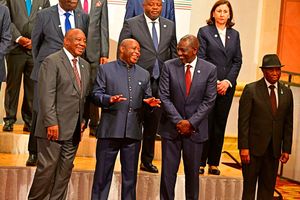
President William Ruto’s messaging in Japan, where he is attending the 9th Tokyo International Conference on African Development (TICAD9) has sounded familiar, a signal of emphasis or reiteration as he hunts for partners to push his agenda.
On Tuesday, ahead of the opening session for the Summit, the Kenyan leader engaged with various Japanese officials, including Prime Minister Shigeru Ishiba. His messaging was that Kenya was a gateway to Africa where investing their money could connect to other markets on the continent.
Ruto told an audience at the Yokohama City Assembly that Kenya wants to be “the Silicon Savannah and Africa’s gateway to growth,” urging Japanese firms to expand their footprint in Nairobi and across the East African region.
“Our relationship must rise to a higher level that fully harnesses the opportunities in my country,” President Ruto said.
He singled out Kenya’s green energy dominance, youthful workforce, and regional trade integration as unmatched incentives for Japanese investors. In Yokohama, sports clubs and firms banking on sports have thrived, and he invited them to look for players in Kenya.
In Kenya, he said Japanese firms will place a bet on 1.4 billion people in Africa because Kenya has signed on the continental free trade agreements.
“Visitors to Kenya are not merely tourists; they are returning home — to the cradle of mankind, the home of original wonder.”
To the Yokohama’s business community, President Ruto said Kenya is not just seeking investment — “it is offering a launchpad to Africa’s vast promise.”
This line of messaging was used when he toured China in April for State Visit. At a forum with Chinese business community, he spoke of $50 billion (Sh6.5 trillion) investment opportunities in Kenya and told of Kenya’s predictive commitment to regional integration for an expanded market access.
“Kenya stands as the gateway to Africa. Kenya is open for business---charting a new cause toward mutual prosperity…we are seeking strategic partnerships to expand our infrastructure…including in transport, logistics and energy…” Ruto said in April.
“With our strategic location, along global trade routes…we offer world class connectivity that augments the business ecosystem…offering investors a natural entry point into Africa’s next wave of industrialisation, innovation and cross-border trade.”
There are reasons for the comparison. Japan and China were the earlies countries to host regular Africa Summits, now running into the third decade. India, UK, US, France, Russia and the European Union have followed suit.
Japan is today Kenya’s third-largest source of Foreign Direct Investment (FDI), contributing over $205 million (Sh26.6 billion) in 2024, and $5 billion (Sh647 trillion) since 2020, seen in projects such as the Mombasa Port, the Olkaria Geothermal Plant, and automotive assembly plants.
Yet, Tokyo’s TICAD has paled in comparison to the Forum on China-Africa Cooperation (FOCAC), whose influence in Africa has seen a volume of $250 billion (Sh32.4 trillion) in trade. Japan amounted to 10 percent of China’s.
As TICAD opened on Wednesday, however, it was clear more trade, not aid, would rectify the situation leaders admitted was unbalanced. It is the problem both China and Japan face in Africa: a trade deficit. In June, Beijing offered zero tariffs on African products to try and reduce the deficit, if they signed on bilateral trade agreements with Beijing, and maintained diplomatic relations. Many like Kenya are yet to sign, although President Ruto has indicted it will.
“Our trade has grown exponentially in that period, growing by 33 percent in 2024. However, the trade relationship is heavily in favour of Japan,” Ruto said in Japan on Wednesday.
“There is a need for Japan to deal with tariff and non-tariff barriers so that Kenyan agricultural produce, including avocados and tea, can get more access to the Japanese market.”
State House Nairobi said Japan’s trade with Kenya reached $900 million (Sh116.6 billion) in 2024, rising by a third in volume to the figures of 2023. But Kenya’s volume of exports there was just about $70 million (Sh907 billion), less than ten percent of the total volume. Nairobi sent goods worth just about $26 million (Sh3.4 billion) to Tokyo last year.
Prime Minister Shigeru Ishiba, meanwhile, proposed an economic bloc known as the Indian Ocean-Africa economic zone to contribute to the development of western Indian Ocean.
“Under this initiative, we will further link Africa with the nations in the Indian Ocean region and support efforts in Africa for regional integration and industrial development so that further growth can be achieved,” Ishiba said.
Mr Ishiba told the opening session that the proposed bloc ‘ride on established Japan-African relations.
“This initiative seeks to promote Africa's regional integration and industrial development in the Indian Ocean-Africa Economic Region, which is expected to serve as a key driver of global economic growth, by fostering collaboration between Japan and countries across the Indian Ocean such as India and Middle Eastern countries,” he said.
Japan says the initiative is positioned as one of the efforts under the vision of a Free and Open Indo-Pacific (FOIP), which will support Japanese companies in expanding trade and investment from countries across the Indian Ocean to Africa, and to ensure that the resulting benefits also flow back to Japan.
Ishiba also proposed the use of development assistance to build the Nacala Corridor development project to link copper mining nations in the African interior with ports on the African east coast.
“This will not only promote African regional integration, but also strengthen the links between Indian Ocean nations and Africa,” he said.
Every TICAD often announces new money and new focus areas. In the last TICAD in Tunis, leaders agreed to focus on inclusive growth, sustainable development and peace and stability, a key area the Japanese have often cited as a barrier to full cooperation.
Japan announced a cumulative $30 billion (Sh3.9 trillion) more worth of investments in Africa and they pledged to strengthen partnerships between Japan and Africa, in areas of infrastructure development, health, and peace and security. Its funding often differs from China’s because Tokyo focuses on partnerships with entities while China mostly build around government-to-government relations.
Kenya’s priority, Ruto said, is to invite investors into agriculture, healthcare, digital economy, manufacturing, and climate action.