Outrage after Zimbabwe court slaps Chinese drug users with ‘light sentences’
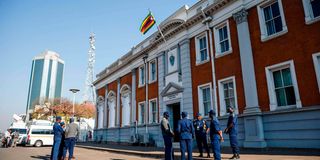
Policemen stand guard outside the courthouse, in Harare on August 22, 2018.

Lighter sentences handed down to nine Chinese nationals in Zimbabwe for using drugs is eliciting uproar, fuelled by accusations of bias.
Each of the nine was slapped with a $150 fine after police caught them abusing hard drugs at a house in Harare.
Harare magistrate Vekayi Chikwekwe had in September fined the Chinese nationals $150 each after they were caught at a drug-fuelled party and detained for only one night.


Mr Chikwekwe justified the light sentences, saying the quantities of cocaine found in their possession were insignificant to warrant harsher penalties. An alternative punishment for the offences would be six months in prison.
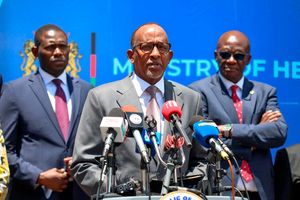
Now the Zimbabwe Human Rights Commission (ZHRC), a State institution with the “mandate to protect, promote and enforce human rights”, says it has noticed that the sentences given to the Chinese were part of a trend where foreigners were treated better than locals by the justice system.
“The ZHRC acknowledges the recent public outcry surrounding the disparate treatment of two cases involving drug offences,” the commission said. “The ZHRC believes that these cases raise critical questions about equality and non-discrimination within our justice delivery system.”
It said the case raised eyebrows when compared to a recent court ruling where a 38-year-old Wadzanai Siyamachira from Harare was caught with 3.0138 grams of cocaine at her residence.
Ms Siyamachira was convicted and sentenced to 18 months in prison with six months suspended, which left her with a jail term of one year for unlawful possession of dangerous drugs.
In contrast, the commission said the nine Chinese, who were found with cocaine, methamphetamine and other substances.
They were granted bail “after only one night and fined a mere $150 with the option of a six-month prison sentence.”
“The ZHRC is deeply concerned about the apparent discrepancies in treatment between Zimbabwean citizens and foreign nationals within the justice system,” the ZHRC said.
“Contrasting outcomes in these cases highlight a troubling double standard.
“While Ms Siyamachira faces a stiffer sentence for a relatively small quantity of drugs, the Chinese nationals received lenient treatment, raising questions about the fairness and impartiality of our legal system.”
Zimbabwe has seen an explosive growth in the Chinese population in recent years as the southern African country increasingly becomes one of Beijing’s most favoured investment destinations in Africa.
Chinese business owners often clash with local labour unions, who accuse them of maltreating their employees. The government is accused of turning a blind eye to the abuse, fearing disturbing relations with the world's "superpower".
Broken justice system
The commission said the varied treatment of two cases not only undermined the principle of equality before the law, but also eroded trust in the justice system.
“Citizens are increasingly concerned that the justice system may favour foreigners, leading to perceptions of injustice and inequality,” the ZHRC added.
“Such sentiments, amplified through social media, can foster a climate of mistrust and cynicism toward legal institutions.
“It is imperative that the ZHRC recommends the authorities to investigate the causes of such disparities in order to restore faith in the justice delivery processes.”
The National Prosecuting Authority of Zimbabwe (NPAZ) acknowledged the public anger over the sentences imposed on the Chinese nationals and said prosecutors had been instructed to prefer the correct charges in all drug-related charges.
It said the Chinese nationals would be deported from Zimbabwe to demonstrate the seriousness of their crimes.
“The NPA is taking concrete and decisive steps to ensure future prosecutions for drug-related offences are handled with the utmost efficiency and effectiveness,” the NPAZ said.
“Henceforth, all public prosecutors have been instructed to prefer the correct charges in all drug-related cases, and ensure that they aggressively pursue stiffer sentences in court to secure penalties that truly reflect the seriousness of these offences.
“This stance is a direct reflection of the direction that Zimbabwe has taken to combat drug abuse.”
Zimbabwe is battling a worsening problem of drug abuse, especially among young people, which has been attributed to the high rate of unemployment and unending economic problems.
According to health authorities, about 60 percent of patients admitted to psychiatric facilities suffer from conditions related to drug and substance abuse.
There are no official statistics on the number of drug users in Zimbabwe, but experts say the crisis is getting out of hand.
Some of the common drugs in Zimbabwe are cocaine, cannabis and methamphetamine (commonly known as crystal meth).
The uproar over the sentence given to the Chinese nationals was a manifestation of growing anger over their perceived preferential treatment in Zimbabwe.
In July, a senior Zimbabwean government official issued a rare rebuke of Chinese nationals, whom he accused of disregarding local labour and environmental laws as well as illicit financial flows.
Tafadzwa Muguti, a senior official in President Emmerson Mnangagwa’s office, took delegates at a conference to discuss Chinese investments in Harare by surprise when he warned investors from the Asian country to desist from “illicit financial activities, environmental harm and disregard for local laws.”
Zimbabwe is one of the countries in Africa that are more receptive to investment from China due to its over 20 years of isolation by the West following a violent land reform programme that displaced white farmers.
In 2024, the Zimbabwe Investment Development Agency recorded 441 new investments from China which contributed $2.75 billion compared to 56 investments with a combined value of $52.28 million the previous year.
Chinese President Xi Jinping in 2015 designated Zimbabwe as an ‘all-weather friend,’ a title only given to 14 countries worldwide. The Chinese have heavily invested in Zimbabwe’s energy, construction, agriculture and mining sectors.
China has also financed and undertaken large infrastructure projects such as power stations, airports, roads and hospitals, but the growing influence of the world’s second-largest economy has been polarising Zimbabwe.