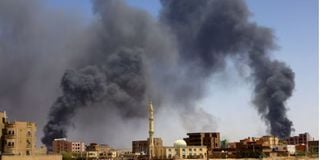
Sudan’s Darfur and Kordofan regions are witnessing a worrying escalation of attacks and violations against civilians who had already been under a brick-pile of famine.
And it has forced rights groups to demand a tougher and expanded sanctions regime, including an arms embargo on both the Sudanese army and allied militia, as well as rivals in the Rapid Support Forces (RSF).
In truth, an arms embargo already exists on the Darfur region, owing to its past horrible war in the early 2000s, which saw then leader of Sudan Omar al-Bashir and his lieutenants indicted by the International Criminal Court.
In the current war, which started in April 2023, between the RSF and the Sudanese army (SAF), both sides have received a string of sanctions from the US and UK, mainly targeting their revenue streams and sourcing of arms. The suppliers of those weapons, however, have not been blockaded, which rights groups say is allowing more suffering in Sudan.
Two years down the line, at least 40,000 people have died, some 12 million displaced from their homes and more than half the country’s GDP ruined in the war.
Today, more than half of Sudan’s 49 million people require urgent humanitarian assistance, UN estimates say.
In Darfur, the suffering is mostly due to a siege, rather than direct gunfire.
In April 2024, the RSF imposed a total siege on El Fasher, the capital of North Darfur, blocking the entry of food and humanitarian aid. Residents reported resorting to eating animal fodder, while several soup kitchens — a lifeline for many — were forced to shut down last month. On August 20, a World Food Program (WFP) convoy was struck by a drone attack, destroying three trucks.
According to the UN Human Rights Office, RSF fighters killed at least 57 civilians in an August 11 assault on the Abu Shouk displacement camp, followed by 32 more deaths in attacks between August 16 and 20.
These atrocities follow a large-scale RSF attack in April on the Zamzam displacement camp, south of El Fasher, during which civilians, including health workers, were executed, civilian buildings were burned, and widespread looting forced hundreds of thousands to flee.
Medical charity group Doctors without Borders (MSF) has documented what it described as “systematic patterns of violence” against civilians in El Fasher and Zamzam since April 2024, including mass killings, sexual violence, abductions, starvation, looting, and assaults on markets and health facilities. MSF reported that the RSF and allied militias deliberately targeted non-Arab communities, particularly the Zaghawa.
Civilians fleeing El Fasher told researchers for the rights lobby, Human Rights Watch, that RSF fighters and allied militias manning checkpoints on the road to Tawila, 60 kilometres away, stripped them of belongings, food, and means of transport. Several witnesses said women and girls were raped at these checkpoints.
A 45-year-old woman who fled with her eleven children in May recounted that two of her daughters, aged 13 and 15, were among 30 women and girls abducted by militia fighters. “When they brought my daughters back, one was bleeding,” she said. “They were raped not far from us. We saw it, but they shot at my neighbor when we tried to intervene.”
The tragedy extends beyond Darfur, however, and involves the other side of the war. In Kordofan, SAF airstrikes killed civilians and hit civilian infrastructure, including sites hosting displaced people. In mid-July, the UN reported that an RSF assault on villages in North Kordofan killed at least 300 people, including children and pregnant women.
“The Security Council needs to confront the RSF over its ongoing siege and deliberate attacks on civilians, and press both warring parties to stop obstructing humanitarian access,” said Laetitia Bader, deputy Africa director at Human Rights Watch.
“Council members should expand the arms embargo and impose targeted sanctions, while setting a clear timeframe for action.”
The 15-member Council has been sorely sluggish on dealing with the Sudan issue, however, meeting only occasionally to issue condemnations.
On August 13, the UN Security Council demanded an end to the siege of El Fasher and the delivery of aid, but stopped short of concrete measures against those committing violations of international humanitarian law.
The Integrated Food Security Phase Classification (IPC), the global body monitoring food insecurity in regions, has warned that ongoing fighting in Darfur and the Nuba Mountains of South Kordofan is driving severe food shortages, leaving entire communities at risk of famine.
The Sudan International Nongovernmental Organisations Forum has also cautioned that there are “no safe routes out of the city, with roads blocked and those attempting to flee facing attacks, taxation at checkpoints, discrimination, and death.”
UN officials warn that the obstruction of humanitarian access by both sides is compounding the crisis. International actors have accused regional powers of supplying arms to the rival factions, fueling the conflict. Meanwhile, the Security Council remains divided over proposals to deploy a civilian protection mission, a measure long overdue.
Beyond Sudan’s borders, regional analysts caution that the conflict threatens to destabilise neighboring countries, including Chad, South Sudan, and the Central African Republic, all of which are already struggling with their own political and security challenges. The influx of refugees, coupled with cross-border arms smuggling and militia activity, risks igniting broader regional instability.
The Security Council is set to review the renewal of the Sudan arms embargo on September 12. Human Rights Watch urged the Council to extend sanctions to cover the whole country, hold perpetrators accountable, and consider deploying a civilian protection mission in Sudan — a step long overdue.