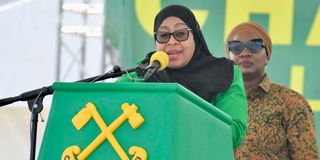
But the repression unleashed by newly re-elected President Samia Suluhu Hassan has also been unprecedented. She has gone further than her autocratic predecessors in closing off the political space and silencing opposition figures.
The protests spread across a series of major cities and towns in Tanzania. However, an internet blackout created a fog of war in which details are difficult to ascertain.
Amateur and professional coverage found its way through the internet blackout. What I see in this footage is anger and tragedy running through these protests, and the struggle of the anti-authoritarian movement at large. However, at least fleetingly, there has been hope as well.
Tanzanian riot police officers walk past a vandalised campaign poster of President Samia Suluhu Hassan.
Photo credit: Reuters
The anger is directed at the regime. It simultaneously focuses on Tanzanians’ material circumstances and what they see as the political sources of those circumstances. The hope comes from a changing sense of what is possible – the regime long seemed invulnerable. The protests have thrown its authority into doubt.
The protests turned violent. Protesters set police stations and other buildings ablaze, hijacked police and ruling party vehicles, and ransacked polling stations.
The anger is not just about policy, but politics too.
A Tanzanian police officer walks past a vandalised campaign poster of President Samia Suluhu Hassan at the Namanga One-Post Border crossing point between Kenya and Tanzania on October 30, 2025.
Photo credit: Reuters
Protesters are directing their anger against the regime. They have torn down posters of Hassan. They are demanding constitutional reform, a truly independent electoral commission, and free and fair elections.
Yet, Zanzibar aside, protests against the regime itself have always remained anaemic, until now.
Chadema, and the opposition at large, has struggled in the face of a violent state apparatus to draw protesters beyond a cadre of committed activists to its banner. Until now.
Until days ago, the sort of protests unfolding across Tanzania seemed like a fool’s hope. The CCM regime, and its security apparatus, would never allow them. Protesters were arrested, brutalised, abducted or killed . Resistance, it seemed, was futile.
As political scientists Adam Branch and Zachariah Mamphilly observe, in protests, what seems possible can change profoundly and suddenly. Whenever protests gather momentum, the dynamics of their formation and repression change. Security personnel can seem hopelessly outnumbered. Protests can seem unassailably large.
In this context, protesters have created spaces in which they – rather than the regime – rule, at least temporarily. The footage of protesters making off with ballot boxes, tearing down posters and saying the previously unsayable shows moments that have an air of emancipation.
The exuberance may not last. Tanzania’s regime has not endured for 64 years for nothing. If the crackdown hardens, and the death toll climbs, the streets may clear quickly. If, in contrast, the police are unable to contain the protests and the military refuse to support them, they may quickly lose control.
Whatever follows, Tanzania has changed almost overnight. One way or another, the change is almost certainly not yet over.