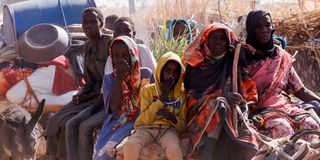
The United Arab Emirates (UAE) and the African Union are pushing for humanitarian corridors in Sudan in renewed calls for civilian protection, even as the conflict reached 1,000 days on Friday.
Earlier on Tuesday, the African Union hosted representatives from the Emirates in a meeting that signaled a change in strategy for the UAE, which has been fighting allegations of taking sides in the war.
But this week, both sides piled pressure on warring factions in Sudan, the Sudanese Armed Forces (SAF) and the Rapid Support Forces (RSF) to strike a permanent ceasefire geared towards establishing an independent civilian-led government reflecting the aspirations of the Sudanese.
African Union Commission (AUC) Chairperson Mahmoud Ali Youssouf and UAE Minister of State Sheik Shakhboot bin Nahyan met in Addis Ababa and reiterated the need for an immediate unconditional humanitarian truce.
“On Sudan, both sides underscored the need for an immediate unconditional humanitarian truce, a permanent ceasefire, unhindered humanitarian access throughout Sudan, accountability for violations of international humanitarian law, and establishing an independent civilian-led government reflecting the aspirations of the Sudanese people,” read a joint statement from the African Union.
The UAE is among countries known as Quad, which alongside the United States, UK, Egypt and Saudi Arabia had in September tabled a ceasefire proposal that included an immediate cessation of hostilities, reopening channels for aid distribution and a political dialogue over the next 18 years. The SAF, however, refused UAE’s involvement, accusing Abu Dhabi of arming the RSF, claims the Emiratis deny.
The Tuesday development came at a time the international community has condemned atrocities being committed against civilians by the warring parties, warning of a humanitarian crisis if a lasting truce cannot be found.
The conflict reached 1000 days on Friday, showing relentless violence over the last three years. Aid agencies say some 100,000 people have died since the conflict erupted, including victims of famine and disease outbreaks.
“One thousand days into this conflict, Sudanese families continue to pay the price of this war, while the world watches on with delay and inaction. The warnings were clear, the data undeniable, and communities have made their needs known countless times,” said Abdirahman Ali, Country Director for CARE International in Sudan.
“Women and girls endure unimaginable suffering, yet decisive action to protect them has failed to come. The situation in Sudan demands urgent protection of civilians, safe humanitarian access and a lasting commitment to end the violence.”
According to the International Red Cross, humanitarian needs far exceed available resources amid dwindling international funding and limited access to impoverished communities threaten to leave even more people without assistance.
“One thousand days of war is one thousand days of failure,” said Bob Kitchen, the IRC’s Vice President of Emergencies, who recently visited Darfur.
“I watched families fleeing south with whatever they could carry, while at the same time I saw our teams pushing north through mountain passes to meet them with healthcare, clean water and cash assistance,” he said.
In Addis Ababa, the high-level meeting was building on political consultations held in Abu Dhabi in September 2025, also saw both parties condemn atrocities against civilians and reaffirm support for Sudan's territorial integrity and unity. They welcomed regional and international efforts to address the humanitarian crisis.
For the UAE, however, the AU meeting was also to gather regional support for other geopolitical events especially in the Gulf and Somalia. The UAE had stayed off the Somaliland issue but this week issued a joint statement with the AU affirming respect for sovereignty and territorial integrity of Somalia, in the wake of Israeli recognition of Somaliland.
They reaffirmed that the occupation of the three islands of the United Arab Emirates (Greater Tunb, Lesser Tunb, and Abu Musa) by Iran constitutes a violation of the sovereignty of the UAE.
This is in addition to reiterating support for the UAE’s call for a peaceful resolution of the dispute on the three islands, in accordance with international law, including through bilateral negotiations or the International Court of Justice.