Women in Turkana trek for contaminated water as boreholes offer a rare glimpse of hope
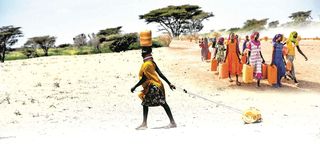
A woman pulls a jerrican of water in Turkana County. As climate change intensifies, women face higher rates of violence, displacement, and poverty.

What you need to know:
- Prolonged drought has left over 400,000 people in Turkana sharing contaminated water pans with livestock and wildlife.
- Women bear the heaviest burden, trekking for hours and facing GBV along the way.
- Community-managed boreholes are offering hope, freeing women from dangerous walks and enabling kitchen gardens.
Greenish water shimmers under the scorching Turkana sun, the only lifeline for an entire village. Women trek for hours with empty jerrycans on their backs, their children waiting at home.
At night, the wildlife comes to drink from the same contaminated pan. This is the daily reality for thousands of women in Turkana County, where the prolonged drought has transformed water from a basic necessity into a precious commodity worth walking miles to find.
Across Turkana County, one of Kenya's 23 arid and semi-arid counties, scenes of desperation have become disturbingly common. Contaminated water pans dot the landscape, broken pumps stand idle, and groups of women trek long distances with empty jerrycans perched on their heads. Herders line major roads in search of water, while overcrowded boreholes serve as gathering points for communities pushed to the brink.


In Ng'iu village, Turkana West, a single water pan filled with greenish water has become the sole source of water for residents, livestock, and wildlife alike. “We have no other source of water besides this greenish pan,” said Longor Tupur from Long'echen village near the Kenya-South Sudan border. “While my livestock drink, I take the opportunity to cool myself from the scorching heat. During the day, even dogs come here to drink. At night, the situation worsens when wildlife also arrives to drink."
Tupur fears the water will not last beyond two months as herders from 10 neighbouring villages migrate to the area in search of water. His next option, he says, will be to move into South Sudan, hoping that security agencies and peace actors will protect them. He warns that the shrinking and increasingly contaminated water pan poses serious health risks to both people and animals.
In Ngijawoi village, the situation is equally dire. Losiru Lowasa explained that scoop holes dug along the seasonal Tarach River, about six kilometres away, serve as the main source of water for households and livestock. "The bigger your herd, the harder the work becomes," he said. "You have to dig deeper scoop holes as the riverbed dries."
Lowasa added that a community borehole fitted with a hand pump is at risk of breaking down due to overuse. It takes at least five people to fill a 20-litre jerrycan using the hand pump, forcing many pastoralists to walk six kilometres through wildlife-infested hills and thickets to save their livestock from dying of thirst.
A lifeline for women
While the crisis affects everyone, it is the women of Turkana who bear its heaviest burden. For them, water scarcity means more than just thirst—it means danger, exhaustion, and the constant fear for their children's safety. However, some communities that safeguarded their water sources by forming water user committees after construction by the county government, national agencies, and development partners are now reaping the benefits. These success stories offer a glimpse of hope amid the crisis.
The Nayanae Epuol borehole, constructed in 2024 by the Kerio Valley Development Authority (KVDA) through the Ministry of East African Community, Asals and Regional Development, currently serves more than 2,500 people and over 60,000 livestock.
Joseph Emuria, a resident, recalled that before 2024, villagers routinely migrated more than 30 kilometres in search of water and remained away until the rainy season. Those left behind—children, the elderly, and weak livestock—would risk fetching water from scoop holes along seasonal rivers about 15 kilometres away.
The community put measures in place to protect the borehole after realizing how remote and hard-to-reach their village is. "I am happy that women here are now safer from gender-based violence," Emuria told theNation. "Previously, they were exposed to rape while walking long distances for water. Now, they fetch water in the morning for domestic use, and herders take over later in the day."
Jane Ewoi echoed this relief, noting that the borehole provides enough water for both domestic use and livestock. "During droughts, my husband would migrate with the animals to Nadunga village in search of water," she said. "Now he is assured of adequate water and pasture nearby."
However, she noted that the borehole is attracting herders from neighbouring villages, creating overcrowding and highlighting the need for water piping to households.
In Netwel village, Loima, Mary Nangolol said the availability of water has enabled permanent settlement. "Women used to migrate with their husbands in search of water to save our livestock," she said. "Now that we have water, we want support to establish kitchen gardens so we can grow and access nutritious vegetables."
She urged authorities to distribute relief food equitably to ensure that communities with adequate water sources do not migrate solely for the purpose of accessing aid. In Kalokode village, Ms Esther Akai said a women's group had established a garden where they grow vegetables and fruit trees. "After meeting our household needs, we sell the produce at Sh20 per bunch," she told the Nation. "Our children, who previously suffered from malnutrition, are now healthy."
She added that the group's investment in a water storage tank has reduced the need for daily water trips, freeing up time for other household chores. Schools in the area no longer struggle to access water for preparing porridge, and children's learning is no longer disrupted by long walks in search of water.
Government response
The Nation reached out to the Turkana government, which confirmed that about 77,000 households—more than 400,000 people—are affected by the severe drought. Governor Jeremiah Lomorukai said the county has rolled out an emergency drought response targeting food-stressed households while working with development partners to address water shortages. The county has procured 3,850 metric tonnes of maize and 194 metric tonnes of cooking oil, with distribution prioritizing the hardest-hit wards. The exercise is set to conclude by the end of January 2026.
The governor added that health teams have been deployed alongside relief distribution to support Social Health Authority (SHA) registration and improve access to healthcare. The Cabinet Secretary for East African Community, Asals and Regional Development, Beatrice Askul, said the government is mobilising development partners and humanitarian agencies as the number of people needing food aid continues to rise. "In Turkana, KVDA is drilling boreholes, constructing small dams, and establishing water pans to harvest rain and flood water," she said, noting that water trucking is ongoing in the worst-hit villages.
KVDA Managing Director Sammy Naporos said the authority has invested more than Sh200 million in 17 projects benefiting over 204,000 people and 300,000 livestock. Board Chairperson Mark Chesergon said KVDA continues to implement drought mitigation programmes annually, with government and partner support to address Turkana's chronic water challenges.
For the women of Turkana, water is more than survival—it is safety, health, and hope for a better future. As they continue to shoulder this burden, the successful community-managed boreholes offer a model that could transform lives, one jerrycan at a time.


