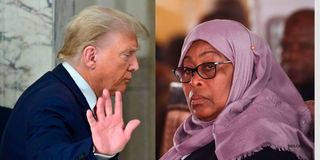
The US government on Thursday said it was reconsidering the state of relations with Tanzania in the wake of Dodoma’s heavy-hand response against post-election protesters.
The announcement, which piles fresh pressure on Tanzanian leader Samia Suluhu Hassan, said Washington was concerned with the security agencies’ violent response to protests, including killings. The US said such actions “raise grave concerns about the direction of our bilateral relationship and the reliability of the Tanzanian Government as a partner.”
“As a result, the United States is comprehensively reviewing our relationship with the Government of Tanzania. The Government of Tanzania’s ongoing repression of religious freedom and free speech, the presence of persistent obstacles to US investment, and disturbing violence against civilians in the days leading up to and following Tanzania’s October 29 elections, required this reconsideration of our ties.”
This move could be a step backwards for Samia who had retooled ties with Washington after taking the mantle of presidency in 2021, following the death of the inward-looking John Pombe Magufuli.
During her first time, Samia successfully re-attracted American tourists and the Millennium Challenge Corporation returned to consider investing in the country following a pause in the Magufuli era.
But while she won with a landslide in the October elections, the response to protests has been condemned even by African electoral observers deployed there.
“These actions have put American citizens, tourists, and US interests in Tanzania at risk, and threatened to undermine the mutual prosperity and security that have defined our partnership for decades,” the State Department said.
“The United States cannot overlook actions that jeopardise the safety of our citizens, or the security and stability of the region. The future of our bilateral relationship with the Government of Tanzania will be based on its actions.”
The US announcement came just two days after President Samia tried to justify the police crackdown on protesters as preventing a foreigner-engineered regime change.
At a meeting with elders in Dar es Salaam, she accused foreign actors, again, of colluding with opposition groups to cause a “regime change” while dismissing questions over her unprecedented 97 percent victory.
It was the umpteenth time the Tanzanian leader has spoken of foreign interference, even though her administration has provided little evidence to back the claim. The meeting with Tanzanian elders was supposed to mark her continued occasion to explain the outcome of the elections as well as a thanksgiving opportunity. But she has had to use this occasion to defend the unprecedented 97 percent victory in the October 29 elections.
“Our youth were manipulated, becoming mere parrots, singing songs and attempting to recreate what happened in Madagascar so that it would occur here.
“In that context, the response must be proportionate to the threat. When we are told we used excessive force, I ask, what would constitute appropriate force?” Samia posed on Monday.
“Were we to sit and watch the protesters who were prepared for regime change to succeed? It is not even unique to Tanzania. We have seen in other countries that whenever protesters misbehave, governments often exert their force. It has happened in other places and we saw it. So it doesn’t make sense. We ask ourselves whether those critics as the sponsors of this violence.
“We took oath to protect the borders of this country and its people. In doing that, as they do, we will do the same here.
After the October 29 General Election, Samia retained her seat after getting 31,913,866 votes (97.66 percent), out of the 32 million people who voted, according to the local electoral commission. Her nearest challenger didn't even master 1 percent.
Yet earlier in the year, the electoral commission disqualified opposition party Chadema from posting candidates in any race. Chadema leader Tundu Lissu was then charged with treason, a crime punishable by death in Tanzania. ACT-Wazalendo, another bigger opposition party, had its candidate, Luhaga Mpina, disqualified. He had crossed the floor from the ruling Chama Cha Mapinduzi. The electoral commission (INEC) did not reverse the ban in spite of a court order.
The exact number of injured or dead has been a matter of mystery. Tanzanian authorities have fought back an opposition claim of “thousands” but has not defended the heavy response including shooting to death of unarmed protesters. A CNN investigation found security agencies had fired on protesters and buried many of them in secret graves.