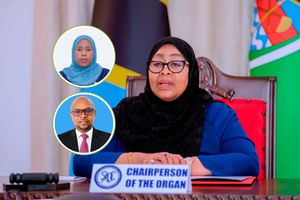
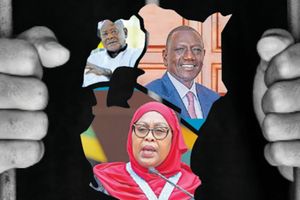
When Tanzanian President Samia Suluhu Hassan announced her new round of government appointments this week, two names stood out immediately, but not for their political résumés.
Her daughter, Wanu Hafidh Ameir , was named Deputy Minister for Education, while her son-in-law, Mohamed Mchengerwa , was appointed Minister for Health. Both are sitting MPs, familiar faces in Tanzanian politics. But their ascent to powerful cabinet roles has ignited a fierce national debate about whether the president is placing trusted leaders in key positions or pulling her own family closer to the centre of state power.
The reaction in Tanzania has been intense. Critics call it a classic case of nepotism, arguing that roles as sensitive as health and education ministries that touch the daily lives of millions should not be handed to relatives of the head of state. Supporters counter that both Wanu and Mchengerwa are qualified and experienced, and that family ties alone shouldn’t disqualify them.
Tanzanian president Samia Suluhu. Inset is her daughter Wanu Hafidh Ameir and Ridhiwani Kikwete, son of ex-president Jakaya Kikwete.
Photo credit: Pool
But whether one sees the appointments as strategic or problematic, one thing is clear: Samia’s move is not new. Across Africa, political families have long played outsized roles in government.
The pattern raises deeper questions about loyalty, meritocracy, and the concentration of power.
Zimbabwe: Sons, nephews, and a growing political dynasty
In 2023, Zimbabwe’s President Emmerson Mnangagwa came under heavy criticism after naming his son and nephew to his cabinet.
His son, David Kudakwashe Mnangagwa, was appointed Deputy Minister of Finance, a powerful role in a country battling economic instability and runaway inflation. Around the same time, his nephew, Tongai Mnangagwa, was named Deputy Minister of Tourism.
These appointments were met with widespread public backlash. Many Zimbabweans saw them as a signal that the Mnangagwa family was entrenching itself in the state’s most influential positions drawing uncomfortable comparisons to the Mugabe era, where accusations of elite enrichment and political patronage were common.
For analysts in Harare, the appointments fit a broader pattern: a leader consolidating a trusted inner circle at a time when political opposition remains fragile and the state faces significant governance challenges.
Uganda: A family embedded in the state
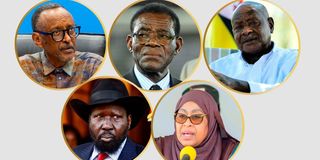
Few African governments illustrate the fusion of family and political power as clearly as Uganda under President Yoweri Museveni.
For years, Museveni’s wife, Janet Kataaha Museveni, has served in the cabinet, currently holding the influential position of Minister of Education and Sports. His brother, General Salim Saleh, is a long-time presidential adviser on defence and security, wielding substantial behind-the-scenes influence.
Uganda First Lady and Education Minister Janet Museveni.
Photo credit: Morgan Mbabazi | Nation Media Group
Then there is Museveni’s son, General Muhoozi Kainerugaba, whose rapid rise through the military ranks has sparked widespread speculation about succession. Muhoozi has served as the commander of the Special Forces Command and later as Chief of Land Forces. His increasingly political public statements have raised fears of an emerging hereditary transition a “Muhoozi Project”, as some Ugandans call it.
In Uganda, family involvement in government is not merely symbolic; it is structural. It shapes military command, cabinet decisions, and succession politics all under the watch of a president who has been in power for nearly four decades.
Rwanda: A presidential family integrated into state institutions
In Rwanda, President Paul Kagame also has members of his family occupying significant roles within state institutions.
His daughter, Ange Kagame, works in the Office of the President as a senior policy analyst, focusing on strategic policy and governance issues since 2019.
His eldest son, Ivan Cyomoro Kagame, was appointed to the Rwanda Development Board (RDB) in 2020, an influential agency responsible for driving investment and economic transformation.
President Barack Obama and First Lady Michelle Obama with Rwanda's Paul Kagame and his daughter Ange in the Blue Room of the White House during the US-Africa leaders summit dinner on August 5, 2014. PHOTO | WHITE HOUSE | AMANDA LUCIDON
Rwanda is known for its disciplined governance and strict public standards. Still, these appointments have raised questions, especially among regional observers, about whether Kagame like others on the continent is gradually positioning family members to hold greater sway over state affairs.
South Sudan: President’s daughter as senior adviser
In South Sudan, President Salva Kiir appointed his daughter, Adut Salva Kiir, as a senior adviser in the Office of the President.
Equatorial Guinea: Africa’s most extreme example
Perhaps the clearest and most dramatic example of political nepotism in Africa is Equatorial Guinea.
President Teodoro Obiang Nguema Mbasogo, Africa’s longest-serving head of state, appointed his son, Teodoro Nguema Obiang Mangue, widely known as Teodorín , as the Vice President.
Teodoro (aka Teodorin) Nguema Obiang Mongue, the son of Equatorial Guinea's president.
Photo credit: File | Steve Jordan | AFP
Teodorín’s rise has been controversial globally. He has faced international corruption investigations, asset seizures in Europe, and accusations of siphoning state funds. Yet at home, he is widely believed to be the president’s preferred successor, cementing a political dynasty that has lasted over 40 years.
The bigger picture: Loyalty, power, and public trust
Seen together, these examples reveal a familiar pattern across the continent: leaders relying on family members in positions of political or economic power often justified as a matter of trust or loyalty.
In some cases, these family members are qualified, educated, and capable. In others, their competence is overshadowed by the optics of nepotism and the risks of concentrating power within a small inner circle.
For Tanzania, the debate around Samia Suluhu’s appointments is not just about two individuals. It is about what their presence at the top signals for governance, accountability, and the future of political leadership.
As Tanzanians watch the new team settle into their roles, the question remains: Will these appointments strengthen the president’s ability to deliver or deepen concerns about power remaining in the family?
Either way, Samia’s move has placed Tanzania within a broader African conversation one that stretches from Harare to Kampala, Kigali to Malabo about where political loyalty ends, and nepotism begins.
Abdisaid Muse Ali, chairperson of Lomé Peace and Security Forum, says that family appointments are now a recurring feature in a number of African governments.
“They usually tell us less about the individuals involved and more about the way power is organised. Where parties are weak and state institutions have limited independence, bringing relatives into key roles often signals a move to concentrate authority in the presidency, manage succession informally, and narrow the circle of people who have real access to decision making,” he said.
But Mr Ali, a former Foreign Affairs minister of Somalia, warns of institutional risks, noting that such appointments fuse public office with private loyalty.
“Even when the individuals are capable, such appointments corrode trust in institutions, weaken checks on the presidency, and tell civil servants that proximity matters more than performance. They sharpen rivalries within ruling coalitions and erode respect for procedure and law, which makes it harder to build a steady, rules-based system of government,” he said.