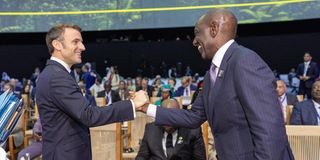
The term “Françafrique” describes the political, economic and military networks built to preserve French influence in Africa. It refers to a past era but many believe that it still shapes relations between France and its former colonies today.
How Françafrique got its name
The term Françafrique was first used in 1945 by Jean Piot , editor-in-chief of L’Aurore newspaper. He saw it as a way to unite France and Africa to renew the French Empire. Later, Félix Houphouët-Boigny , the first president of independent Côte d'Ivoire, gave the term a positive meaning. In 1955, he used it to describe a positive partnership. He wanted to celebrate the shared language, culture and economic ties between France and Africa.
Verschave completely redefined the meaning of the term. For him, Françafrique symbolised a shadowy system of corruption, patronage and political interference.
The pillars of Françafrique
Since African independence in the 1960s, France has maintained close ties with leaders considered to be “friends of France”. Through specific defence agreements, Paris retained the right to conduct military interventions to stabilise or protect allied governments. Key examples include Operation Manta in Chad in 1983 and Operation Serval in Mali in 2013. This structure was upheld by a shadow network. It was made up of unofficial advisors, intelligence services and personal connections among the elite. It was best symolised by the so-called “African cell” within the Élysée Palace, which was long led by Foccart.
The economic pillar of Françafrique is defined by deep financial ties. The CFA franc currency , created in 1945, is a clear legacy of colonial-era monetary dependence. Major French corporations like Elf, Bolloré, Bouygues and Total gained privileged access to key sectors such as oil, infrastructure and telecommunications in Africa. In return, these companies often funded a hidden system of financial support for African political parties and regimes. This corrupt system was exposed in the 1990s when a judicial investigation revealed that the French state-owned oil giant, Elf-Aquitaine, operated a vast network of corruption that involved both French politicians and African leaders.
Beyond official diplomacy, Françafrique thrived on personal and informal networks. It operated through a web of businessmen, diplomats and military figures. These intermediaries formed a powerful “parallel state”. Their networks mixed business deals, intelligence work and personal friendships. This system effectively bypassed standard diplomatic channels. The importance of these personal ties is confirmed in the 2024 memoirs of Robert Bourgi , a key insider. As a disciple of Foccart, he details his extensive relationships with numerous African political leaders.
Is Françafrique really over?
The Francafrique system was weakened by major global and regional shifts. The Soviet Union’s collapse, growing demands for democracy in Africa, and financial scandals in France all challenged its existence.
A key turning point was the 1990 La Baule speech by French president François Mitterrand. He declared that French aid would be tied to democratic reforms. Despite this, French influence persisted, simply changing its form through privatisation, new military partnerships and economic diplomacy.
In the 2000s , successive French presidents – Jacques Chirac, Nicolas Sarkozy and François Hollande – all vowed to end the Françafrique era. However, continued French military action in Côte d'Ivoire in 2002, Mali in 2013, and the wider Sahel region until 2023 demonstrated a lasting French security role on the continent.
Today, the concept of Françafrique is in crisis. Under President Emmanuel Macron, the term itself has become politically taboo . Since his 2017 speech in Ouagadougou , he has insisted on breaking with the old logic of paternalism. He advocates instead for a “partnership of equals”.
Yet for many Africans, this new rhetoric does not match reality. French military presence in the Sahel, the ongoing use of the CFA franc (even as it is slowly rebranded ), and the dominance of large French companies fuel a powerful feeling that French influence remains largely unchanged.
In countries like Mali, Burkina Faso, and Niger rejection of France is now expressed through pan-Africanist and sovereignty rhetoric, which has led to regime changes .
The rise of competing powers
In this new competitive landscape, France is attempting to redefine its policy. It now emphasises targeted bilateral relations, support for civil society, and academic and cultural cooperation. However, this strategic shift is struggling to overcome decades of deep-seated mistrust.
The powerful and enduring image of Françafrique continues to shape perceptions, especially among a younger generations of Africans who view past relations with scepticism.
Today, discussing Françafrique means confronting both a historical system and a powerful political idea. While the shadowy networks of the past have faded, the underlying structures of economic influence remain. So too do the powerful postcolonial emotions that shape relations between France and Africa .
Françafrique may no longer be an official policy. Yet it remains a powerful lens. It is the key to understanding how colonial legacies continue to shape the present day.
Written by Christophe Premat