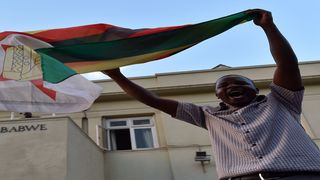
“Free, free, free at last,” read the handwritten poster on a piece of cardboard held jubilantly aloft by one of the thousands who had flocked into the streets of Harare to dance in joy and relief -- at long last, President Robert Mugabe, popular as ‘Uncle Bob’ -- was gone.
It was mid November 2017, when decades of failed dreams of uhuru in Zimbabwe turned from a collective nightmare of political and economic subjugation – this time imposed not by white colonial settlers, but by Zimbabwe’s very own liberation movement leaders – into what seemed to be a new dawn of hope.
At their wits end, exasperated and deeply frustrated, Zimbabweans in their millions took to the streets repeatedly, posing a mounting threat to the Mugabe regime, in power since independence in the autumn of 1980.
When at last their voices were heard, and Mugabe finally gave in to pressure -- even from those closest to him -- to step down after nearly four decades in power, protests turned into wild celebration at the departure of the man who had come to embody both the hope and ruin of an independent Zimbabwe.
People celebrate with Zimbabwe Defence Force soldiers in the streets of Harare, Zimbabwe after Robert Mugabe's resignation in November 2017.
Photo credit: Tony Karumba | AFP
Three years on and the same sense of another failed promise of true freedom runs deep through Zimbabweans, both in those who have stayed behind and the millions who have fled in one of Africa’s largest diasporas.
According to United Nations data, Zimbabwe’s current population is 14,862,924.
But at least three million have fled, legally or illegally, to South Africa alone, with millions more going elsewhere in Africa or overseas to Canada, the USA, Britain, Australia and New Zealand.
After losing a key constitutional change referendum in 2000, Mugabe had become increasingly despotic.
His police and military had become ever-more prone to violence against civil disorder or even peaceful protests, especially after highly contested elections seemed to have repeatedly been stolen by the Mugabe regime.
Oppression became the order of the day, with opposition politicians being arrested, beaten, detained without charge or prosecuted on trumped-up charges. Independent media and critical voices were under constant assault.
Meanwhile, the economy was stuttering to outright collapse and employment, once among the highest per capita in Africa, was falling until, by the time Uncle Bob left, official unemployment was over 90 per cent.
By the time Mugabe was forced from power by his own party, backed by the military, Zimbabweans had endured runaway inflation at over 1 million per cent, with bank notes denominated in the billions only able to buy a loaf of bread – if one could be found.
Hunger had stalked the land, and had been cynically used by elements in the ruling Zanu-PF party to ensure voter support, especially in rural areas.
A wild land-grabbing spree had destroyed Zimbabwe’s main economic powerhouse, its commercial agricultural sector, leaving thousands of white farmers homeless and traumatised. Once a breadbasket of the region Zimbabwe was no longer food-secure.
Now, again, Zimbabweans are staring over the cliff – this time potentially at the complete collapse of the state.
The image of gaunt job-seekers taking refuge from the sun under a shade in the country’s capital Harare captures the despair.
Unemployment, economists suggest, is about 95 per cent and climbing.
With hyper-inflation rendering its currency worthless, Zimbabwe has been forced to embrace the US dollar or South Africa’s Rand.
That worked for a while, but with fewer exports against surging imports, as had been the case prior to Mugabe’s departure and subsequently under his successor Emmerson Mnangagwa’s tenure, soon, foreign currency will run out.
Thousands have daily crossed the border to South Africa, increasingly illegally through a newly-built but essentially useless border fence, using their little SA currency to buy goods for their own consumption and for sale back in Zimbabwe to other desperate countrymen.
This has created a thriving cross-border black market, which has become an essential lifeline to what remains of the Zimbabwean economy, hit harder by the Covid-19 pandemic.
People queue at money transfer service in Bulawayo, Zimbabwe in March 2020, on the second day of a lockdown to curb the spread of the novel coronavirus.
Photo credit: Zinyange Auntony | AFP
Starvation looms, with the World Food Programme (WFP) saying 8.6 million Zimbabweans 'will be hungry' by the end of 2020.
Children, the elderly, those with serious medical conditions and even healthy young adults are dying of hunger, according to aid agencies such as Médecins Sans Frontières (Doctors Without Borders).
On the ground, it is clear there is no hope under the current regime, with South Africa and the African Union once again taking a soft approach – quiet diplomacy – as was done repeatedly and without impact with the Mugabe regime.
Mnangagwa, known as “the crocodile” for his fierce role as Mugabe’s main bully-boy for more than three decades, has proven to have earned his nickname, his forces routinely brutalising anyone who opposes his increasingly dictatorial rule.
“It’s like Uncle Bob all over again,” said one Zimbabwean in South Africa, who identified himself only as ‘Adam’ for fear his family would be targeted. He fled the harsh economic times during the Covid pandemic and is illegally in South Africa
“Anything is better than Zimbabwe. I love my homeland. I hate its leaders. All of them. They are killing us. They have taken the bread from us. They have taken everything from us,” said a bitter Adam.
“I’d rather starve here (South Africa) than there. At least here, I may be robbed or arrested, but people have something to eat and they help me. There’s no help in Zim, only sorrow and death,” concluded Adam, tears welling in his eyes.
Zimbabwe today, more than any time in its past, is a country facing complete failure.
As of 20 August, 5,745 Covid-19 cases had been confirmed, with 151 deaths, mostly in heavily-populated urban and rural areas.
The WFP projects that the number of food-insecure citizens will rise to 3.3 million from 2.2 million in urban areas, and to 5.3 million from 3.7 million in rural areas from October to December 2020.
Dams that supply Bulawayo, the country’s second city, are at just 25.6 per cent capacity, with a deficit of 17 million litres of water a day for the city’s residents, according to international aid agency reports.
In Harare, power and water supply are unreliable and long outages are frequent.
The country’s ageing major power-producing hydroelectric plant at Kariba dam, on River Zambezi, which forms the northern border with Zambia, is barely running.
Eskom, SA’s troubled and debt-ridden power-producer, was owed US$33 million by Zimbabwe for imported electricity until over a month ago.
A $10 million payment was made in early July, according to Zimbabwe’s Energy Minister Fortune Chasi, allowing Zimbabwe to import power again.
With no economic relief in sight as other countries are reluctant to intervene and government systems like health under increasing strain, many fear the country is on the brink of collapse.
The agricultural sector, which is key to recovery, is hampered by the history of land-grabs.
Desperate to revive successful commercial farming, Mnangagwa recently signed an agreement to pay out US$3.5 billion to the 4,500 white farmers for their seized land.
But there is no money to make those payments or to help ad hoc efforts by the remaining commercial farmers – some having been asked by local communities to return to the very land from which they were violently evicted.
No longer interested in fighting Mnangagwa’s repressive regime on its own terms, many Zimbabweans have lost all hope in their political systems and full-scale revolt is in the air, though heavily tempered by decades of deep exhaustion.
Also, with Islamic militants already active in northern Mozambique, there are concerns in strategic intelligence and security circles that Zimbabwe may become a breeding ground for regional and international instability driven by expanding Islamic militant insurgency.
For a country whose economy has collapsed with “80 to 90 per cent of all activity having moved into the parallel or ‘black’ economy”, says one Zimbabwe expert, the disruption occasioned by the Covid-19 pandemic, along with restrictions on personal movement, has caused untold misery.
“Many people are now being pushing into absolute poverty,” says the analyst.
Wheat in Glendale, Zimbabwe.
Photo credit: Paul Cadenhead | AFP
A senior researcher at the Institute for Security Studies, based in Pretoria, South Africa, and whose specific expertise is Zimbabwe, said WFP and other aid agency assessments on potential starvation were accurate.
“But Zimbabweans have been there before,” said the ISS researcher, who declined to be identified.
“You have to remember there have been two decades of trauma, oppression and suppression, which have been stepped up in the past two years to almost absolutely unrestrained brutality against anyone who stands up to the Mnangagwa regime.
“And with Covid restrictions on movement, together with constant state monitoring, there’s little chance that people are going to be gathering on the streets in protests such as were seen previously – most are just trying to hustle the most basic living, merely surviving,” said the analyst.
As to whether Zimbabwe is becoming a ‘failed state’, open to infiltration by insurgent elements already active in northern Mozambique, this expert said that the Mnangagwa regime had sufficient money – or would make sure that it did, by whatever means – to keep paying police, army and security forces, as these were the only way to keep itself in power.
“You could say Zimbabwe became a failed state back in 2006. But there had been some recovery due to economic reform in recent years, now gone again.”
Another long-term Zimbabwe-watcher said: “It’s both interesting and terrifying. The confluence of forces operating in Zimbabwe at present is unprecedented. It could easily lead to another change (in leader), though whether that will mean the end for the governing Zanu-PF is another matter.”
“But widespread hunger is already apparent on the ground and mass starvation is likely without enormous and immediate foreign donor aid. As Bob Marley wrote: ‘A hungry man is an angry man.’ It is unclear whether the anger of starvation will create enough desire for change to generate another unstoppable wave of protests, but something has to give, or a great many people, millions maybe, will suffer and die.”