The two-day industrial action by the Kenya Aviation Workers Union (Kawu) has left in its wake a trail of economic, financial and emotional disruption for travellers and airlines.
While the aviation workers called off their strike yesterday, bringing relief to hundreds of travellers who had endured flight delays and cancellations since Monday, the strike had paralysed operations at major airports, with passengers stranded and airlines forced to reschedule or cancel flights.
But that did not lessen the burden for some, such as Peter Githinji, who was meant to undergo surgery in India on Wednesday. By Tuesday afternoon, he was still stranded at Jomo Kenyatta International Airport (JKIA), uncertain whether he would make it in time for the life-saving procedure.
“I’m going for heart surgery. I have both heart and kidney failure. I was to have an operation on Wednesday but here I am,” a devastated Githinji, who had arrived at the airport on Monday, told Nation .
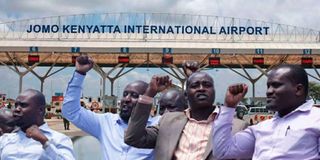
Members of Kenya Aviation Workers Union during a meeting on February 14, 2026 when the union declared a strike in the aviation sector.
Photo credit: Francis Nderitu | Nation Media Group
Visibly frail, exhausted and weak, he said he had neither slept nor eaten properly for hours and had been forced to seek medical attention while waiting.
In a similar fate was Mackim Shindo, who was travelling to Italy and was supposed to report to work yesterday. Instead, he remained stranded at JKIA, unable to make his connecting flight through Addis Ababa, Ethiopia.
For Muthoni Kihiko, a medic, she was expected to arrive in Addis Ababa on Monday evening for a three-day seminar to represent her organisation. But as of Tuesday afternoon, she wasn’t sure what to do, even as her flight and accommodation had already been paid for.
“I got here on Monday at 3pm and we were to depart at 5.30pm. We boarded the plane and waited for over four hours before they told us to disembark. We were asked to wait until midnight, when they informed us that the flight had been rescheduled to 11am Tuesday,” a devastated Kihiko narrated.
By Tuesday afternoon, she was still waiting. “Last night, someone was very sick and collapsed. I helped resuscitate him,” Ms Kihiko said.
Across the terminal, scenes of exhaustion and despair played out. Children, the sick and elderly lay on the floor and couches, trying to rest as uncertainty lingered.
Ruth Nyambura was travelling to London to reunite with her fiancé, who was recuperating from surgery. She should have landed by Tuesday noon. Instead, she remained stuck at the check-in lounge.
“The General Service Unit (GSU) officers were stationed at the entrances of the check-in areas and did not allow us to leave,” she lamented.
Kapulanga, who was supposed to be in Zurich, Switzerland, said he was stranded for more than 24 hours at JKIA and survived on minimal provisions.
“Nobody is giving the rightful information,” Mr Kapulanga said.
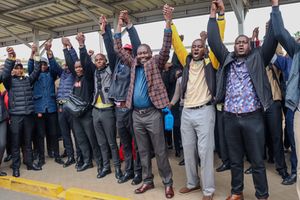
The Kenya Aviation Workers Union secretary-general Moss Ndiema addresses members of the union during a meeting on February 14, 2026.
Photo credit: Francis Nderitu | Nation Media Group
The disruption left scores of passengers stranded, many waiting for hours without clear communication.
“Nothing is working here. Everything is at a standstill,” said a passenger who requested anonymity. He had been at JKIA since morning but, until midday, had not travelled. Neither had he been updated on anything else.
Several airlines, including Ethiopian Airlines and Qatar Airways, were forced to reschedule flights between Monday and Tuesday when the strike was called off.
Brenda Akinyi, a tours and travels consultant with Kibaria Travels, said airlines have an obligation to support passengers during prolonged disruptions.
“Whenever there are long disruptions to travel schedules, airlines should provide passengers with meals and accommodation. And this cost should be on the airline, not on the passengers,” she explained.
Most passengers at JKIA, however, said they had not been provided with accommodation or adequate meals.
One passenger travelling with Ethiopian Airlines said they had only received a $7 cup of tea despite being stranded for more than 24 hours.
“I don’t know what’s next. I have been here since yesterday. I was supposed to fly at 5pm,” said Job Cheruiyot, who was travelling to the United States and had to find accommodation on his own after the airline failed to provide it.
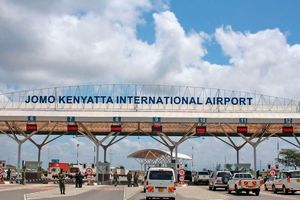
Security checks at the entrance of the Jomo Kenyatta International Airport in Nairobi.
Photo credit: File | Nation Media Group
“Dear Customer, we regret the inconvenience caused by cancellation of your flight,” reads part of the message Qatar Airlines sent to customers affected by the disruptions.
The aviation workers called off their strike following an agreement reached with the relevant authorities after what the union Secretary-General Moses Ndiema described as successful consultations and engagements.
“In effect, Kawu would like to call off the strike action on terms that have been agreed in the return-to-work formula. We are satisfied with the guidance and the intervention of the government in this matter,” he said.
At the coast, the tourism sector was also affected, with Moi International Airport witnessing minimal flight activity.
Mohammed Hersi, a tourism stakeholder, said the strike was damaging the country’s economy and reputation.
“Tourism runs on connectivity and when flights are disrupted, it is not just passengers who are affected. It is hotel bookings cancelled at the last minute, safaris postponed, conferences moved elsewhere, and future bookings quietly redirected to competing destinations perceived as more stable,” said Mr Hersi.
Investors in the tourism sector heavily rely on conference tourism during the low season, and many delegates often arrive by air.
Among the passengers stranded was ODM party Director of Communication, Philip Etale, who complained of waiting for over 15 hours at the airport with no communication from the airline he had booked.
“In developed countries, in such circumstances, airlines will simply have passengers taken to a hotel, rest and embark on the journey the following day, fresh and geared up,” he stated on X.
National carrier Kenya Airways said on Tuesday it was seeing delays of up to four hours for departures. Uganda Airlines stated that two of its flights had been cancelled, while Jambojet asked passengers not to travel to the airport until instructed.
Meanwhile, the UK issued a travel advisory to its citizens regarding the disruption at JKIA.
Reporting by Daniel Ogetta, Mercy Simiyu and Anthony Kitimo