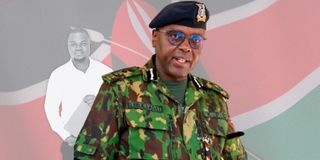
The High Court has set August 29, 2025 deadline for the Director of Public Prosecutions (DPP) to respond to a petition seeking criminal charges against Deputy Inspector General of Police Eliud Lagat over the death of teacher Albert Ojwang.
The order comes as Mr Lagat’s lawyers argue that the court lacks authority to compel prosecution, while rights activists maintain there is evidence linking him to the alleged police killing at Nairobi’s Central Police Station in June 2025.
In directions issued by Justice Bahati Mwamuye on Monday, the court granted the respondents, including the DPP and attorney-general, to file their responses so that the petition can proceed to the hearing stage.
Mr Lagat has filed a response arguing that the court does not have the authority to force the DPP to charge him with murder in relation to Ojwang’s death.
In his filings, he contends that granting such an order would set a dangerous precedent in Kenya’s justice system and amount to usurping the DPP’s constitutional mandate.
The 31-year-old teacher died at Nairobi’s Central Police Station two months ago after being arrested over an allegedly offensive social media post against Mr Lagat who says he has already been cleared by the Independent Police Oversight Authority (Ipoa) and the DPP of any culpability.
“We submit that the 11th respondent (Eliud Lagat), having been cleared by both Ipoa and the DPP, cannot be subjected to indirect prosecution by way of declaratory reliefs that contravene Article 157 of the Constitution,” Mr Lagat’s lawyer, Cecil Miller, says in court papers.
“After thorough investigations and exoneration by both Ipoa and the DPP, continued litigation such as this present petition against the 11th respondent is vexatious. It amounts to trial by publicity, not by law,” he adds.
The lawyer wants the court to dismiss the petition filed by 19 civil rights activists and a lawyers’ lobby group seeking orders to compel DPP Renson Igonga to open murder charges against Mr Lagat.
“The petitioners’ prayer that this court compels the DPP to charge the 11th respondent amounts to an improper attempt to usurp the powers of constitutionally mandated institutions. It is a dangerous precedent that undermines prosecutorial independence and the doctrine of separation of powers. The petition is an abuse of court process and ought to be dismissed with costs,” Mr Miller argues.
Among the orders sought in the petition is a declaration that the respondents are “guilty of a conspiracy to conjure, shield, aid and abet DIG Lagat to escape accountability and responsibility for the unlawful complaint, abduction, detention and murder of Albert Ojwang.”
They also seek an order compelling IPOA to publish its investigation report and the inquiry file it submitted to the DPP recommending prosecution of six suspects in connection with Ojwang’s death.
However, Mr Miller says the petitioners have not provided convincing evidence linking Mr Lagat to the alleged torture, abduction or killing.
“The unsubstantiated allegations are speculative. The 11th respondent was not present at the scene, did not issue any unlawful instructions, and his role as DIG is purely administrative and command-based. He did not engage in operational conduct relevant to the incident,” says Mr Miller.
He adds that his client neither supervised nor authorised the actions of the individuals accused of killing Ojwang on the night of June 7–8, 2025, a few hours after police officers picked him up from his home in Homa Bay County.
“The law does not impute liability simply because of one’s rank or office, absent mens rea or actus reus. The petitioners attempt to invoke ‘command responsibility’ without factual or legal basis,” Mr Miller states.
According to him, Ipoa’s findings — and the DPP’s subsequent decision — confirm that only six individuals should face charges: Central Police Station OCS Samson Taalam, police officer James Mukhwana and civilians Peter Kimani, John Ngigi Gitau, Gin Ammitou Abwao alias Gilbeys and Brian Mwaniki Njue.
“We humbly submit that the DPP’s power to direct prosecutions is autonomous and free from external direction. A court cannot compel prosecution unless the DPP has acted in bad faith, without evidence, or contrary to constitutional dictates — none of which is demonstrated here,” Mr Miller says.
The petitioners through lawyer Kibe Mungai have alleged that excluding Mr Lagat from the murder trial is questionable and discriminatory, claiming the arrest and subsequent killing stemmed from a complaint lodged by the police boss.
But Mr Miller insists it would be improper to hold Mr Lagat vicariously liable for alleged operational failures without proof of personal involvement, direct command, or neglect.
“The court cannot declare someone guilty without a trial, nor can it force the DPP to prosecute absent manifest failure of duty. Further, there is no legal provision allowing courts to direct the removal of a DIG without a disciplinary process,” he says.
The case will be heard on November 25, 2025, at 11:30 a.m. before Justice Mwamuye, with a mention on October 21 to confirm compliance.