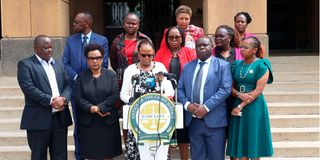
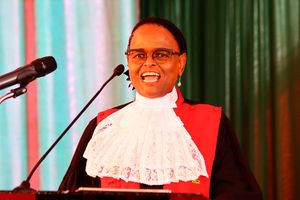
The top court has returned to the national spotlight following the launch of the search for the Supreme Court’s 14th judge by the Judicial Service Commission (JSC).
Led by Chief Justice Martha Koome, this recruitment process is a pivotal moment, filling a crucial seat ahead of next year’s presidential election and ensuring the seven-member bench operates at full capacity.
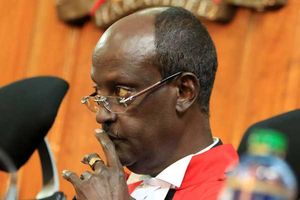
The vacancy arose following the death of Justice Mohamed Ibrahim on December 17, 2025, prompting the JSC to formally advertise the position on January 13, 2026.
Following Justice Ibrahim’s death, the Supreme Court bench was reduced to six active judges, highlighting the importance of this appointment.
The JSC had set Tuesday, February 17, 2026, as the deadline for applications, after which it will shortlist candidates and conduct rigorous background checks.
These checks involve consultations with state security agencies and stakeholder engagements to ensure thorough vetting.
Since its establishment under the 2010 Constitution, Kenya’s Supreme Court has seen 13 judges serve on its bench, making the incoming appointee the 14th in its history.
The court’s leadership has evolved through three Chief Justices: Willy Mutunga (2011–2016), David Maraga (2016–2021), and Martha Koome, who made history as Kenya’s first female Chief Justice upon her appointment in 2021.
President William Ruto with his deputy Prof Kindiki Kithure and Chief Justice and President of the Supreme Court of Kenya Martha Koome during the swearing -in of newly appointed judges of the Court of Appeal at State House, Nairobi on January 28, 2026.
Photo credit: PCS
Chief Justice Koome’s ten-year term is set to conclude in May 2031, though she has the option of early retirement, having already reached the age of 65.
The current recruitment holds symbolic significance, tracing back to the court’s inaugural bench in 2011, which included Chief Justice Mutunga, Deputy Chief Justice Nancy Baraza, and Justices Philip Tunoi, Mohammed Ibrahim, Jackton Ojwang, Smokin Wanjala, and Njoki Ndung’u.
Over the years, retirements and new appointments have reshaped the court’s composition. Notably, Justice Kalpana Rawal succeeded Baraza as Deputy Chief Justice from 2013 to 2016 before Philomena Mwilu assumed the role in October of that year.
Justice Mwilu, previously a Court of Appeal judge, continues to serve alongside later appointees such as Justices Isaac Lenaola (2016), David Maraga (2016 as Chief Justice), Martha Koome (2021 as Chief Justice), and William Ouko (2021).
Across those transitions, 13 judges have worn the Supreme Court robe. The next will be number 14.
Article 167 of the Constitution governs judicial tenure, stipulating that judges must retire at 70 but may opt for early retirement upon reaching 65.
This provision hints at upcoming vacancies, with Deputy Chief Justice Mwilu, now 68, scheduled to retire in April 2028, followed by Chief Justice Koome in 2031—or earlier, should they choose.
Justices Wanjala (65), Ouko (64), Ndung’u (60), and Lenaola (58) will follow suit in due course.
The advertised position offers a gross monthly salary ranging between Sh956,192 and Sh1,268,996, excluding benefits such as medical cover, security, transport, and mortgage, among others.
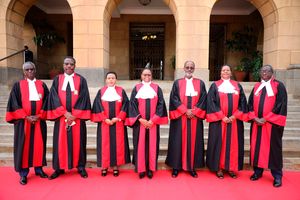
Supreme Court judges (from left) Isaac Lenaola, Dr Smokin Wanjala, Philomena Mwilu, Chief Justice Martha Koome, the late Mohamed Ibrahim, Njoki Ndung'u and William Ouko.
Photo credit: File | Nation Media Group
Beyond academic credentials, the JSC evaluates candidates based on professional competence, communication skills (written and oral), integrity, judgment (including common sense), fairness, legal and life experience, and commitment to community and public service.
The Judicial Service Act (2011) -Section 30, Part V and the First Schedule - outlines a meticulous recruitment timeline, typically spanning three to six months, depending on the number of applicants and the need for thorough background investigations of the candidates.
This recruitment of the 14th judge arrives at a sensitive time as Kenya prepares for the 2027 General Election, where incumbent President William Ruto is defending his seat.
The Supreme Court’s role in presidential petitions and constitutional disputes underscores the weight of this selection.
Each judge’s jurisprudential approach shapes the court’s rulings, which lawyers scrutinise, politicians analyse for signals, and citizens feel acutely during electoral or human rights disputes.
The JSC’s timeline is tight: applications close on February 17, 2026, with interviews slated for late March or April. A shortlist will be published for public scrutiny, allowing citizens to voice opinions on candidates.
According to the Act, the vetting process unfolds in three stages: initial application reviews (14 days), reference checks (21 days), and comprehensive background investigations involving consultations with relevant institutions (30 days).
The background investigation and verification are continuous processes and may continue until the time the commission votes on its nominations.
In regard to reference checks, the commission may not share with the applicants any materials it solicits or reveal the identity of the source of information unless the source waives anonymity.
Applicants are required to hold a law degree or be High Court advocates with at least 15 years’ experience as judges, academics, judicial officers, or legal practitioners.
Integrity is non-negotiable, with adherence to Chapter Six of the Constitution—emphasising moral character, impartiality, and leadership ethics—mandatory.
The Supreme Court’s mandate justifies this rigour. It holds exclusive jurisdiction over presidential election petitions, appellate cases from the Court of Appeal and advisory opinions for national and county governments.
It also handles appeals arising from tribunals set up to consider the removal of judges and matters flowing from a declaration of a state of emergency.
In essence, it resolves Kenya’s most complex legal questions, where a single vote or judgment can sway national stability.
To uphold transparency, the JSC mandates a competitive process requiring detailed CVs, five writing samples, income declarations, and clearance certificates from tax, police, anti-corruption, credit, and professional bodies. Falsifying documents carries criminal penalties.
The commission pledges fairness, meritocracy, and inclusivity, ensuring equal opportunities for women, men, and persons with disabilities while reflecting Kenya’s diversity.
JSC says the appointment will be made under Article 166 of the Constitution and the Judicial Service Act, and that certificates will be verified with issuing institutions.
"It is a criminal offence to present fake documents or false information,” the notice warns.
As the JSC navigates this high-stakes appointment, its commitment to due process reaffirms public trust in Kenya’s judiciary—a cornerstone of democracy poised to influence the nation’s legal trajectory for years to come.