Motorists on Monday began receiving instant traffic fine alerts within hours of the National Transport and Safety Authority (NTSA) rolling out its new automated enforcement system, even as questions emerged over its legality.
The instant fine system automatically captures traffic violations and sends notifications to motorists via SMS.
In a public notice, NTSA said the system is fully automated and operates without human intervention, with fines payable through the branch network of KCB Group within seven days.
“Failure to settle the fine within the seven-day period will result in the amount attracting interest. In addition, a vehicle or driver with a pending fine will not be able to transact on NTSA service platforms until the fine is settled,” the notice warned.
The authority urged motorists to observe traffic regulations and respond promptly to official notifications. However, some motorists captured by cameras mounted along major roads criticised the move, terming it punitive.
“This is extortion at this point,” lamented one motorist who was fined Sh10,000 for allegedly driving at 128km/h on Thika Road, above the 110km/h limit.
“Would be helpful if you could tell us what violations are covered and whether the roads are clearly marked, for example, speed limit zones,” an X user wrote.
NTSA said the system is meant to improve transparency, efficiency and accountability in traffic enforcement through automated monitoring technology. But legal experts have raised concerns over the legality of the system.
Advocate Marvin Onyango argued that the authority may have overstepped its mandate, noting that only courts have the power to declare someone guilty of an offence.
“Traffic offences are criminal in nature. Automated enforcement raises questions because it presumes guilt without considering the right to a fair hearing under Article 50. They cannot simply declare someone guilty and impose a fine without a hearing and proper evaluation of evidence,” he said.
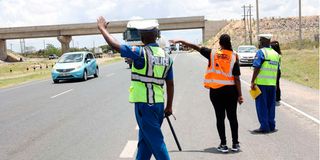
Police officers and officials from the National Transport and Safety Authority inspect vehicles at a roadblock in Lukenya, Machakos county on March 27, 2024.
Photo credit: Evans Habil | Nation Media Group
Driving without properly displayed identification plates attracts a fine of Sh10,000, the same penalty imposed on motorists operating vehicles without valid inspection certificates. Driving without a valid licence endorsement for the class of vehicle carries a Sh3,000 fine.
Public service vehicles (PSVs) operating without functional fire extinguishers and fire kits attract a Sh2,000 penalty.
Pedestrians found obstructing the free passage of vehicles face a Sh500 fine. Owners or operators of PSVs who employ unlicensed drivers or conductors risk a Sh10,000 fine, while failure to refund fare for an incomplete journey attracts a Sh3,000 penalty.
Speeding forms the backbone of the enforcement system, with penalties escalating depending on how far a driver exceeds the speed limit.
Those exceeding the limit by 6–10km/h are fined Sh500, while drivers going 11–15km/h above the limit face a Sh3,000 penalty.
Motorists exceeding the limit by 16–20km/h are fined Sh10,000, making it one of the most heavily penalised offences.
The same graduated structure applies where motorists exceed the 50km/h speed limit or any other limit prescribed by traffic signage.
Beyond speeding, the system also targets driver qualifications and pedestrian safety.
Driving a public service vehicle while unqualified attracts a Sh5,000 fine, the same penalty imposed on motorists driving on pavements or pedestrian walkways.
Failure to renew a driving licence or produce one on demand carries a Sh1,000 penalty.
Disobeying instructions from a uniformed police officer or ignoring traffic signs attracts a Sh3,000 fine.
Other offences listed include passengers boarding or alighting at unauthorised locations and travelling with part of the body outside a moving vehicle, practices commonly associated with the matatu sector.
It was not immediately clear whether special considerations would be made for certain vehicles, such as those transporting perishable goods or commodities like muguka .
NTSA had not responded to requests for clarification on several grey areas, including whether repeat offenders will face harsher penalties.
The rollout follows a directive by President William Ruto, who on March 2, 2026, issued a one-month ultimatum to NTSA to deploy smart traffic cameras in major towns.
Speaking at a road safety meeting convened by the National Council on the Administration of Justice (NCAJ) at State House, Nairobi, the President expressed frustration over delays in implementing the automated enforcement programme.
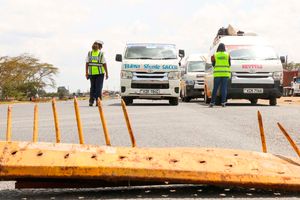
A police officer and an official from the National Transport and Safety Authority inspect vehicles at Salgaa area along the Nakuru-Eldoret Highway on December 4, 2025 as part of a renewed effort to curb road accidents during the festive season.
Photo credit: Boniface Mwangi | Nation Media Group
“I’ve always wondered why we have taken so long. Why aren’t we enforcing the instant fines programme? Why haven’t we rolled out cameras on our roads?” President Ruto asked.
The initiative aims to reduce road accidents, curb corruption in traffic enforcement and improve compliance with traffic laws.
Under the project, more than 1,000 smart cameras will be deployed across Kenyan roads under a public-private partnership.
The network will include 700 fixed cameras installed along major highways and high-risk corridors, as well as 300 mobile units targeting speeding hotspots and accident-prone areas.
The cameras will automatically detect traffic violations and transmit alerts to NTSA, linking offences to drivers’ profiles under the smart driving licence system.
According to NTSA, the cameras are part of a broader transport modernisation programme that includes smart driving licences, an integrated instant fines system and a digital mobile licence wallet for payment of penalties.
Approved by Cabinet in December, the project will run under a 21-year public-private partnership involving KCB Bank Kenya and Pesa Print.
NTSA said the programme is necessary given the rising toll of road crashes, which caused more than 5,100 deaths in 2025 and an estimated Sh450 billion economic loss through medical costs, lost productivity, property damage and other social impacts.
The authority attributes weak enforcement to limited speed cameras, red-light monitoring systems and low enrolment in the smart driving licence programme due to shortages of kits and registration centres.