Controller of Budget (CoB) Margaret Nyakang’o has flagged the Office of the Spouse of the Deputy President, Dr Joyce Njagi, for spending Sh44.52 million in the first six months of the 2025/26 financial year despite no funds being allocated to the office by the National Assembly.
Her husband Prof Kithure Kindiki, is the Deputy President.
The details of the questionable allocation to the office, which is not established under the constitution using public funds, are contained in the CoB’s National Government Budget Implementation Review report for the period July 1, 2025 and December 31, 2025, currently before parliament.
The report indicates that the office may have been facilitated through the Office of the Deputy President, which was allocated Sh3.07 billion in the current financial year, compared to Sh3.22 billion allocated in the fiscal year 2024/25.
“The Office of the Spouse of the Deputy President had no budget budgetary allocation in the period under review, but incurred expenditure of Sh44.52 million,” says Dr Nyakang’o.
photo 32
Photo credit: Photo | Francis Nderitu | Nation
The deputy president’s office is in charge of coordinating and supervising the implementation of government policies, plans, programmes and projects.
However, facilitating the operations of the office of the spouse of the deputy president is not among the tasks under the DP’s office.
In 2024, President William Ruto directed the scrapping of the budgets of the offices of the first lady and those of the spouses of the deputy president and the Prime Cabinet Secretary, as part of austerity measures to align government spending with reduced revenue.
This followed President Ruto’s refusal to sign the 2024 Finance Bill that had proposed to generate Sh346 billion in additional revenue to finance the 2024/25 financial year’s budget, following widespread Gen Z protests over punitive taxation measures in the Bill.
This was accompanied by a 50 percent reduction in confidential budgets for various executive offices under the national government and the proposal to merge the 47 parastatals.
At the time, Sh1.3 billion had been earmarked for the three offices not established under any laws of Kenya.
In the current financial year, the two offices were not allocated any funding, and it’s not clear whether they will be allocated funds in the next financial year, whose budget-making process is currently in the process.
Of the Sh1.3 billion, the Office of the First Lady had been allocated Sh696.6 million, and the Office of the Spouse of the Deputy President Sh557.6 million.
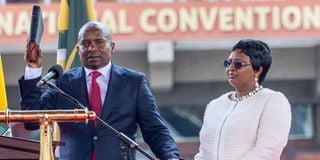
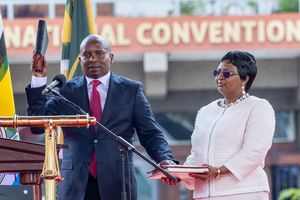
Deputy President Kithure Kindiki and his wife, Dr Joyce Njagi Kithure (right), during his swearing in at the Kenyatta International Conference Centre. With them is the Chief Justice, Martha Koome.
Photo credit: PCS
The withdrawal of the funds left various programmes initiated by the offices- “faith diplomacy” and “empowering the boy child” without formal government funding.
Despite the funding freeze, some government officials have appealed to the National Assembly to reinstate a portion of the funds specifically to pay the salaries for staff currently employed in the First Lady’s office.
Despite the questionable funding of the office of DP’s spouse, the CoB report states that analysis of the Office of the Deputy President’s programme and sub-programmes performance showed varied fund utilisation and absorption rates.
For instance, the coordination and supervision sub-programme fully depleted its budget at a 100 percent absorption rate.
All the domestic and foreign engagements for the Deputy President were coordinated, achieving 100 percent of the target.
However, consultative forums with government Ministries, Departments and Agencies (MDAs) and other actors on coffee value chain interventions “were yet to record any output in the first six months of the 2025/26 fiscal period.”