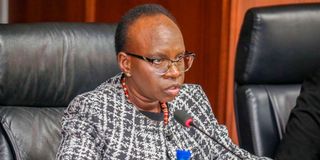
The office of the auditor-general has questioned how Sh2.5 billion earmarked for various donor projects was used, as various documentation supporting the expenditure were presented for scrutiny in Parliament.
Ms Nancy Gathungu, in her latest report on the summary of donor-funded projects under the 2023/24 Financial year indicates that in some instances, payments were made without adequate documentation such as work plans, contracts, invoices, or delivery confirmations.
The move, according to the auditor, contravened regulation 104 (1) of the Public Finance Management (National Government) Regulations, 2015, which requires accounting officers to ensure proper use of public resources and maintain supporting records for all financial transactions.
“Such expenditure not only compromises the reliability of financial statements but also exposes the donor-funded projects to the risks of misappropriation of funds,” reads the report.
The report states in the case of Bolgoria Silali geothermal project, records of fuel delivery and consumption amounting to Sh981 million were not provided for audit.
For the Kenya electricity expansion project which was dealing with the rural electrification and renewable corporation, the report states that works done with value of Sh75, 231,232 were not supported by any documentation.
Ms Gathungu says in her report that for the Mombasa-Mariakani highway project which is being undertaken by the Kenya National Highways Authority through funds from the African Development Fund (ADF), there was missing exchequer and receipt vouchers worth Sh127, 483,464
In the Horn of Africa groundwater for resilience project, the report says payments of Sh31.3 million made towards fuel and consultancy lacked documentation.
The report also states that the financing of locally-led climate action projects, transfer of Sh228.4 million to counties lacked individual project finances.
For affordable housing finance, Ms Gathungu says in the report that travel expenses worth Sh1.6 million were not supported with attendance records.
The audit report has also listed the Eastern Electricity Highway project financed by both the African Development Fund and International Development Association, where there was partial disclosure of Sh324.6 million as outstanding compensation to the contractor.
According to the report, Sh18.4 million meant for Lake Nakuru Biodiversity conservation project was also used for other purposes not related to the project.
Ms Gathungu also revealed in her report that a contractor undertaking the Lake Victoria and sanitation project was overpaid Sh17, 849,476 and there was no evidence of recovery.
The audit report has also raised questions over payment house and other allowances amounting to Sh23.6 million to staff of Jaramogi Oginga Odinga University of Science and Technology under the USAID Boresha Jamii project.
“The project paid house and other allowances to staff amounting to Sh23.6 million. However, the basis of the rates used to pay the allowances was not provided for audit,” reads the report.
On the Covid-19 health emergency response project, the report says the State Department for Medical Services failed to submit expenditure returns amounting to Sh26.6 million.
Ms Gathungu also says in her report that a total of Sh176, 280 listed as compensation to employees under the Global Fund to reduce malaria and deaths by at least 75 percent was not supported by any documentation.
On the improvement of rural roads and market infrastructure projects, the report says reimbursement of travel costs amounting to Sh35, 005,463 were not supported by any documentation raising doubts over the expenditure.
The report also says that a total of Sh575,842,147 under the global fund and meant to contribute to achieving vision 2030 through universal access to comprehensive HIV prevention, treatment and care programmes was withdrawn and there was no supporting returns.
In her report, Ms Gathungu has also raised concerns that Sh15 million meant for the Sirari corridor accessibility and road safety improvement project for the Isebania-Kisii-Ahero road rehabilitation was paid for land on road reserves but not to the project-affected persons as required by law.
Ms Gathungu has also questioned a total of Sh2.8 million paid as transport cost, but was not supported by any documentation. The money was part of the global fund tuberculosis grant credit No KEN-T-TNT-2067 given to the State Department of Public Health and professional standards.
Ms Gathungu noted in her report that most donor-funded projects had common weaknesses such as financial reporting gaps, delayed or stalled projects, low absorption of funds, procurement irregularities and non-compliance with contract conditions.
The report also identified governance and oversight challenges in the management of the donor-funded projects.
“The issues observed point to broader weaknesses in project management and oversight, which require immediate corrective actions,” reads the report.
The auditor-general says that while the majority of donor-funded projects’ financial statements were fairly represented, a significant number still exhibited weaknesses in financial reporting.
Ms Gathungu says in her report that key interventions such as enhancing capacity, developing and implementing standard operating procedures, strengthening internal control and reinforcing risk management processes should be adopted urgently.