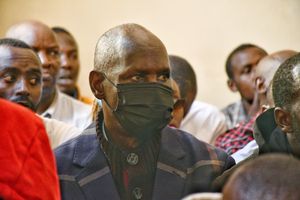
Milimani Law Courts.

A police officer featured in a viral TikTok video containing the slogan "Ruto Must Go" has lost his bid for court intervention following his dismissal from the National Police Service.
The Employment and Labour Relations Court struck out Mr Joyfred Maina's petition. The court ruled that he approached the court prematurely while an internal appeal process remained unresolved.
Mr Maina, who was formerly stationed at Riruta Police Station, had contested his September 2024 dismissal that stemmed from the social media incident.
The court determined the officer improperly sought judicial intervention while still pursuing administrative remedies within the police disciplinary system. It ruled that Mr Maina, having already invoked the internal disciplinary appeal mechanism under police regulations, could not bypass that process without justification.
"There is no dispute that the petitioner has invoked the internal and prescribed appellate procedure," the judge said, adding that the court would not intervene while the appeal is pending and with no shown good reason or justification.
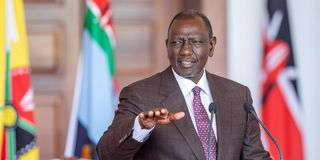
President William Ruto.
The case stemmed from events during the nationwide protests on July 19, 2023, a day marked by heightened political tension and demonstrations.
Mr Maina, an Administration Police officer recruited in 2008, was on duty as a station guard when he went live on TikTok in full uniform. During the live stream, viewers posted political comments, including chants of "Ruto Must Go!" — a slogan critical of President William Ruto’s administration.
Mr Maina later argued that he merely read some comments aloud and cautioned viewers against using such language.
The court heard that the video spread rapidly after being edited by unknown people, triggering public outrage and scrutiny of police conduct during protests.
Political neutrality
Police commanders viewed the livestream as a breach of the National Police Service (NPS) Code of Conduct, the Leadership and Integrity Act, and the obligation of political neutrality expected of officers. The following day, Mr Maina was served with a notice to show cause.
He was accused of multiple disciplinary offences, including making false statements, acts amounting to hate speech, negligence of duty, improper possession of public property, and wilful disobedience of lawful orders under the National Police Service Act.
After responding to the notice, Mr Maina was interdicted. He was later suspended and subjected to orderly room proceedings (internal disciplinary hearings).
The disciplinary committee found its powers inadequate and forwarded the matter to the senior commanders.

National Police Service Commission CEO Peter Leley.
In September 2024, the National Police Service Commission dismissed Mr Maina from service. His dismissal was backdated to the effective date of his suspension. He was given 14 days to appeal.
"Taking into account both the nature of the misconduct and the petitioner’s previous disciplinary infractions—including an incident of desertion—the committee recommended his dismissal from service, which was formally approved by the National Police Service Commission and communicated to him via a letter dated September 20, 2024," said Mr Silas Andiema, Commissioner of Police and Staffing Officer Personnel, in court filings.
Mr Maina told the court that his constitutional rights had been violated, including the right to fair labour practices, fair administrative action, and a fair hearing.
He claimed the disciplinary process was flawed and alleged that he was denied the mandatory seven-day notice and subjected to overlapping disciplinary steps. He also said that his freedom of expression was unlawfully curtailed, stating that his right to communicate and have interactions as an individual should not be limited solely because he was a police officer.
Disciplinary proceedings
However, the Inspector General of Police and the Attorney-General opposed the petition, arguing that the officer had been lawfully disciplined and that due process was followed.
State lawyers said the officer's actions, while in uniform and on duty, violated the strict requirement of political neutrality imposed on police officers.
They told the court that a waiver notice was properly issued to expedite disciplinary proceedings due to the gravity of the misconduct and that Mr Maina participated in the hearing.
"The petitioner has neither been denied a hearing nor furnished with a final determination of the appeal," the respondents said, describing the petition as an abuse of judicial process.
In its ruling, the court agreed that the case could not proceed while the statutory appeal was still pending.
The judge found no evidence that the waiver of the seven-day notice was unlawful or that Mr Maina was denied an opportunity to respond.
"The petitioner has failed to establish his case regarding the alleged violation of rights," the judge said, noting that the court would not delve into the merits of issues still before the disciplinary appeal body.
The court struck out the petition—rather than dismissing it—and ordered each party to bear its own costs, citing the pending administrative appeal.
Follow our WhatsApp channel for breaking news updates and more stories like this.