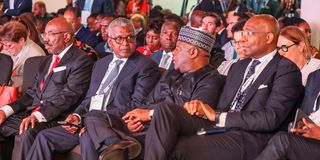
Business leaders and industry experts yesterday renewed calls for a more conducive policy and business environment in Africa, arguing it is the critical first step to attract investment in infrastructure, energy and money markets.
Speaking during a business forum on the first day of the Africa Forward Summit, Gbenga Oyebode, chairman of the Africa Legal Network and co-founder of Aluko & Oyebode, said geopolitics is changing and African partnerships are becoming more important, hence the need for a clear strategy on how to approach them.
The session was co-chaired by President William Ruto and French President Emmanuel Macron, the co-hosts of the summit.
“The French are showing that they are committed to the continent, especially at a time when there is no foreign funding coming in. What we need is to create a conducive environment for investment,” said Oyebode.
“In Africa, we don’t lack potential. We just need to invest. This is the right time. Our own people should be at the forefront of investment. Let us remove the bottlenecks that hinder us. We need a legal framework that can attract investment.”
The Africa Forward Summit in Nairobi, also known as the France-Africa summit, is being attended by hundreds of global leaders, including heads of state, business executives, investors and policymakers.
The summit, which started yesterday and ends today, aims to unlock investment opportunities across Africa in artificial intelligence, renewable energy, agriculture, health systems and digital infrastructure.
Mauritius Commercial Bank CEO Thierry Hebraud said Africa cannot continue to be an exporter of raw materials and importer of finished products, stressing the need to create an environment that can attract business.
“It has been said that there are 600 million Africans who have no access to electricity. This energy crisis cripples healthcare, education and economic opportunity, leaving millions in the dark—literally and figuratively,” said Hebraud. “Therefore, there is a critical need for tailored solutions instead of blanket policies designed for wealthier nations.”
He highlighted the growing demand for critical minerals such as cobalt, nickel and lithium—resources abundant in Africa—as part of the global energy transition. He argued that if managed effectively, Africa could not only contribute to global green supply chains, but also benefit economically by capturing more value from its natural resources.
“By investing in local processing industries, Africa could maximise its share of the mineral value chain and significantly increase its GDP, eventually securing a leading role in the global shift towards sustainability,” he said.
Ahmed El Alfi, founder and chairman of Sawari Ventures, said Africa must shift from an extractive economy to a creative one to prevent the loss of its best talent.
“By fostering brain circulation through strategic partnerships with Europe, African entrepreneurs can gain the knowledge and capital necessary to build world-class companies at home,” he said.
James Mwangi, managing director and CEO of Equity Bank, said he was inspired by the sustainable model of the Champagne region in France, which Kenya can learn from in value addition.
According to him, Kenyan producers have successfully transformed local tea from a basic commodity into a premium luxury product through geographical indications and strategic branding.
By prioritising farmer ownership, regional identity and collaborative quality control, this initiative has increased the tea’s market value by 20 to 30 times.
“This project demonstrates how value addition can be demystified and unlocked by leveraging unique local heritage to create globally competitive products,” said Mwangi.
James Mworia, CEO and managing director of Centum Investment Company Plc, emphasised the urgent need for Africa to transition from a continent of untapped potential to a global leader through industrialisation, digital job creation and green manufacturing.