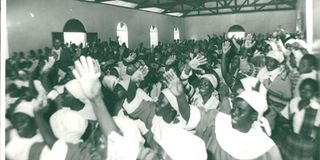
In June 1942, a Ugandan clergyman arrived in Nairobi for a religious crusade in the then Central province. Some 80 years later, William Nagenda appears to have disappeared from the church discourse. However, the legacy he left behind saw the acceptance of the Luganda song, Tukutendereza Yesu, as the rallying anthem among Christians.
In September 1938, the evangelist had left his mark in Western Kenya, drawing in crowds into what was known as revival conventions, and that is the time the Luganda song was first introduced in Kenya.
In recent years, historians interested in the growth of the Christian religion have been looking at Nagenda's legacy in trying to understand why it took the country by storm and why, many years later, the impact of Nagenda's mission is still being felt. One of the revival pioneers, Joe Church, kept an impressive archive of testimonies, now at Cambridge University, which provides scholars with short autobiographies of the early African Christians and how they conceptualised sin.
In an age of colonial resistance, the revival mission had offered the colonial government a new platform where people could "confess sins" in testimonies that were controversial and, at times, hilarious. After every confession, the signature Tukutendereza song was sung by converts as they welcomed a member into "a new life”.
Researchers have been going through the revival archives, and they contain gems on how the converts created a new identity around "salvation," which they used to lock out those who had not confessed their sins. According to Prof Derek Peterson in his book Ethnic Patriotism and East African Revival. These converts "positioned themselves differently in the social world”. As he argues, these early converts offered a contentious look at the world they lived in by abandoning their past by identifying and confessing their sins in public. And since they were now people with "integrity," they were restricted in what they did or said in public.
In most of the revival meetings, the translated version of John Bunyan's The Pilgrims Progress, first published in 1678, was distributed in local languages, and the converts started to see themselves as part of a pilgrim. And part of this pilgrim was to spread the gospel, which was made easier by the introduction of bicycles.
"Converts conceived of themselves…as journeymen and journeywomen, leaving worldly attachments behind and moving unencumbered to a new home. Most of them travelled by bicycle, and it is not a coincidence that the history of the bicycle in eastern Africa overlaps with the trajectory of the revival," writes Prof Peterson.
By the 1940s, bicycles symbolised progress, and most evangelist missions were powered by them – especially in Western Kenya. In Nagenda's mission, the converts were supposed to outline their sins. It is said that in Tanganyika, a confession would be rejected if the convert did not mention adultery, drunkenness, theft, or idolatry as part of the sin. According to Prof Peterson, "If one or more of the cardinal sins is not mentioned, it was felt that something was missing."
It is noted that the first revival pilgrims would sing the localised versions of the hymn "Whither , Pilgrims, Are you going?" which is today a popular song among the Akorino community. But it was in Uganda and Rwanda where the revivalists had pioneered with their "loud songs and noisy sermons”. But the early nightmare was confessions on adultery, which would bring some social disorder as converts openly "sullied other people's characters."
When Gersamu Ruhindi was converted in 1941, "he stood up in church and confessed to have written love letters to female friends. He read some of the letters aloud, even where the girl had no inkling of his affection. After the church services, the girls would be embarrassed and run away."
In some places, especially in Uganda, the converts among the Ankole were ridiculed as people who ate placenta – thus portraying them as undisciplined in their dining habits.
In the Buganda revival, which was championed by Nagenda, the conceptualisation of sin took precedence. In Rwanda, he had listed dozens of sins on a blackboard and asked would-be converts to confess. A man who had left a government post to go preaching, according to a "vision" he saw, Nagenda was in 1939 trained at the Anglican theological school in Mukono, near Kampala – but they had been expelled because of their "noisy preaching" and the habit of waking up at 4am to confess sins.
Together with his brother Dishon Mukasa, Nagenda continued to cause controversy by continuing to disgrace the congregation with his confession demands. What offended the Baganda was the open confessions of private sexual affairs. One missionary reported that young male converts were confessing the most embarrassing sins “without a spark of shame before an audience of women and girls. Things I have never known or heard are being broadcast”.
Not everyone was comfortable with Nagenda's mission. Bishop Stuart protested the emergence of the "saved person" theology, which Nagenda and his group were advancing, and he argued that "the whole moral tone of the church has gone down because of the balokole (saved people), who by their quite revolting confessions and their constant reference to adultery cause people's minds to be fixed on obubaka (adultery). Because of their disgusting talk, the whole atmosphere we breathe is defiled, and they are putting thoughts into men’s minds and causing them to sin."
By bringing private conjugal testimonies to the public space, the revivalists became a controversial movement among some Baganda. Even some missionaries fell into Nagenda's theology of testimony. Doris Hubbard, who converted in 1941, told a crowd of Europeans and Africans that he would never sleep with her husband. In Uganda, the police started opening revivalist mails, and undercover police attended their crusades as they got worried that the converts were using the forums to insult persons in authority.
Among the Luo in Kenya, the converts stirred controversy by distancing themselves from other members of the community. Nagenda first preached in Maseno School in 1938, where the head student confessed to fornication and stealing money from his father. By 1944, Nyanza had 2,000 revivalists who developed some anti-social habits.
"When non-converts visited a convert's home, the homeowner would cleanse the chairs in which his visitors had sat by passing a burning brand over them."
In central Kenya, Tumutumu became the new hub of revivalists. The Kikuyu converts followed the Baganda and Rwanda traditions of constructing stories on sin – but went further in bringing symbols of sin to revival ceremonies.
Such symbols included beer-brewing implements, gourds, and sugar-cane scrapers. Like in Uganda, the missionaries were worried that some of the confessions should not be in public, and they felt that the converts' intention to show their horrible past could have led to rehearsed testimonies. In time, each revivalist had their own inventory of sins. By 1948, they could easily identify each other with the Tukutendereza song and through a new greeting, "Mwathani Agocwo" (Praise the Lord), which distinguished converts from non-converts.
There was a crash in Tumutumu among the Presbyterians, who locked out the revivalists in the Kiriko church. The revivalists broke the church's door and likened pastor Johanna Wanjau to the devil during their testimonies. The presbytery moderator Charles Muhoro, for instance, asked the church leaders to "beat them, excommunicate them, and imprison them."
Thus, from the start, the church remained divided on the fate of revivalists in their midst who were accusing the non-convert clergy of "sin “. Finally, a presbyterian committee was appointed to investigate the revivalists, and it condemned the group for "their manner of greeting which involved kissing and hugging and ecstatic jumping."
The challenge came during the Mau Mau uprising when oath-takers warned revivalists against speaking out or confessing about the oath. The revivalists refused to join the Mau Mau or work for the government. Mau Mau indeed targeted revivalists who spoke against them in public rallies. The revivalist would later be used to get converts in detention centres where detainees would confess their sins.
How the confession of sins theology gained momentum in eastern Africa for the last 80 years is undoubtedly a topic that interests scholars who study how identities are constructed and why they linger. All this is thanks to Ugandan evangelist Nagenda.