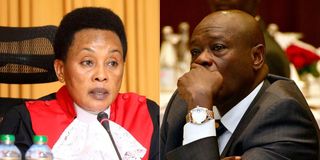
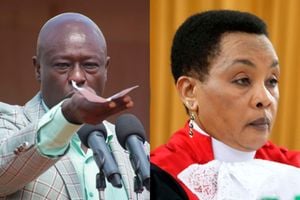
The Judicial Service Commission (JSC) has rejected a petition for the removal of Deputy Chief Justice Philomena Mwilu
The petition filed by Belinda Egesa also raised allegations of incompetence and constitutional violation on the part of Ms Mwilu for exercising powers of her boss, Chief Justice Martha Koome.
However, the commission found that the petition did not meet the threshold for removal of a judge from office under Article 168 of the Constitution and that there was no evidence Ms Mwilu had acted in bad faith.
Members of Judicial Service Commission during a past sitting at the Supreme Court Building.
Photo credit: Pool I Nation Media Group
Article 168 specifies the grounds for removal, which include inability to perform functions of office arising from mental or physical incapacity, breach of a code of conduct prescribed for judges of the superior courts, bankruptcy, incompetence, and gross misconduct or misbehavior.
In disallowing Ms Egesa’s petition, JSC said that though the Court of Appeal had found that Ms Mwilu acted unlawfully in appointing the judges, her decision was in good faith.
“While the Court of Appeal made a finding that the Deputy Chief Justice exceeded her powers, the Commission noted that the actions were taken in good faith against the backdrop of a constitutional and procedural ambiguity regarding the exercise of the Chief Justice's functions during their absence,” said JSC Secretary Wilfridah Mokaya.
The commission noted that at the time Ms Mwilu assigned the impeachment case to judges Erick Ogola, Anthony Mrima and Dr Freda Mugambi, the law was unclear on performance of her duties. According to the commission, this fact of legal ambiguity was confirmed by the Court of Appeal in a verdict dated May 9, 2025.
“The Commission observed that the very fact that the matter had to be determined by the Court of Appeal underscores the existence of such ambiguity, which has since been clarified through the said judgment,” stated Ms Mokaya in a letter to Ms Egesa’s lawyers, Bashir & Associates Advocates.
Consequently, JSC ruled there was no evidence of bad faith or misconduct on the part of the Deputy Chief Justice and that her actions appeared to have arisen from a genuine legal uncertainty, rather than an intentional action.
The petitioner had alleged that Ms Mwilu’s actions contravened the Constitution and the Judicial Service (Code of Conduct and Ethics) Regulations 2020.
Ms Egesa alleged that the Deputy Chief Justice demonstrated incompetence by misinterpreting Article 165(4) of the Constitution on the powers of the Chief Justice to assign judges in an expanded bench dealing with a case raising substantial questions of law.
The ouster petition originated from the Court of Appeal’s finding that it was unlawful for the DCJ to assign Justices Ogola, Mrima and Mugambi a case filed by three Kirinyaga county residents in relation to Mr Gachagua’s impeachment.
The case was filed at the High Court in Kerugoya and was challenging the swearing-in of Deputy President Prof Kithure Kindiki to replace Mr Gachagua.
Deputy President Kithure Kindiki and former DP Rigathi Gachagua.
Photo credit: File | Nation
In the verdict dated May 9, 2025, the Court of Appeals in Nairobi found that the Mwilu-appointed bench, which allowed Prof Kindiki to be sworn in as the Deputy President, was illegally constituted since she lacked authority to exercise the powers reserved for the Chief Justice.
Based on this verdict, Ms Egesa moved to the JSC asking it to investigate Ms Mwilu in relation to alleged gross misconduct, incompetence and violation of the Constitution. She wanted the commission to recommend to the President the removal of Ms Mwilu from the office of the Deputy Chief Justice.
“The consequence of the unconstitutional conduct of the Deputy Chief Justice in improperly empanelling the bench of three Judges resulted in setting aside of the conservatory orders in Kerugoya High Court, thus greenlighting the swearing-in of Prof Kindiki as the Deputy President replacing Mr Gachagua. These events cannot be practically reversed,” argued MS Egesa’s advocates. They raised concerns about procedural legitimacy.
They contended that Ms Mwilu violated Article 165(4) of the Constitution since the power to assign judges is reserved for the Chief Justice.
“The DCJ acted in excess of her mandate under Article 165(4) by unlawfully empanelling a High Court bench on October 18, 2024. This was a direct usurpation of the Chief Justice’s constitutional role. The Court of Appeal found her conduct to be unconstitutional,” she says.
Ms Egesa’s advocates were banking on the Court of Appeals finding that "indubitably, we find and hold that there was no evidence that the Deputy Chief Justice was the acting Chief Justice or that there existed exceptional circumstances that permitted the Deputy Chief Justice to exercise the mandate constitutionally reserved for the Chief Justice by Article 165(4) of the Constitution.