A court has dismissed a petition challenging the government’s decision to excise portions of land at Kenyatta University for the establishment of public projects, including medical research facilities and a settlement scheme.
In its judgment, the Environment and Land Court ruled that the 2022 Cabinet directive was lawful and aligned with constitutional provisions governing public land use.
“The acts and decisions questioned in the petition were taken within the framework of the law, and no violation of the Constitution or any statute has been demonstrated,” said the judge, paving the way for the sub-divisions and reallocations of the prime land.
He refused to surrender the title deed, leading to his suspension for 30 days “pending investigations” into allegations of “acts of misconduct”.
The dispute centered on Kenyatta University’s 410-acre parcel (LR No. 11026/2) registered under Grant No. I.R. 33404, which restricts its use to educational, administrative, and residential purposes.
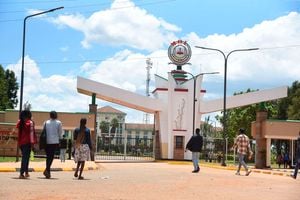
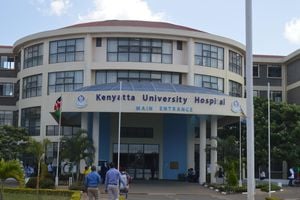
The main entrance to Kenyatta University.
Photo credit: Wilfred Nyangaresi | Nation Media Group
The petitioner, Joseph Enock Aura, argued that the government’s decision—communicated to the University Council through two letters dated July 4 and 7, 2022—violated constitutional safeguards on public participation, transparency, and institutional autonomy.
According to the contested directive, portions of the land were allocated to the World Health Organization (30 acres), Africa CDC (10 acres), Kenyatta University Teaching, Referral and Research Hospital (180 acres), and the Kamae Settlement Scheme squatters (190 acres).
Mr Aura contended that the Cabinet lacked authority to reallocate university land without involving the National Land Commission (NLC) and accused the government of disregarding a 2021 court judgment that recognised a prior donation of 30.82 acres to squatters by the university.
He also alleged breach of the land grant conditions, stating that the original land grant restricts usage to educational purposes. He argued that allocating land to the WHO and the Africa CDC violated these terms.
However, the court found that the NLC’s mandate under Article 62(2) of the Constitution excludes land held by state organs like Kenyatta University.
Instead, the court said the university’s council—empowered by its charter and the Universities Act—lawfully approved the reallocation after consultations with the government.
The judge noted that the allocations served public interest, particularly in health and research, aligning with the university’s broader mission.
“Accordingly, the establishment of these entities on the excised portions of land is consistent with the University’s educational and research objectives and will ultimately benefit both the institution’s students and the public at large,” stated the court.
Regarding the allocation of land to squatters, the judgment emphasised that the Constitution obligates the State to address squatters’ rights to humane settlement. The judge cited a Supreme Court precedent on the humane resettlement of squatters.
“The Constitution imposes a positive obligation on the State, including national State organs, to address the plight of squatters and informal settlers,” said the judgment.
While the petitioner raised concerns about the lack of written Cabinet minutes, the court held that official correspondence sufficiently validated the decision.
“The Petitioner raised a credible question regarding the authenticity of the alleged Cabinet resolution, but did not fully discharge the evidentiary burden necessary to establish that no written decision existed within the meaning of Article 153(1) of the Constitution,” said the judge.
The Attorney General had countered that Kenyatta University, as a public institution, holds land in trust for the government and must comply with lawful policy directives.
According to the AG, the allocations served urgent public interests in health and housing, aligning with national development goals.
“The allocations to the World Health Organization and Africa CDC were for auxiliary medical and research facilities intended to complement the functions of both the hospital and the university, and would therefore serve the public interest in health and education,” State Counsel Allan Kamau informed the court.
He stated that after the Cabinet approval, the university's council, after deliberations, approved the reallocation, exercising its statutory mandate under the Universities Act.
“The decision requiring the university to surrender part of its land was neither arbitrary nor hasty, but the result of a deliberate, consultative, and policy-driven process consistent with national planning and public interest,” emphasised the counsel.
Petitioner’s allegations of intimidation or coercion of university council members were described as far-fetched, unfounded and untrue.
The university had also opposed the petition, stating that as a public institution, it is obligated to comply with lawful government policy directives in the execution of its functions. In doing so, the university cannot be said to have acted unlawfully or contrary to its statutory mandate.