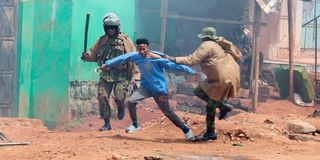
The High Court has ruled that the National Police Service (NPS) violated the Constitution by using excessive force, including live ammunition, rubber bullets, and tear gas against peaceful Gen Z protesters opposing the Finance Bill 2024.
Justice Mugure Thande, in a historic judgment with far-reaching implications for police accountability and protest rights, condemned the police’s “heavy-handed, disproportionate, and unconstitutional” actions, which resulted in fatalities, injuries, and arbitrary arrests.
The court declared the deployment of water cannons, tear gas, and live ammunition against unarmed protesters unconstitutional. “The police acted in excess of their constitutional and statutory mandate,” said Justice Thande.
She emphasized that police failed to exhaust non-violent measures as required by law and that deployment of hooded and masked police officers and vehicles with concealed registration numbers during the protests militate against the Constitution.
“The question that then begs is: given their mandate to serve all, why would police officers conceal their faces and identity and bundle people in unmarked vehicles?” she asked.
“It is only criminals engaged in criminal activities that wear hoods and masks to conceal their identity and move in vehicles without registration plates or with false plates to avoid identification and accountability. Why would the police behave in a similar fashion?” observed the judge.
Anti-riot police officers walking along Kenyatta Avenue in Nairobi during protests following the death of Kenyan blogger Albert Ojwang, who died in police custody on June 12, 2025.
Photo credit: File| Nation Media Group
The court affirmed that abductions, torture, and harassment of protesters violated fundamental rights under Articles 26 (right to life), 29 (freedom from torture), and 37 (right to protest).
While ruling on a petition filed by lawyer Saitabao Ole Kanchory, the judge also found accountability gaps in the conduct of police officers and security agents.
The court criticized the deployment of hooded officers in civilian clothes and unmarked vehicles, noting it undermined transparency and public trust.
“There is nothing in the NPS Act or the Standing Orders that allows the police to be hooded or masked to conceal their faces or the registration numbers of their vehicles when deployed to manage protests or demonstrations,” said Ms Thande. “It is globally accepted that the work of law enforcement officials is a social service”.
Mr Kanchory’s petition detailed how Gen Z protesters were met with brutality despite their peaceful demonstrations against tax hikes in the Finance Bill.
Independent Policing Oversight Authority (IPOA) reports confirmed police used live ammunition and tear gas indiscriminately, even targeting medical camps in June, July and August 2024 nationwide protests.
“IPOA found that the police did not effectively facilitate the protests as envisaged under Article 37 of the Constitution,” reads the affidavit of Abdirahman Jibril, IPOA’s Senior Assistant Director Investigations.
The court heard that IPOA investigated 59 cases of death and 234 cases of injuries linked to police actions during the protests. IPOA’s affidavit revealed that officers failed to facilitate protests as required by law and that masked deployments hindered accountability.
It was IPOA’s further response that pursuant to the Sixth Schedule of the NPS Act, a police officer in uniform is required to at all-time affix a nametag or identifiable service number in a clearly visible part of the uniform, to ensure police officers can be easily identifiable for purposes of accountability.
The Inspector General and Attorney General had argued that protesters were violent, citing property damage.
A police officer aims his gun at protesters on Old Namanga Road in Kitengela during the Saba Saba protests on July 7, 2025.
Photo credit: Billy Ogada | Nation Media Group
“The rights under Article 37 is not absolute and are subject to limitations where there is a breach of peace or when demonstrators are armed,” said Elizabeth Marube, an Assistant Superintendent of Police of the Directorate of Legal Affairs at the Kenya Police Headquarters.
Ms Marube defended plainclothes policing as necessary for intelligence operations and that curtailing civilian clothes would adversely affect national security.
She stated that the Gen Z protestors were not peaceful, claiming that they were armed with crude weapons such as stones and rungus contrary to Article 37 of the Constitution and the Public Order Act.
It was asserted that police officers did not harass, torture, abduct, illegally detain or kill any demonstrators who were peaceful and unarmed and that any force used was within the confines of the law.
“Police officers attached to Directorate of Criminal Investigations, Internal Affairs Unit, V.I.P protection sections and Crime Branches, are mandated through the Service Standing Orders to wear civilian clothes when on duty,” argued the respondents.
However, the court dismissed these claims, finding no evidence that police issued warnings before using firearms or reported incidents to IPOA.
Justice Thande invoked a Kikuyu proverb saying "a vehicle without plates belongs to a thief" to rebuke officers concealing identities.
“The conduct of police, who concealed their identities like criminals, is unacceptable in a democratic society,” said Justice Thande.
The judgment noted the Inspector General violated Article 244 by not maintaining professional standards, allegedly taking unlawful orders from the Interior Ministry and failing to report violent incidents to IPOA.
While authorities claimed protesters were violent, citing property damage and attacks on police), the court found no evidence police exhausted non-violent measures first.
Police block Haile Selassie/Uhuru Highway roundabout to prevent demonstrators from accessing the Central Business District ahead of planned Saba Saba protests on July 7, 2025.
Photo credit: Dennis Onsongo | Nation Media Group
Another finding was that the authorities failed to issue mandatory warnings before using firearms and that medical teams were targeted instead of assisted.
However, the court declined to restrict potential internet shutdowns, calling the request "speculative."
The petitioner wanted the court to prohibit grant the Inspector-General of Police and Interior Ministry from interfering with the right to freedom of expression and association through social media platforms such as X (Formerly Twitter), TikTok, Instagram, YouTube or any other online platform by shutting down the internet or limiting internet connectivity. The court said this request was speculative.
The ruling sets a precedent for policing protests and upholds Kenya’s constitutional safeguards amid rising youth activism.