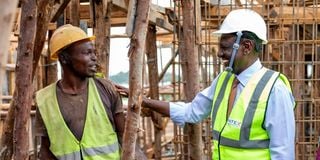
The Environment and Land Court has suspended construction of the Southlands Affordable Housing Project in Lang’ata, Nairobi, dealing a setback to President William Ruto’s flagship housing agenda and raising fresh uncertainty over similar projects nationwide.
The legal dispute centres on the use of public land to construct private housing units for sale to citizens without prior public participation.
In an order issued by a three-judge bench, the court granted conservatory orders stopping all ongoing work at the Lang’ata site pending a substantive ruling on the legality of the project.
“Pending the ruling of this court… a conservatory order be and is hereby granted staying the ongoing construction of social housing and associated infrastructure in Southlands, Lang’ata Constituency,” the court ordered.
The court said construction must remain halted until it delivers its ruling on February 5, 2026.
The decision is a blow to President Ruto, who has made affordable housing a centerpiece of his economic transformation agenda. The Lang’ata project, launched in March 2025, was billed as a model development expected to deliver about 15,000 housing units alongside a primary school.
The case was filed by Busia Senator Okiya Omtatah, backed by community activists under the Lang’ata Reject AHP Committee.
They argue the project sits on public land originally reserved for roads, railways, and environmental buffer zones.
The petition accuses the Ministry of Lands, the National Land Commission, and the National Environment Management Authority of unlawfully converting protected public land into private residential use without proper public participation or environmental safeguards.
“The project is being undertaken on land historically reserved as a road and railway corridor, as well as an environmental buffer zone,” the petition states.
The court has directed the respondents to move quickly to justify their actions by filing their responses to the petition. It ordered the respondents to file further affidavits and submissions within 14 days.
The judges are expected to determine whether the Lang’ata project violates constitutional safeguards on public land, environmental protection, and public participation. They will also assess whether the state followed due process in reallocating the land.
Far-reaching implications
Earlier, the court had certified the dispute as raising substantial constitutional questions, prompting the empanelment of a three-judge bench. The court found that the determination of this dispute could have far-reaching implications beyond the Lang’ata project, affecting how similar projects are designed and executed.
“It raises fundamental questions regarding the legality and constitutionality of the national Affordable Housing Programme, a flagship government initiative being replicated across the country,” the court previously observed.
The government has defended the project as a lawful and urgent intervention to address Kenya’s housing deficit. State lawyers argued that the right to housing justifies rapid implementation of such developments.
They insisted environmental and land-use laws were followed, although the petitioners say no valid Environmental Impact Assessment license has been produced. Petitioners also claim construction debris has blocked emergency routes, posing safety risks to nearby residents.
The court will now balance competing constitutional interests, including the right to housing, the right to a clean and healthy environment, and principles governing public land under the Constitution.
For President Ruto, the suspension is both a legal and political setback.
The Lang’ata project was meant to showcase progress under his affordable housing programme, which relies partly on a controversial housing levy that is also subject to ongoing litigation in another court.
With construction halted and a ruling months away, uncertainty now hangs over one of the Kenya Kwanza administration’s most visible developments.
The eventual decision could redefine how public land is used for housing and determine the future pace of similar projects across the country.