Five months after Kenya and Tanzania revived plans for an East African oil refinery, Kenya is set to break ground on the $16 billion (Sh2 trillion) project on Wednesday, one of the region’s biggest industrial bets.
In May, Tanzania’s President Samia Suluhu publicly reprimanded President William Ruto for disclosing that plans were underway to establish the refinery in Tanga without her knowledge. Weeks later, Dangote Group announced that it had entered an agreement with Kenya to have the oil refinery set up in Lamu.
The facility is expected to boost the country’s economy directly and through a multiplier effect by supporting industries.
“We are not looking at this as just a refinery. We are looking at a refinery that is going to elevate our industrial scale. We are also looking at the opportunities that will come with this, especially in improving our human capital in engineering, chemical engineering, mechanical engineering and the rest. We are looking at the businesses, jobs and opportunities that will benefit,” Dr Ruto said.
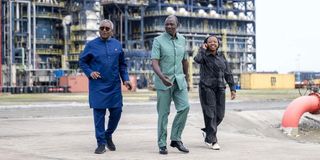
When he toured the Dangote Refinery at Lekki in Lagos, Nigeria, last week, Dr Ruto gave an assurance that the land where the project will be developed had been secured. He added that the government was working on all the other requirements needed.
The facility, aimed at producing up to 700,000 barrels of oil per day, will be the largest industrial investment in East Africa. It will be built within the Lamu Port-South Sudan-Ethiopia Transport (Lapsset) precincts and is expected to be completed by 2030.
“The refinery, whose construction we will launch in Kenya next week (this week), will be bigger. It will transform the petroleum sector in our country and region, providing fuel reliability and security, scaling up industrialisation and creating 60,000 jobs. When the refinery is completed, spin-off industries will emerge, including the production of fertilisers, chemicals, and packaging,” the President added.
Dangote Group plans to finance the Lamu refinery through internal cash flow, bonds and an initial public offering (IPO).
The plant could source crude oil from South Sudan, Uganda and Kenya, with additional supplies from other countries and regions, including the Middle East, through Lamu Port.
According to Energy CS Opiyo Wandayi, Kenya is ready to start extracting crude oil from the Lokichar oil fields in Turkana.
Two weeks ago, Dr Ruto said construction of the refinery project and the Lokichar-to-Lamu crude oil pipeline may run concurrently. However, the amounts are only between 20,000 and 50,000 barrels per day. “The Kenyan oil production is supposed to commence in earnest before December this year in the South Lokichar basin,” Mr Wandayi said.
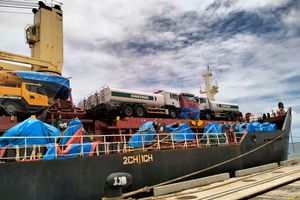
On Friday, Gulf Energy E&P BV SEZ Chief Executive Officer Paul Limoh confirmed that Kenya’s plan to deliver its first crude oil before the end of the year has reached another milestone with the arrival of the drilling rig at the Port of Mombasa.
President William Ruto and Dangote Group President and CEO Aliko Dangote during a tour of the Dangote Refinery in Lekki, Lagos State, Nigeria on September 25, 2026.
Photo credit: PCS
A cargo ship carrying an integrated onshore drilling rig leased by the firm docked at the Port of Mombasa from Duqm Port in Oman. The firm plans to begin the first phase of the $6 billion (Sh774 billion) crude oil production on November 1.
“All workstreams at Gulf Energy E&P BV SEZ are running to a tight project management schedule and the project remains on course for First Oil production in December 2026,” Mr Limoh said.
In the first phase of the South Lokichar development project, Gulf Energy plans to produce 20,000 barrels per day before scaling up to 50,000 barrels per day in the second phase.
The crude oil will be transported by road for storage at the Kenya Petroleum Refineries Limited facilities in Changamwe.
The Lapsset Master Plan included the construction of crude oil pipelines from both South Sudan and Lokichar to Lamu. However, these remain long-term plans, leaving a strong possibility of importing crude from outside the region, bearing in mind that Uganda’s crude oil is currently routed to Tanzania via the East African Crude Oil Pipeline (Eacop).
The Eacop is a 1,443-kilometre heated crude oil pipeline running from Hoima, Uganda, to Tanga, Tanzania, designed to transport up to 216,000 to 246,000 barrels per day.
Although design details about the refinery by Dangote Group have yet to be made public, the Lapsset Master Plan indicated that 53 hectares have been reserved for oil tank storage and an oil refinery with a capacity of 125,000 barrels per day in Lamu. This is lower than the targeted 700,000 barrels per day.
“The refinery would comprise crude and product tank farms, primary and secondary processing units, administrative service area and construction yard,” the Master Plan states.
“The tank facility will be located at the southern edge of Lamu Port, with land in this area reserved for a future oil products refinery. Locating the oil storage facility outside of the port industrial area could compromise future opportunities.”
Oil, gas and minerals were introduced as a priority sector under the Master Plan, based on oil and gas discoveries in the country. It was realised that despite the discoveries, Kenya had inadequate infrastructure and technical capacity to take advantage of the deposits. Lamu was selected to provide relief to the congested Port of Mombasa and because of the availability of land, which would provide an opportunity to develop export-oriented manufacturing or agro-processing industries.
The Lamu Port, which is deeper than the Port of Mombasa, can also support the export of oil both by sea and along the Lapsset corridor.
“Some heavy industry will be developed in close proximity to the port (85 ha). The oil storage and loading facility will be developed within the port zone,” the Master Plan explains.
On Saturday, a vessel carrying 2,930.295 tonnes of construction materials for the Dangote project docked at Lamu Port, marking a milestone in preparations for the groundbreaking and subsequent construction of the refinery.
Lamu Port General Manager Abdulaziz Mzee expressed expectations that the refinery would serve as a huge revenue catalyst for the port, drastically increasing vessel traffic and revenue in equal measure.
“The Dangote refinery will heavily boost business by forcing a continuous stream of Very Large Crude Carriers and cargo ships to dock, unload crude oil, and reload refined products. That business vessel call-in will increase and that means revenue will be streaming as well,” he said.
Kenya Ports Authority Managing Director William Ruto acknowledged that the Lamu Port has in recent times continued to experience an unprecedented surge in cargo volumes and mega-ship traffic, a move that has transitioned it from a quiet strategic project into a highly active deep-water transhipment hub.
He cited the entry of the East African refinery project as an ultimate catalyst to finally unlock the full potential of the port and the broader Lapsset Corridor.
First caller vessel MV DA YANG BAI HE arrives at Lamu Port in Kililana, Lamu West on Saturday, September 26, 2026. The vessel was laden with 2930.295 metric tonnes of project cargo for the construction of the East African Oil Refinery by Aliko Dangote.
Photo credit: Kalume Kazungu | Nation Media Group
Dangote Group has signed a contract worth more than $450 million (about Sh58.1 billion) with India’s Engineers India Limited (EIL) to provide project management and engineering consultancy services for its planned refinery and petrochemical complex. The announcement gave a new indication of the scale of the proposed Kenyan investment.
The agreement positions the Indian government-owned engineering consultancy as the project management consultant and engineering, procurement and construction management consultant for what Dangote describes as a greenfield refinery and petrochemical project intended to strengthen fuel production in East Africa.
EIL announced the agreement in New Delhi last Tuesday, saying it would draw on its experience working with Dangote on the group’s 650,000-barrel-per-day refinery and petrochemical complex at the Lekki Free Zone in Nigeria.
“Driven by this proven track record of execution leadership, EIL is proud to extend this transformative partnership to Dangote's upcoming Greenfield Refinery and Petrochemical Plant in Kenya,” the company said.
EIL said its mandate would cover project management and engineering, procurement and construction management services, drawing on its experience across the oil and gas, refining, petrochemical, infrastructure and other industrial sectors.
The Kenyan refinery is being planned as a combined refinery and petrochemical facility, linking fuel production with downstream industrial processing.
Dangote Group, headquartered in Lagos, has interests in oil and gas, mining, petrochemicals, fertilisers, cement, sugar and food. The group operates in 17 African countries. The development of the Kenyan facility would expand Dangote’s refining footprint beyond West Africa into East Africa, creating a new large-scale source of petroleum products for the region.
In his speech at the Dangote Petroleum and Petrochemicals EFZ IPO signing on September 7, Dangote Group chairman Aliko Dangote affirmed that the Group's expansion plans to Ethiopia for a fertiliser plant, to Kenya for a refinery at Lamu, and to Tanzania for cement, fertiliser, port and energy projects, as well as to Namibia and other African countries are still viable.
In the IPO at the Nigerian Exchange Limited, the company offered 4.1 billion ordinary shares to raise approximately $1.63 billion (Sh210.3 billion), at an offer price of about $0.40 (Sh51.6) per share. Mr Dangote encouraged investors that the offer was little with respect to his refinery expansion plans, as the East African refinery in Lamu alone is estimated to cost about $16 billion (Sh2 trillion).