The rain had just begun to fall when Mr Paul Oduor pulled down the iron door of his garage in Grogan at Kirinyaga Road on Friday evening.
It was barely 6.30pm and outside his workshop sat two vehicles his mechanics had been repairing for days, their engines half open, tools scattered on the concrete floor.
The plan, he recalls, was to close early because of the downpour and return the next morning before the owners came to collect them.
Within minutes, the Nairobi River burst its banks. Water rushed through the narrow streets of Kirinyaga Road. He remembers hearing screams before he even saw the water.
“I just watched as the vehicles were swept away,” he said in disbelief and exhaustion. “Some were submerged, others rolled into the river.”
On Saturday morning, Mr Oduor waded through the muddy current trying to salvage what he could. By then, the flood had already invaded neighbouring garages and workshops, scattering tools, spare parts and tyres along the road. Mechanics and traders stood helplessly along the riverbank, watching the raging water drag away property worth thousands of shillings.
“They are nowhere to assist in this flood,” he said, anger creeping into his voice. “There is disaster budgeting within the county government. When they want votes they come looking for us, but when we have a disaster like this one, nobody comes.”
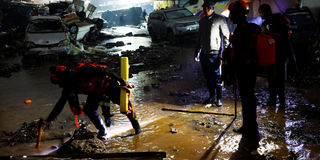
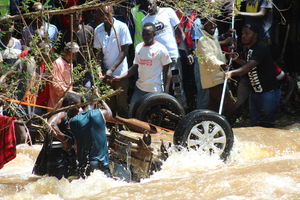
A member of the Kenya Red Cross searches for bodies trapped in the wreckages of vehicles destroyed following heavy rainfall in the Grogan area, popular for automotive workshops and secondhand spare parts in downtown Nairobi, Kenya, March 7, 2026.
Photo credit: Thomas Mukoya | Reuters
A few metres away, Mr Peter Ndirangu stood beside what remained of his kiosk. The businessman, who trades is spare parts and also looks after several street families around the Grogan area, said the floods swept through the settlement without warning. Among those missing, he says, are several homeless people who lived near the river.
“Some of them climbed trees when the water started rising,” he said. “But even the trees were swept away. We have been searching for them since morning.”
Eight of them, he said, remained unaccounted for. “We are in pain,” Mr Ndirangu said, shaking his head slowly. “Our leaders have failed us. They are nowhere during this disaster.”
Across Nairobi, the story repeated itself through the night as torrential rains pounded the capital, turning streets into rivers, sweeping away vehicles and flooding homes across several estates.
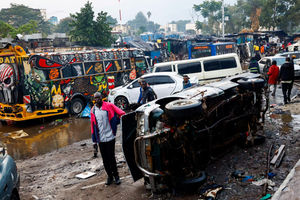
A member of the Kenya Red Cross stands atop a car in search of bodies trapped in the wreckages of vehicles destroyed following heavy rainfall in the Grogan area, popular for automotive workshops and secondhand spare parts in downtown Nairobi, Kenya, March 7, 2026.
Photo credit: Thomas Mukoya | Reuters
By Saturday evening, the death toll stood at at least 25 people, according to Public Service and Special Programmes Cabinet Secretary Geoffrey Ruku. Among the dead were 21 adult men and four children: two in Nairobi and two in Kitui County. Thousands more were left counting losses.
In neighbouring Kajiado County, the rains left a similar trail of tragedy and disruption, exposing once again the dangers posed by poorly designed and frequently submerged river crossings.
On Friday night, Mr Peter Chakua, 37, was swept away by raging floods while attempting to cross a submerged bridge on the Kitengela River at around 10pm while driving home to Mashimoni from his workplace in Mlolongo.
The wreckage of his vehicle was discovered several kilometres downstream on Saturday morning, with police officers and Kenya Red Cross rescue teams taking hours to retrieve his body from the mangled car.
His wife, Lydia Onyinkwa, said she grew worried when his phone went off shortly after they had spoken.
“We had spoken on the phone a few minutes before 10pm when he was on his way home. It’s painful that that was the last call,” she said.
In a separate incident, police said an unidentified middle-aged man was swept away by flash floods in Meruishi Village in Kajiado East while trying to cross a seasonal river that had burst its banks.
A member of the Kenya Red Cross inspects a manhole as he searches for bodies trapped in the wreckage of vehicles destroyed following heavy rainfall in the Grogan area, popular for automotive workshops and secondhand spare parts in downtown Nairobi, Kenya, March 7, 2026.
Photo credit: Thomas Mukoya | Reuters
The incidents pushed the number of flood-related deaths in Kajiado to three within a week, even as transport was paralysed and dozens of homes submerged along River Orata in Kitengela and surrounding satellite towns such as Ngong, Ong’ata Rongai and Kiserian. Several rural roads were cut off in areas like Maparasha Village in Kajiado Central.
The government says 3,500 households in Nairobi alone have been affected by the floods, while 381 households in Kisumu County were displaced after the Sondu-Miriu River burst its banks, affecting Kobala and Kobuya locations.
The worst-hit neighbourhoods in Nairobi included Mukuru, Kibra, Mathare, Pipeline, Githurai, South B, South C, Roysambu and parts of Westlands, where residents woke up to water inside homes, destroyed household items and damaged businesses. Entire sections of the city were paralysed.
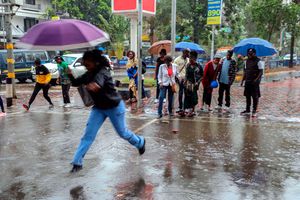
Major roads including Mombasa Road, Uhuru Highway, Lang’ata Road, Mpaka Road in Parklands and Kangundo Road access were submerged, leaving hundreds of motorists stranded for hours. Some motorists said they spent the entire night trapped in traffic.
“There was no response,” said Mr James Osama, a motorist who was stuck along Uhuru Highway. “Most of us remained stuck on the road the whole night. I reached home in the morning after spending more than seven hours in traffic.”
Videos circulating on social media showed matatus being swept away by raging water near the Nairobi River, while pedestrians climbed onto rooftops and road barriers to escape the surging floods. The heavy rains also left parts of the city without electricity after power lines were damaged, while several water pipelines were affected, disrupting supply in multiple neighbourhoods.
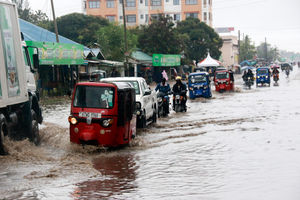
A truck stuck on a flooded road in Nairobi on March 6, 2026.
Photo credit: Nation Media Group
The disaster has once again exposed a problem that residents say has remained unresolved for years — Nairobi’s broken drainage system. Across the city, clogged storm water drains and garbage-filled waterways turned ordinary rainfall into a destructive force.
Along Haile Selassie Avenue and sections of Uhuru Highway, floodwaters rose rapidly after drainage channels failed to carry away the water.
Urban planners and residents have long warned that Nairobi’s drainage system, much of it designed decades ago for a smaller population, has not kept pace with the rapid expansion of the city. The problem is compounded by blocked drains filled with plastic waste, illegal construction along waterways and poor maintenance have worsened flooding across the capital.
In 2015 and 2024, heavy rains caused similar flooding in Nairobi, sweeping away homes and businesses and triggering public outrage over the city’s poor drainage. A decade later, residents say little has changed.
“This is the third time this has happened here,” Mr Oduor said in Grogan. “Every time it happens we cry, we complain and then everything goes back to normal.”
The national government has acknowledged the scale of the disaster. Public Service and Special Programmes Cabinet Secretary Geoffrey Ruku said floods have been reported in Nairobi, Kiambu, Kajiado, Makueni, Nakuru, Migori, Murang’a, Bungoma, Kwale, Kirinyaga and Tharaka Nithi counties.
“The situation has affected both urban and rural areas,” Mr Ruku said during a multi-agency briefing at Harambee House on Saturday.
Public Service Cabinet Secretary Geoffrey Ruku at a past event at the Kenya School of Government, Nairobi on September 21, 2025.
Photo credit: Lucy Wanjiru | Nation Media Group
He said the government had activated a nationwide emergency response system involving the Kenya Defence Forces, National Police Service, National Youth Service, Kenya Red Cross and multiple engineering agencies to assist in rescue operations and infrastructure repairs.
“The government has directed all sub-counties to establish public information desks, emergency response centres and rapid response stations for direct assistance,” Mr Ruku said.
Critical infrastructure has also taken a heavy hit. Across the country, roads and bridges have been damaged or swept away by raging rivers. In Makueni, the Wote-Emali Road and Kyamelu Bridge were flooded and overflowed, while in Bungoma the Kimama footbridge was washed away.
In Migori, the River Migori Bridge was destroyed by the floods. In Nairobi, at least 15 schools have been affected, with classrooms and facilities damaged by floodwater.
President William Ruto said the floods had caused “immense distress” to families across the country.
“The ongoing flooding in parts of Nairobi and several other areas of our country has resulted in the tragic loss of lives, displacement of residents and damage to homes, property and livelihoods,” he said in a statement on X.
He added that the government had ordered the immediate deployment of a multi-agency emergency response team led by the Interior ministry and supported by the Kenya Defence Forces.
The government, he said, would also release food from national strategic reserves and cover hospital bills for those injured during the floods.
A flooded fuel station in Nairobi on March 6, 2026.Floods
“We recognise that these floods once again highlight the urgent need for lasting solutions to the perennial challenge of flooding in our urban areas,” President Ruto said.
He pointed to the Nairobi River Regeneration Programme as part of a long-term strategy aimed at restoring river ecosystems and improving drainage systems within the city.
Prime Cabinet Secretary Musalia Mudavadi described the flooding in Nairobi as “deeply concerning and unacceptable”.
“It reinforces the critical need for collaboration between the national government and Nairobi City County in improving service delivery and protecting residents,” Mr Mudavadi said.
He said efforts were underway to clear blocked drainage systems and restore proper water flow across the capital.
“Nairobi remains a major regional hub and must be kept clean, safe and well-managed to reflect its standing in Africa,” he said.
At City Hall, Nairobi Governor Johnson Sakaja said the county had deployed 4,000 Green Army personnel to unclog drainage systems and clean river channels across the city. Emergency response teams, he said, had also been activated to assist residents trapped in flooded neighbourhoods.
The county government confirmed that emergency call centres received hundreds of distress calls between 7pm and 3am from residents reporting flooded homes, stranded motorists and residents trapped in areas including Dagoretti, Parklands, South B, South C, Kariokor, Umoja, Eastleigh and parts of the central business district.
County authorities said preliminary assessments showed dozens of homes have been destroyed and several residents displaced. They said that humanitarian support, including blankets and other relief supplies, would be provided to affected families once assessments are completed.
“We have also activated 18 Community-Based Disaster Response Teams comprising 100 personnel to support search and rescue operations, evacuations, and community flood risk communication in affected areas. Yet even as emergency teams work to restore order, meteorologists are warning that the worst may not be over,” the county government said.
The flooding also disrupted critical water infrastructure across the city after several pipelines were damaged by the raging water.
Among the affected lines are the DN 600mm Outering Road pipeline at the Nairobi River crossing, the DN 300mm Eastleigh-Kiambiu pipeline, the DN 200mm Korogocho-Dandora line and the DN 100mm Brookside Drive line serving Lower Kabete.
Nairobi City Water technical teams have since been deployed to the affected areas and were working to repair the damaged sections and restore supply to residents as quickly as possible.
The Kenya Meteorological Department said its heavy rain advisory issued on March 3 is in effect till 7pm on Monday.
“The advisory warns that moderate to heavy rainfall is expected to continue through the weekend,” the department said in a statement.
- Additional Reporting by Stanley Ngotho, Pius Maundu and Barnabas Bii